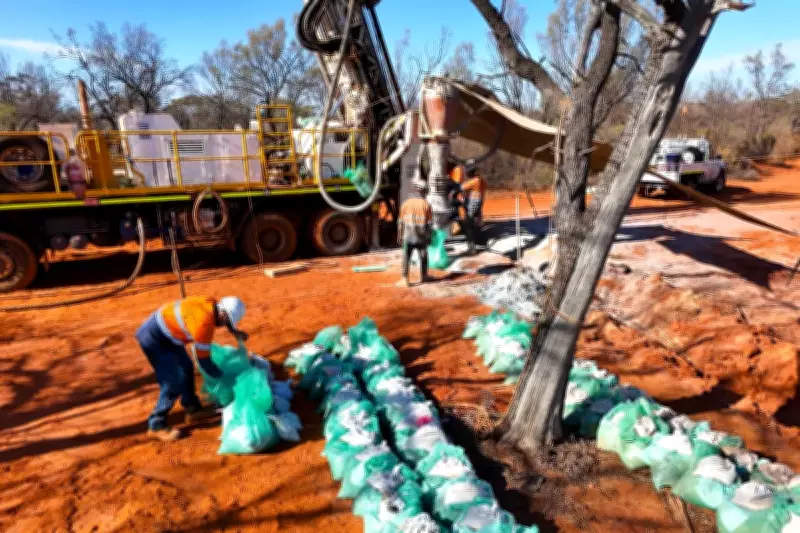
Western Mines Group has delivered a significant update from its Mulga Tank nickel project, located northeast of Kalgoorlie in Western Australia's Eastern Goldfields. The company has confirmed extensive magmatic nickel sulphide mineralisation following the receipt of assays from a deep diamond core tail that extended a previous reverse circulation (RC) drill hole.
Building on Earlier Success
The new results have built upon earlier drilling success, solidifying the project's standing as a large, highly fertile nickel sulphide system. The findings indicate significant potential for not only nickel but also cobalt, copper, and platinum group element (PGE) mineralisation.
Combined with earlier RC assays, the full drill hole delivered a cumulative run of nickel sulphide mineralisation totalling an impressive 466 metres. This intercept graded 0.32 per cent nickel, 130 parts per million (ppm) cobalt, 49ppm copper, and 23 parts per billion (ppb) platinum plus palladium (PGE).

Technical Details and Geological Significance
The diamond tail was drilled from 312 metres depth to a total depth of 934.1 metres. It intercepted 550 metres of high magnesium ultramafic rocks, known as adcumulate dunites, which are geologically significant for nickel mineralisation.
These dunites often host large, low-grade disseminated nickel sulphide deposits, as well as higher-grade zones. Their formation involves high-temperature, sulphur-saturated lavas called komatiites, making them prime exploration targets for magmatic nickel sulphides.
The intercept reported a sulphur to nickel ratio of 0.8, which strongly supports the presence of sulphide-hosted nickel. Western Mines Group managing director Caedmon Marriott noted that a review ahead of the Phase 4 program highlighted a very 'active' and prospective mineralised zone within the bottom approximately 200 metres of the Complex, above the basal contact.
Multiple Mineralised Zones Identified
Five key nickel-bearing zones were identified in the diamond tail:
- The first returned 80 metres at 0.22 per cent nickel from 163 metres, with useful cobalt, copper and platinum-palladium credits.
- A second interval hit 9 metres at 0.34 per cent nickel from 276 metres.
- Drilling then cut a broader 87-metre zone grading 0.32 per cent nickel from 291 metres.
- A standout 128-metre intersection at 0.39 per cent nickel from 490 metres depth was recorded.
- The entire sequence concluded with a final 162-metre zone running 0.32 per cent nickel from 694 metres.
Notably, the results are very similar to those of a nearby diamond hole, which returned a hit in the lower basal zone of 140 metres grading 0.49 per cent nickel from 874 metres, including 82 metres at 0.55 per cent nickel.
Expanding the Prospective Area
That adjacent hole shows evidence of two prospective stacked mineralised horizons, with the active basal zone lying beneath an upper zone. The two intercepts are thought to relate to two separate sulphur-saturated magma pulses.
The information from the latest hole effectively doubles the prospective area for higher-grade massive sulphide accumulations, as higher-grade channels could occur independently in either of those two layers.
Pulling it all together, the disseminated to semi-massive sulphides, elevated copper and PGE mineralisation are strong indicators of magmatic sulphide processes. Additionally, visible high-grade sulphides confirm the system is 'live' and capable of forming basal massive nickel sulphide deposits.
Historical Context and Future Plans
In April last year, Western Mines delivered its maiden resource estimate for Mulga Tank of 1.97 billion tonnes, averaging 0.27 per cent nickel, 131ppm cobalt, 82ppm copper, and 17ppb PGE. The total resource is estimated to contain 5.3 million tonnes of nickel metal, 257,000 tonnes of cobalt, 161,000 tonnes of copper and 1.1 million ounces of PGE.
With further drilling set to begin shortly, including RC infill and extensions, Western Mines appears to be methodically unlocking Mulga Tank's intriguing architecture to better understand this massive nickel-rich base metal target.

The latest diamond tail not only stretches the enriched basal zone further along strike, it is also likely to boost confidence in the overall scale of the geological model. This keeps Mulga Tank front and centre as a potential heavyweight in Australia's nickel sulphide story.
With a giant inventory of critical metals already on the board, Western Mines has every reason to continue pursuing this growing nickel system in the resource-rich region near Kalgoorlie.