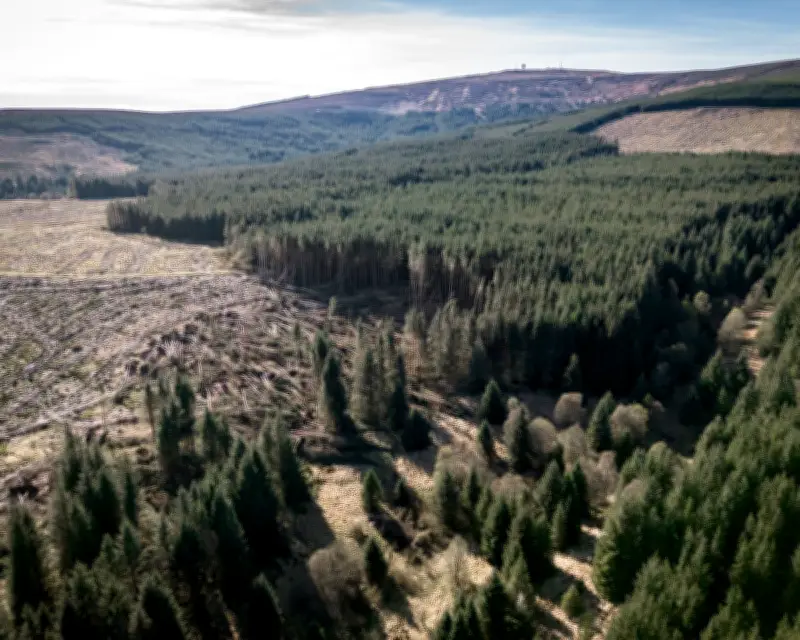
Last week, a well-balanced piece highlighted the success story of Kielder Forest, England's largest forest, which has transformed from a commodity-driven plantation to a conservation haven. Central to this achievement has been learning from the planting mistakes of the 1970s. Today, Kielder thrives both as a commercial forest, supplying 25% of England's homegrown timber, and as a biodiversity hotspot, providing habitat for red squirrels, voles, and ospreys.
Challenging Outdated Views on Monocultures
It was disappointing to read an article on commercial forests that contained an unchallenged and outdated trope from Camilla Fowler, chair of the Lilliesleaf, Ashkirk and Midlem community council. She stated: 'This kind of forestry scars the landscape and replaces it with monocultural, dark trees that harms our biodiversity.' However, it would be illegal today in both Scotland and England to plant a monoculture. Modern forestry practices prohibit planting a forest that contains 100% conifer, even if they are of different species.
One of the newest productive forests planted in England is at Doddington, Northumberland. Here, the planting mix on 354 hectares includes 41% Sitka spruce, 20% native broadleaves, 15% managed priority habitat, 13% Scots pine/native broadleaves, 10% open land, and 1% mixed conifer. This diverse composition reflects modern standards.

Both north and south of the border, the housing crisis can only be fully addressed by building more homes, which require timber for construction. Opponents of productive forestry should update their understanding of modern planting practices, mindful that you cannot live in a sheep.
The Environmental Impact of Not Planting
While the article on private investors using tax breaks for tree-planting correctly notes that productive forest expansion in southern Scotland must not ignore local conservation interests, it fails to consider the environmental impact of not planting productive trees. Studies on timber consumption show that wealthy nations are responsible for global forest loss beyond their borders, causing biodiversity loss through demand for timber products grown in other countries, effectively 'exporting extinction' (Wiebe & Wilcove 2025, Nature 639: 389–394).
The UK, as the world's second biggest importer of timber products, is effectively 'offshoring' its timber supplies with consequences for the world's remaining natural forests. While it may be irritating to see private investors using forest expansion as a tax reduction tool, it must be remembered that those investing today may never see the final return, as benefits are only realized up to half a century into the future. Hence, support through tax relief is necessary.
While safeguarding the natural environment remains vitally important, it is crucial to consider where all the wood used for everything from building homes to cardboard packaging comes from.
Community Concerns in the Scottish Borders
Your article accurately pinpoints the reason for the rapid and overwhelming change in the Scottish Borders landscape, from farmland to monoculture Sitka spruce plantation, and the associated negative effects on employment, housing, and community. The pursuit of profit is creating new clearances. In Dumfries and Galloway, the Save Warblaw Action Group is campaigning to prevent the planting of 214 hectares of Sitka on a peatland hill adjoining the former mill town of Langholm.
The forestry proposal is riding roughshod over the community, aiming to plant monoculture on peatland that is already sequestering carbon. If improving biodiversity and combating climate change were truly the goal, the plans would be very different. It is time for the Scottish government to review its forestry policy, which is enriching the already super-rich at the expense of nature and struggling rural communities.