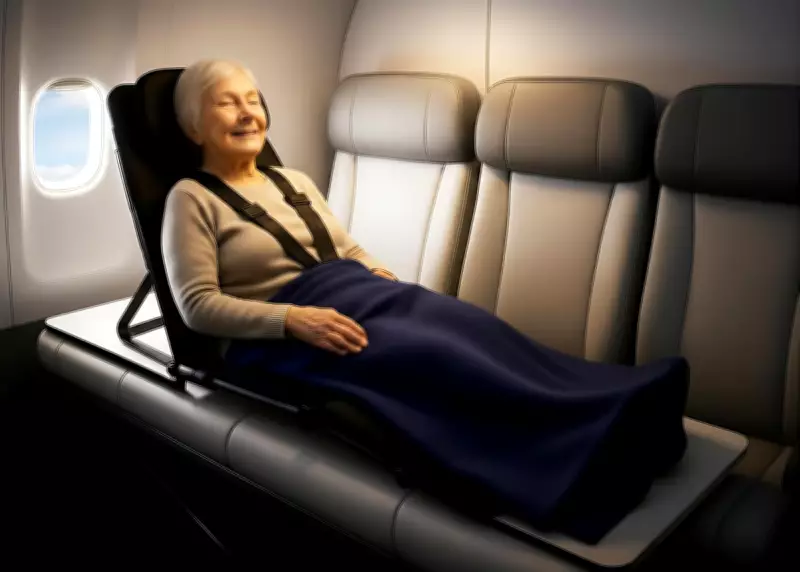
SkyBudi Aims to Revolutionise Aeromedical Transportation with Innovative Economy Bed System
An Australian company, SkyBudi, is poised to transform aeromedical transportation through an innovative economy bed system designed for ground and in-flight testing mid-year, ahead of a planned airline launch. This patented solution seeks to bridge the gap between clinical care and commercial air travel for passengers with medical or mobility needs.
Lightweight and Rapidly Deployable Design
SkyBudi comprises a lightweight system weighing only 10 kilograms that can be rapidly deployed to convert existing airline economy-class seats into a stable bed surface. Crucially, it requires no aircraft cabin modifications, with the unit stored conveniently in overhead baggage compartments when not in use. This design ensures minimal disruption to standard airline operations while providing enhanced comfort.
Addressing a Critical Mobility Gap
Founded by Andy Heath, a flight nurse with two decades of experience across 3500 global aeromedical flights, SkyBudi targets passengers who are clinically fit to fly but physically unable to endure an economy-class seat or afford a business-class flatbed. Heath explains that aviation accessibility has long been a binary struggle, where individuals are either standard passengers or complex cases requiring costly commercial stretchers.

"For decades, aviation accessibility has been a binary struggle — you are either a standard passenger or you are a complex case, for example requiring a commercial stretcher," Mr Heath says. The latter option typically demands nine seats, engineering support, and hi-lift vehicles, creating logistical nightmares for airlines and costing families over $50,000.
Clinical Benefits and Development Journey
Heath developed the system after observing that most mature and medical patients prefer a semi-reclined position, as lying flat at altitude can cause abdominal mass to press against the diaphragm, reducing lung expansion and oxygenation. SkyBudi combines a semi-Fowler position to improve ventilation with elevated legs to reduce oedema, and EEG sleep tests have confirmed it supports sustained deep sleep.
The journey began with the Qantas Avro program in 2017, which aimed to accelerate travel and technology startups. "Early-stage failures provided critical insights into airline operations," Mr Heath notes. After pivoting, the solution underwent proof-of-concept developments with Virgin Australia, leading to the current pre-production phase.
Safety, Manufacturing, and Market Launch
SkyBudi is now collaborating with Friedman Research on aerospace safety requirements and patient transport leader Ferno on manufacturing. The final product is on track for ground and flight testing in Australia with an unnamed carrier around May or June. A US market launch is scheduled for early 2027, with a major US tier-one carrier expressing strong interest.
Operational Model and Cost Savings
The system places no operational burden on airlines, as onboard installation and clinical care are provided by a certified escort, known as a Budi—derived from the Sanskrit word for "awakened one." The proposed business model offers SkyBudi at no cost to airlines, with users hiring the solution along with an endorsed medical escort. A Budi App will connect families, hospitals, and insurers with certified escorts.
Mr Heath highlights that replacing a business-class seat or medical stretcher with SkyBudi could slash medical transport costs by 50 to 70 percent. "And because it's a no-cost model for airlines, there are no barriers for the industry to adopt SkyBudi," he adds. "This is the most significant change for the commercial stretcher in 50 years. It was designed with a nurse and patient at the centre of it, and with airline and commercial benefits aligned."