A flight school has broken its silence after a training plane crashed into a hangar at an Adelaide airport, killing a student and instructor and injuring ten others in what investigators have described as a “catastrophic” scene.
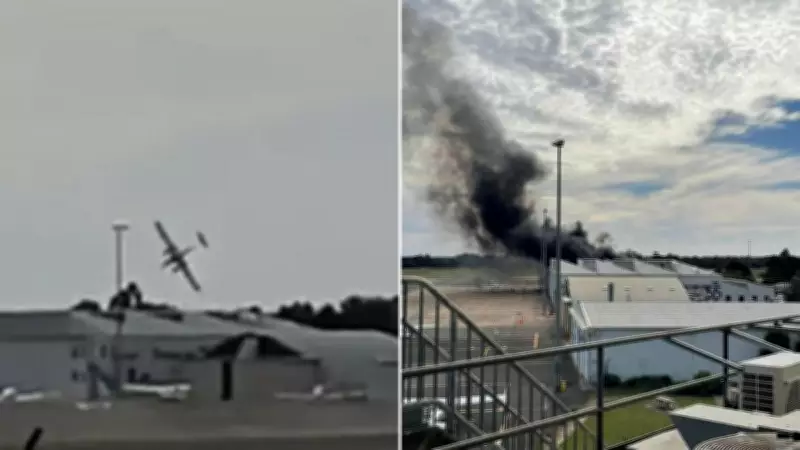
Emergency crews rushed to Parafield Airport on April 29 after the light plane crashed into a hangar, sparking a large fire and sending a thick plume of smoke over nearby suburbs.
Marking a week since the crash, Flight Training Adelaide — which operated the training aircraft involved in the incident — said the loss of the two men in the tragedy has been “a very difficult moment for our school community.”

“We extend our deepest condolences to the families of our student and instructor, and we also hold in our thoughts those who sustained injuries and are receiving care,” chief executive Pine Pienaar said in a statement.
“We are profoundly grateful to the South Australian emergency services — including police, ambulance, and fire crews — for their swift and courageous actions.
“Their dedication in the face of such a devastating event is deeply appreciated.”
He said the school was working closely with authorities and the Civil Aviation Safety Authority (CASA) to understand what happened.
“Our focus remains on supporting the families, our students, staff, and the wider aviation community during this difficult time,” he said.
“Flight Training Adelaide (FTA) is currently working closely with CASA on mapping out a pathway to resume flight training operations.
“Activating training at FTA is totally dependent on final approval from CASA. No timeline has been finalised, given due process must be followed.”
Instructor Identified as Robert 'Rob' Hoyle
Rob Hoyle was the instructing pilot who died in the crash at an Adelaide airport. The Diamond DA42 had been airborne for only seconds when it rolled sharply left, passed beyond 180 degrees and plunged into the hangar in a steep descent, sparking a massive post-impact fire.
Engineers and maintenance staff were working inside at the time, and students from the flight school were inside a classroom.
Among the first medically trained responders was Dr Dahn Tran, whose clinic sits just three buildings from the crash site.
He said he and a colleague heard “a loud explosion followed by another little explosion” around 2.10pm and ran outside to find black smoke pouring from the hangar.
“We decided to rush over and help,” he said.
“One injured person had severe burns… at least 80 per cent of his body.”
Dr Tran said the man was conscious and breathing on his own, and that he and his team hosed the burns while waiting for paramedics.
“We couldn’t do anything more for the pilots until the fire crews arrived,” he said.
The instructor killed in the crash has been identified as 29-year-old Robert “Rob” Hoyle, a respected commercial pilot who had wanted to fly since he was eight years old.
His father, Scott Hoyle, told 7NEWS his son had been a commercial pilot for more than a decade and was “respected and admired by his peers and students”.
He preferred to be called Rob and was affectionately known as “Goose” — a Top Gun reference — by the students he trained.
ATSB Investigation Underway
Australian Transport Safety Bureau (ATSB) Chief Commissioner Angus Mitchell said investigators were confronted with “quite a catastrophic scene” inside the hangar, where several people on the ground were injured and multiple aircraft were destroyed.
He said the aircraft “very soon after take-off… started a roll to the left”, but it was too early to determine whether mechanical issues, asymmetric power, pilot input or training activity caused the sudden loss of control.
The investigation into the crash could take weeks.
A witness who saw the aircraft moments before impact said it appeared suddenly and silently.
“I probably watched it for like two seconds and then it just disappeared into the hangar… it was so quiet and then there was a bang, and it was just a big black cloud of smoke,” they told 7NEWS.com.au
The same witness said the crash came within about 50 metres of the airport’s main fuel depot, describing it as a near-miss that could have made the disaster far worse.

“If it was 50 metres further to the south… that’s where they fill planes up,” they said.
South Australian Premier Peter Malinauskas described the incident as “tragic”, offering condolences to the families of the two men killed and thanking first responders for their “swift and courageous response”.
The ATSB is analysing CCTV, eyewitness accounts and aircraft documentation, and will take engine components to Canberra for further examination. Investigators expect to remain on site for several days, with a preliminary report outlining the known facts due in six to eight weeks.