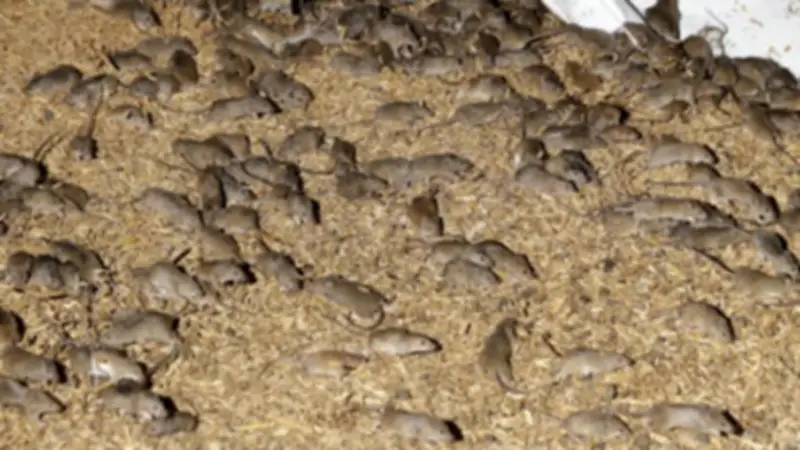
Rick Rycroft/AP Australian farmers are desperate to escape the latest mouse plague – and may soon get relief.
Relief on the Horizon for WA Farmers Battling Mouse Plague
For months, a flood of mice has engulfed Western Australia’s agricultural regions. For people living through it, this latest mouse plague is all-consuming. Houses, sheds, paddocks and roads are blanketed with mice. And the smell of mice, both dead and alive, is impossible to escape. It may well be the worst plague the region has ever seen, with scientists recording up to 8,000 mice in each hectare of land. That’s ten times the number needed to officially declare a mouse plague. But there are signs the plague could end soon. And that’s promising news for local farmers and communities.
Why So Many Mice?
In WA’s northern wheatbelt region, the current mouse plague started back in April. That was after a cyclone created the ideal conditions for mice to thrive, including increased rainfall and soil moisture that boosted crop yields. However, scientists were warning of a potential mouse plague back in March, based on modelling and field monitoring. Research suggests large-scale mouse plagues mainly affect Australia and China, but the reasons for this are not yet understood.

An End in Sight
Many people in affected regions are wondering when their living nightmare will end. The good news is, it’s likely to be soon. There are three main reasons for this.
1. Less Food When it comes to growing crops, Australia is a boom and bust country. While good conditions fuel bumper crops, times of drought reduce crop yields and the growth of native plants. So in drier years, such as this year, mice populations can drop dramatically as there’s less available food.
2. Less Rain Rainfall is the single strongest predictor of mouse plagues. High rainfall boosts the growth of plants, including agricultural crops, which provides female mice with the food and nutrition needed to rapidly breed. Research shows plagues generally occur about three months after unusually high rainfall. However, it also suggests mouse plagues do not occur for at least two years after a significant plague event.
3. More Heat With the right conditions, mouse plagues can stretch from early autumn to winter, and even summer of the following year. However, WA tends to have hot, dry summers that further compact and suck moisture from the region’s already hard soils. Research shows this makes it much harder for mice to burrow and keep breeding.
Concerns for Local Wildlife
The current mouse plague has wreaked havoc in rural communities across WA. That’s because of its scale and its timing, having coincided with the critical crop sowing period. This prompted local farmers to lobby for double-strength mice bait to be made available, particularly in large-scale crop farming. This higher-dose bait is made of zinc phosphide, and kills mice more quickly and effectively than existing products. This lobbying proved successful, with Australia’s federal pesticides regulator approving it for use in May.
However, concerns are mounting about the effect of this double-strength bait on native birds. This type of bait has been used during previous mouse plagues, without causing secondary poisoning of native wildlife. This is because this bait does not get concentrated in mice, and therefore can’t be ingested by native predators in large quantities.
However, scientists are worried this higher-dose bait will directly poison native birds, particularly those that eat grain from paddocks. One local wildlife carer reported finding 106 native birds either dead or dying, in the small farming community of Coorow. These included western corellas, little corellas, galahs, Regent parrots and Australian ringnecks. It is possible to test these birds for exposure to zinc phosphide, but such tests are not routinely used for screening dead wildlife and can take weeks or even months to complete. So the long-term effects of using stronger mice baits, particularly on native birds and wildlife, remain unknown.
Communities across WA have borne the brunt of this latest mouse plague. But as winter sets in and the double-strength baits take effect, relief will hopefully come soon.