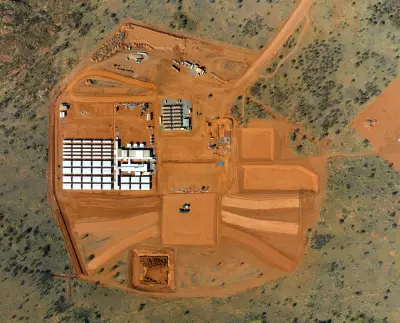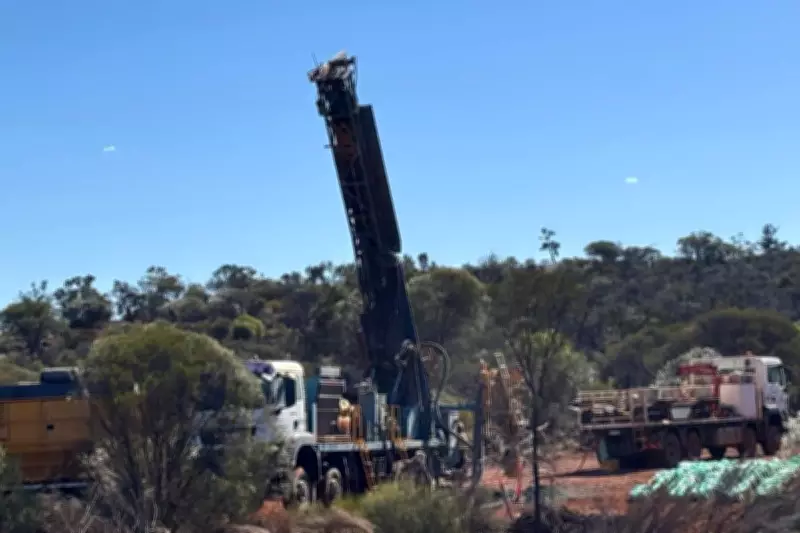
Terrain Minerals has expanded one of its biggest induced polarisation (IP) geophysical programs at its Smokebush gold and silver project, located 350 kilometres north of Perth in Western Australia's Mid West region. The company added four new survey lines across three historic prospects: Paradise City, Hurley, and T17.
The three prospects are situated 2.5 kilometres southeast of Terrain's high-grade Lightning and Monza deposits, within the company's northern granted mining lease. The extension adds four kilometres of dipole-dipole IP coverage across these targets, where historic drilling and rock chip sampling have already returned significant gold intercepts.
The move comes as Terrain prepares the next batch of drill targets ahead of its upcoming maiden resource estimate for the Lightning deposit. The company is applying the same geophysical technique that identified a 600-metre-long chargeability anomaly in 2023, which later led to the discovery of the flagship Lightning gold deposit.

IP is a non-intrusive geophysical method that maps the response of disseminated sulphide minerals from the surface. It works effectively where target structures are concealed beneath transported cover and has proven successful at Smokebush, where sulphides are closely associated with gold mineralisation.
Terrain Minerals executive director Justin Virgin commented: "These are not blank-canvas targets - Paradise City, Hurley and T17 all have historic gold results that genuinely warranted a closer look. The dipole-dipole configuration is the same technique that defined the Lightning anomaly in 2023, which we have since drilled with more than 16,000 metres. We are applying exactly what we know works at Smokebush to the next generation of targets, and we expect the results to give us a clear picture of what to drill in the second half of 2026."
The historic prospects covered by the survey extension have already yielded encouraging geochemical results. At Paradise City, historic reverse circulation drilling returned intercepts including 3 metres at 2.17 grams per tonne (g/t) gold from 10 metres depth, 5 metres at 1.35 g/t gold from 13 metres, and 2 metres at 3.61 g/t gold from 15 metres depth.
Historic rock chip sampling across Paradise City also delivered seven samples above 10 g/t gold, with a best result of 49.27 g/t gold. A total of 31 rock chip or grab samples averaged 8.15 g/t gold. Terrain's follow-up sampling over old workings at Paradise City averaged 5.18 g/t gold from four rock chip samples. Historic drilling at Hurley and T17 returned 10 metres at 1.4 g/t gold from 15 metres depth and 2 metres at 2.5 g/t gold from 51 metres depth, respectively.
The extra lines build on Terrain's plan, outlined two weeks ago, to use IP geophysics to test for repeat Lightning-style structures along the same north-south shear corridor and around the Mt Mulgine intrusive setting that hosts Lightning and Monza. That earlier program already included Hurley, but the latest extension broadens the sweep to bring Paradise City and T17 into the same modern survey.
The extended survey also follows the company's 21 May update, which indicated that Lightning's maiden mineral resource estimate remains on track for July, while final technical work such as collar surveys, drone topography, and metallurgical sampling continues.
By running the proven dipole-dipole IP configuration over old gold occurrences rather than relying on lower-resolution historical work, Terrain aims to improve subsurface geological definition before deciding which targets deserve priority drilling in the second half of 2026.
With Wildflower drilling assays still pending, and the Lightning resource estimate and fresh IP targets due in July, Terrain's Smokebush project looks set to deliver a steady stream of news while building a broader pipeline of follow-up opportunities.