Dalaroo Metals has successfully completed a large-scale systematic soil geochemistry program at its Gold Ridge prospect, marking a major technical milestone for the Bondoukou gold project in Côte d'Ivoire.
The company's campaign represents the first district-scale geochemical coverage ever completed over the interpreted 9-kilometre-long mineralised corridor, significantly expanding the company's surface footprint over highly prospective structural corridors.
The program was designed to home in on areas associated with artisanal gold workings, quartz veining, and favourable Birimian host lithologies within interpreted regional shear zones.

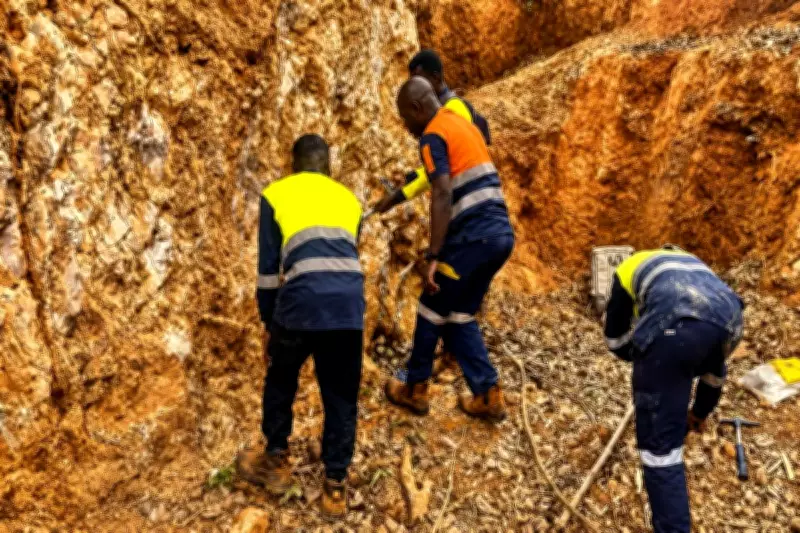
Dalaroo says the program was a comprehensive operational success, wrapping up both the Priority 1 south-eastern block and the Priority 2 north-western block. Systematic coverage is now complete over the entire 9-kilometre corridor, with a total of 3612 primary soil samples collected by field crews on the ground.
In an exhaustive effort by the company to ensure data integrity, a total of 4363 samples, comprising soil, channel, grab, and quality control samples, have been dispatched to Intertek Laboratory for gold and multi-element analysis.
The resulting assay data will assist the company in defining high-priority targets for subsequent trenching, auger drilling, and maiden reverse circulation drilling programs.
Notably, Dalaroo says one of the major goals of the program was to pinpoint the source of serious historical rock-chip grades that have previously turned up results that clocked in as high as 17.95 grams per tonne gold along the interpreted structural corridor.
John Morgan, CEO of Dalaroo Metals, stated: "The scale of the corridor, widespread artisanal workings, extensive quartz veining and strong structural setting continue to reinforce our belief that Bondoukou has the potential to host a significant Birimian gold system."
Furthermore, the program was also aimed at testing for extensions to the company's previously identified gold corridor measuring 2.5 kilometres by 400 metres, effectively tripling Dalaroo's high-conviction search area.
The company says that to achieve this high-resolution data set, its field crews completed approximately 194.5 kilometres of soil sampling lines using a tight 200-metre by 50-metre grid spacing to ensure no potential mineralisation was missed.
Parallel work at the Dingbi and Amodi artisanal workings has added another layer of data. These sites, where local miners have been active, saw 71 channel samples and 14 selective grab samples collected. Because artisanal workings are often the most reliable surface indicators of a meaningful system in this region, these areas are now being fast-tracked into the drill-planning process.
The geological observations made during the campaign have added to the anticipation. Dalaroo says field crews reported widespread evidence of a large-scale hydrothermal system, including extensive quartz veining and iron oxide alteration, specifically hematite, goethite, and limonite.
In tropical terrains like the Birimian, these features are considered the classic "fingerprints" of gold mineralisation buried beneath the surface weathering profile.
While Bondoukou is a primary growth focus for the company, Dalaroo continues to advance a diverse portfolio of international and domestic exploration assets. This includes the Blue Lagoon project in Greenland, which is prospective for rare earth elements, zirconium, and niobium, alongside the Lyons River and Namban projects located in Western Australia.
Looking ahead, the company's next steps include the receipt of assay results, the identification of coherent gold anomalies, and the integration of geochemistry with existing structural and geological models. The transition from regional reconnaissance to targeted drilling will mark a significant shift in the project's development as the company moves toward target generation.
Dalaroo is following the textbook West African exploration playbook: find a proven geological address, conduct the systematic groundwork, and let the data lead the way. With a 9-kilometre corridor now fully sampled and visual indicators looking strong, all eyes will be on the laboratory results, then to see if the "truth-divining" drill bit can deliver the goods.