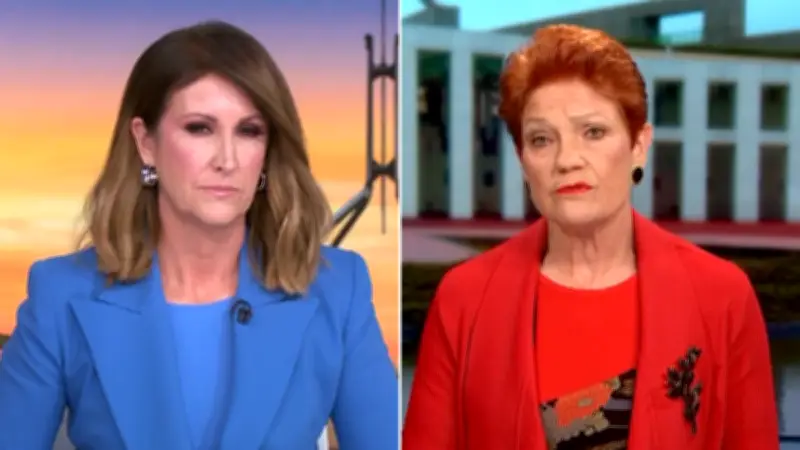
One Nation leader Pauline Hanson has defended her call for a “monocultural” Australia, insisting she is not asking migrants to abandon their cultural backgrounds but wants Australians united under one set of laws and shared national values.
Hanson clarifies monocultural stance
Hanson sparked national debate last week when she told the National Press Club that Australia “must be monocultural”, arguing the nation could be multiracial but “cannot be a multicultural society”. But speaking on Sunrise on Tuesday, Hanson said her comments had been misunderstood.
Hanson said her vision of a monocultural Australia was not about people abandoning their heritage, but about ensuring everyone assimilates into Australian society and is governed by the same laws and values. “Nothing would really change, we’d still have our culture, we’d still have our laws,” she said.

She said her concerns centred on what she sees as a growing fragmentation of Australian society. “Do we really want to see Sharia law, do we want to see multiple marriages, do we want to see these gangs sitting around our streets with machettes? That’s not the Australian way of life,” she said.
“It’s about being united under the one culture, and everyone should be treated the same under one law. I’m not saying forget where you came from or your cultural background by no means.” Hanson said Australia should focus on national identity while still recognising people’s heritage.
“When we go to the Olympics, we represent our nation; it’s all under the one flag, and it’s the Australian flag. Japan has a monoculture, so what’s wrong with Australia having a monoculture?”
When asked whether it was possible to be multicultural while still sharing Australian values, Hanson maintained Australia was “multiracial” but needed to place greater emphasis on assimilation. “We must look at being Australians instead of all these different little individual groups who live in their own cultures, their own laws and beliefs,” she said. “People have come here to be Australian.”
English language requirement
Hanson argued that requires migrants to learn English and fully participate in Australian society, pointing to figures she claimed showed 872,000 people in Australia could not speak the language. “872,000 people in Australian can’t speak English... these people will probably go on to vote in elections, do they really know what they’re voting for, who they’re voting for?” she said. “People must learn to speak English to actually assimilate into a society... I’m not against people who have come here.”
Maternity leave comments ‘taken out of context’
Hanson also moved to clarify comments she made about maternity leave during her National Press Club address, after remarks about women being paid while away from work sparked questions about whether she supported scrapping paid parental leave. Asked directly on Sunrise whether she wanted paid maternity leave abolished, Hanson rejected the suggestion. “There’s no way, shape or form that I am saying to get rid of it,” she said.
“I think it’s been very beneficial to women to get back into the workforce, and yes, they do need that when they’re at home and having their children. That was taken completely out of context.” From July 1, the federal government’s paid parental leave scheme will provide eligible parents with 26 weeks of leave paid at the national minimum wage. Hanson said she supported the government-funded paid parental leave scheme but believed individual businesses should decide whether they could afford to offer additional benefits. “There are smaller businesses that cannot afford it,” she said. “You put another pressure on small businesses to pay for maternity leave, they’ll actually fold.”

One Nation’s potential coalition with Liberals
Hanson’s comments come as new polling fuels questions about the shape of Australian politics ahead of the next federal election. A Roy Morgan survey released this week found One Nation’s primary vote had climbed to 31.5 per cent, ahead of Labor on 27 per cent and the Coalition on 17.5 per cent. The poll also suggested a hypothetical contest between Labor and One Nation would be too close to call, with Labor narrowly leading 51 per cent to 49 per cent on a two-party preferred basis.
The figures prompted Deputy Prime Minister Richard Marles to argue the Liberals and One Nation would ultimately need each other to form government. “I think what’s really clear is that when you look on the right side of politics, whether it’s the Liberals or One Nation, they’re going to need each other,” he told Sunrise on Tuesday.
Despite suggestions One Nation’s most realistic path to power would involve working with the Coalition, Hanson revealed she had not spoken to Opposition Leader Angus Taylor since around 2019. “It’s a two way street, Angus Taylor hasn’t picked up the phone to me either,” she said. However, she indicated she would be open to cooperation in the future. “In time, I’m sure we’ll get to talk and strategise about our preferences.”
“I’m not anti-the coalition by no means; I hope that we can work together because I want to get rid of this toxic Labor, Greens, Teals government that is destroying this nation,” she said. Hanson’s criticism comes as the Albanese government negotiates with the Greens to pass key elements of its budget agenda through the Senate. The government has already agreed to delay planned NDIS reforms after the Greens demanded a longer Senate inquiry into the reforms and is now facing pressure for further concessions on its tax package.
Opposition Leader Angus Taylor has accused Labor of striking a “dirty deal” with the Greens, arguing the government is shifting further to the left in order to secure enough support to pass its agenda through the Senate. However, Marles rejected suggestions Labor was governing in partnership with the Greens. “The Greens are completely separate from the government,” he said. “We are governing Australia in the national interest and, in doing so, very much focused on challenges around the cost of living.”
One Nation’s experience questioned
Hanson rejected suggestions One Nation lacks the experience required to play a larger role in government, despite having only one current member with previous experience in government. She argued the party’s ranks include people with backgrounds in business, economics and finance who could help shape policy and provide the expertise needed to govern. “We have people with that background knowledge and experience, so don’t underestimate One Nation and the people that we have,” she said.
Hanson said voters should judge her party against the performance of the current government, which she accused of failing to properly manage key portfolios. “Is it working with what we’ve got? Because I see such incompetence from the ministers we have now, who are not across a brief, across their portfolios, and that’s why so much damage has been done to the country.”