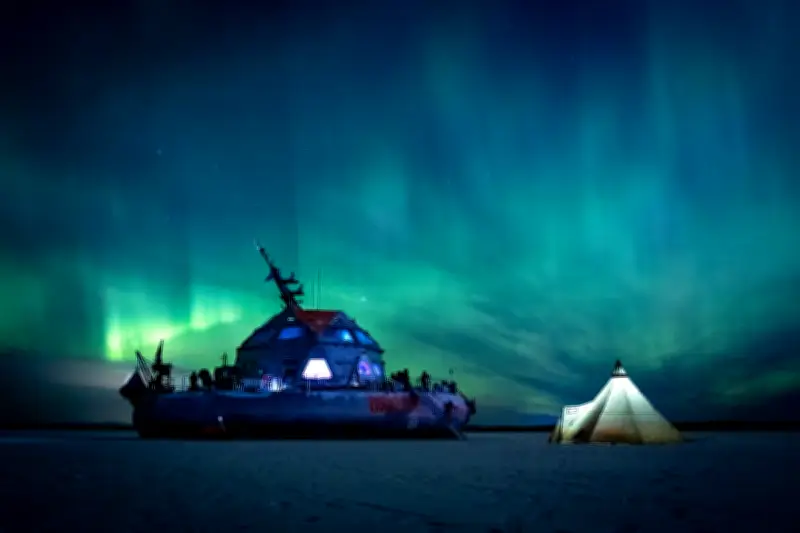
Six scientists and six crew members will embark next month on a daring voyage to the central Arctic Ocean aboard the Tara polar station, a futuristic floating laboratory designed to be frozen into pack ice. Departing from Kirkenes, Norway, they will endure months of darkness and temperatures as low as -50°C (-58°F) on an eight-month mission to study one of the most fragile and least-understood ecosystems on Earth before it is altered forever by climate breakdown and pollution.
Mission to Document a Changing World
The expedition, led by the Tara Ocean Foundation, aims to gather critical data on the impact of climate change and pollution on the central Arctic Ocean's unique ecosystems. Romain Troublé, executive director of the foundation, warns that species are being lost before they can be discovered. "In the next 20 years, everything will shift," he says. Troublé, a microbiologist turned sailor, was recently awarded the prestigious Shackleton medal for his work on the polar station.
The Tara polar station, a 26-metre-long, 16-metre-wide vessel, will drift slowly over the North Pole to Greenland, overwintering through intense polar nights. The design, conceived by Agnès Troublé and Étienne Bourgois, required €26 million (£22 million) in funding and coordination of scientists from 15 countries.

A Race Against Time
The Arctic is warming three to four times faster than the global average, causing sea ice to melt rapidly and exposing the region to threats from shipping, fishing, mining, and pollution. This expedition is the first stage of a planned 20-year continuous mission across 10 legs, aimed at driving policy changes to protect the Arctic. Dr Nina Schuback, a biological oceanographer from the Swiss Polar Institute, emphasizes the urgency: "We know the central Arctic Ocean is changing really, really rapidly. But if you want to talk about the effect on biology, it is very hard to get data."
Schuback and her colleagues will sample microbes in seawater through the station's "moon pool," a central opening that also serves as a launch point for divers, underwater drones, and remotely operated vehicles. They hope to discover new species adapted to the unique environment where the sun does not rise for nearly half the year.
Human Challenge and Scientific Promise
The crew will face extreme isolation, with rescue potentially taking a week. Schuback, who underwent a rigorous selection process likened to evaluation for the International Space Station, admits she is both excited and scared. "My biggest fear is the darkness," she says. "But time will go very quickly. There's exciting science – and how often do you get the chance to do something like this?"
The expedition builds on the legacy of earlier Arctic voyages, including Fridtjof Nansen's 1893-96 drift aboard the Fram and a 2006 transpolar drift by the Tara schooner. Troublé notes that while the physics and depth of the Arctic are well understood, the biological aspect remains largely unknown. "It is a blank sheet to discover," he says.