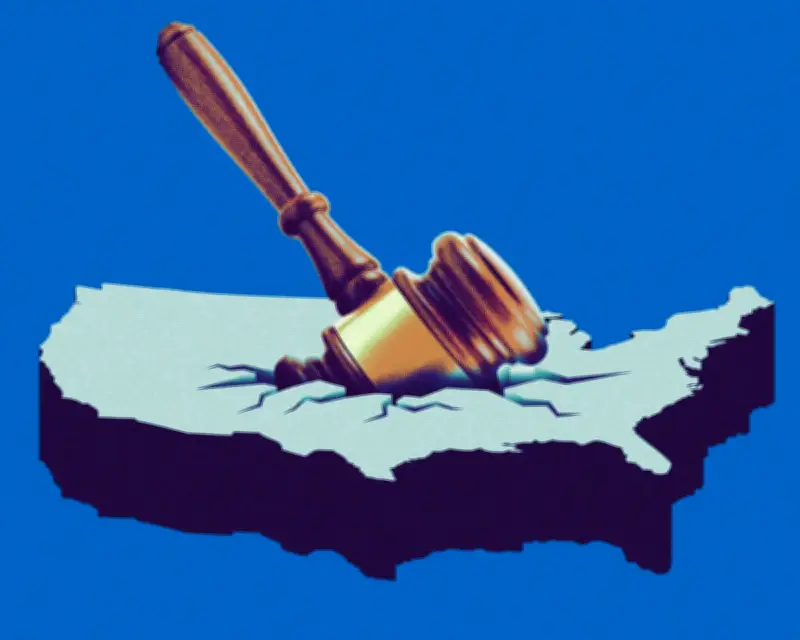
The US Supreme Court, a vital cog in the constitutional framers' vision of checks and balances, has made Donald Trump stronger than ever, showing little inclination to stop. After a momentous term ending with Tuesday's rejection of Trump's attempt to scrap birthright citizenship, the court has acquiesced in multiple power grabs, leaving a dramatically transformed political landscape.
Birthright Citizenship Ruling: A Surface-Level Setback
The birthright ruling, upholding citizenship for anyone born in the US, appeared as a major setback. However, closer inspection reveals a court that has shifted its perception of what is legally possible, accommodating Trump's expansive view of presidential powers. Legal scholars note the lackluster support for birthright citizenship illustrates a sea change in legal perceptions.
Four conservative justices challenged the long-held principle enshrined in the 14th Amendment. Clarence Thomas, Samuel Alito, and Neil Gorsuch filed dissenting opinions, while Brett Kavanaugh concurred in part, arguing Trump's bid violated federal law but not the Constitution. "The Overton window has moved," said Laurence Tribe, emeritus law professor at Harvard University, noting the republic is "hanging by a thread."

Court Acquiesces in Power Grabs
The court, with a six-to-three conservative majority due to Trump's appointments of Gorsuch, Kavanaugh, and Amy Coney Barrett, has adopted vast segments of Trump's program. Most significant was Monday's ruling in Slaughter v. Trump, granting the president the right to remove heads of federal agencies at will, overturning a 90-year-old precedent. This decision, justified by the unitary executive theory, opens the door to an "imperial presidency."
"What the court has done with executive power has been really significant," said Daniel Epps, law professor at Washington University in St. Louis. Justice Gorsuch wrote separately, stating the job is not finished and the court needs to rein in the administrative state further.
Ripple Effects on Voting Rights and Immigration
The court weakened the 1965 Voting Rights Act, allowing southern legislatures to redraw congressional districts, likely benefiting Republicans. In two rulings on the same day as the birthright decision, the court dismissed transgender girls' participation in female sports and lifted campaign finance restrictions. It also boosted Trump's immigration crackdown by allowing the removal of temporary protective status for refugees from Haiti and Syria.
Kim Lane Scheppele, an expert at Princeton University, predicted weakening the Voting Rights Act would trigger "a huge set of ripple effects," reducing Black representation in Congress. She compared the court to those in Russia and Hungary, packed with supportive judges. "Packed courts don't always vote in favor of the autocrat," she said, noting the birthright case was a five-four loss that invites Trump to come back with the next proposal.
Future Targets: Congress and Civil Servants
Trump's next targets may include Congress and civil servants, boosted by the knowledge that some conservative justices are prepared to contemplate the previously unthinkable. "A lot of legal arguments that we thought were off the wall are now on the wall," said Scheppele. Future rulings could see the court assert the president's power to ignore congressional spending or rules on partisan makeup of government.
Such a scenario could propel the US into uncharted waters, with a president unencumbered by guardrails. "Even King George III had a parliament to worry about, but King Trump, as the supreme court would have it, really needn't worry about much at all," said Tribe.