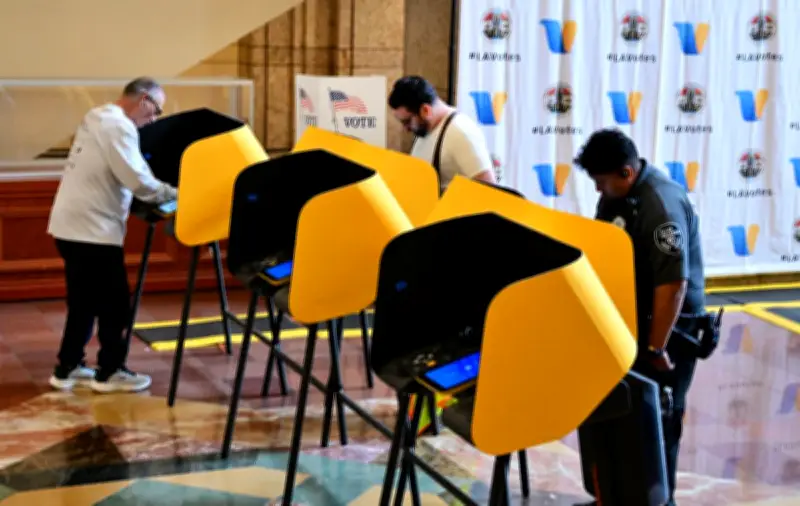
President Donald Trump on Wednesday signed into law a sweeping new federal election bill that overhauls voting procedures nationwide, drawing sharp criticism from Democrats and civil rights groups who argue it will disenfranchise millions of voters.
Key Provisions of the New Law
The legislation, which passed Congress largely along party lines, mandates that all voters present a government-issued photo ID to cast a ballot. It also imposes strict limits on mail-in voting, requiring that absentee ballots be requested in person and returned only by mail or at designated drop-off locations.
Additionally, the law shortens early voting periods in many states and bans the use of private funding for election administration, a practice that became common during the pandemic. The bill also empowers partisan poll watchers to more closely monitor voting sites.

Reactions from Both Sides
Trump hailed the law as a necessary step to ensure election integrity. “This is about making sure every legal vote counts and that our elections are secure,” he said at the signing ceremony. “The American people deserve confidence in their democracy.”
Democratic leaders, however, denounced the measure as the most significant rollback of voting rights in decades. Senate Majority Leader Chuck Schumer called it a “shameful assault on democracy” that would disproportionately affect minority, elderly, and low-income voters.
Civil rights organizations have already announced plans to challenge the law in court, arguing that it violates the Voting Rights Act and the Constitution. The NAACP Legal Defense Fund described the legislation as “a modern-day poll tax.”
Impact on States
The law preempts many state-level voting regulations, meaning states like Georgia, Arizona, and Texas—which had already passed restrictive voting laws—will now have to align with the new federal standards. Some states with more expansive voting access, such as California and New York, will be forced to scale back their procedures.
Election officials across the country are scrambling to implement the changes ahead of the 2026 midterm elections. Many have expressed concerns about the cost and logistical challenges of new voter ID requirements and the shortened early voting windows.
Broader Political Context
The signing of this law marks a major victory for Trump and his allies, who have long claimed without evidence that widespread voter fraud tainted the 2020 and 2024 elections. The legislation is expected to be a central issue in the upcoming midterm campaigns, with both parties mobilizing voters around the issue of voting rights.
Public opinion on the law remains deeply divided along partisan lines. A recent poll found that 85% of Republicans support the new measures, while 78% of Democrats oppose them. Independents were split, with a slight majority expressing concerns about voter suppression.