Lone Pine, California, a small town with a population of 1,882, sits along a scenic highway framed by the vast Inyo Mountains and a sweeping desert landscape of sagebrush and dunes. Tourists often pass through on their way to Death Valley, and hikers stop for a motel room between Pacific Crest Trail treks. However, beneath the town's sleepy surface, a battle is brewing over the future of its surrounding lands.
Signs of Conflict
Stickers on the storefront of Mojave Precious Metals, a local gold exploration company, read "Support local exploration and mining," "Responsible mining helps us all get outside," and "Mining gets you there." Around the corner, signs saying "No Gold Mining" and "Protect Conglomerate Mesa" are visible from the street. Conglomerate Mesa, located 15 miles east of Lone Pine, is a dry, 14,000-acre mountainous desert dotted with piñon and Joshua trees, surrounded by boulders. The area feels untouched for millennia, with only the sounds of wind, lizards, and birds breaking the silence.
The Mojave Project
Mojave Precious Metals, a subsidiary of Canadian gold exploration company K2 Gold, has set its sights on Conglomerate Mesa. The company claims the area holds a massive quantity of high-quality gold and mineral deposits and has spent over seven years trying to unearth them. On April 8, the Bureau of Land Management (BLM) issued final approval for K2 Gold's plans, a 6,000-hectare site named the Mojave Project. The company quickly moved in, with locals reporting constant helicopter traffic bringing lumber and equipment to build rigs for exploratory drills. "The setup is complete. The next chapter starts sooner than you think," read a video posted by K2 Gold the day of approval.

Exploratory drilling is typically a prelude to mining. If the gold is viable, K2 Gold can sell the area for a hefty price in the future. This new gold rush follows Donald Trump's Unleashing American Energy Act, which legally required BLM to approve projects like K2's and reclassified gold and silver as critical minerals. With demand for gold at record levels and new mining projects approved in California, Oregon, and Nevada, previously protected lands are now up for grabs.
Guardrails and Opposition
The BLM's approved version of the proposal includes guardrails: no trucks, only 22 boreholes, and fewer gallons of water than the company requested. An agency spokesperson stated that the project allows Mojave Precious Metals to conduct activities on legally held mining claims while minimizing impacts on public lands, following extensive environmental analysis and tribal consultation. Some environmental advocates hail the approval as a win, but Indigenous leaders see any action as a blow.
Esther Fillingame, a monitor for the Paiute Shoshone Tribe, said, "This isn't something that we ever want." For her, the BLM's approval means it's not a question of if mining companies come, but when, forcing tribal leaders to restrategize. "Hopefully they don't find anything," she added.
Divided Town
Lone Pine is split between residents who welcome jobs and economic growth from the Mojave Project and a coalition of tribes and environmentalists who oppose it. K2 Gold is confident in their work, with geologists monitoring the area and previous small-scale drilling yielding promising samples. CEO Anthony Margarit has estimated that a full-scale mine could take 10-15 years to build. He declined to be interviewed, and requests for comment were not returned.
Historical Context
The Eastern Sierra has been a mining draw since the 1840s Gold Rush, leading to towns like Lone Pine, founded in 1861. Dirt roads cut through ancient Paiute Shoshone travel routes, and settlers' cattle depleted tribal food sources, leading to conflict and the killing of hundreds of Indigenous people. When mineral deposits dwindled, towns became ghost towns, and mineshafts were abandoned. Today, much of the Inyo Mountains is BLM land, governed by an 1872 law that allows prospectors to stake claims on federal land for a small fee. What was once a man with a pickaxe is now a billion-dollar company with steel drill rigs.

Community Concerns
At a town hall last summer, over 150 people attended, including Brent Underwood, owner of Cerro Gordo Ghost Town. He fears that mining could lead to an open-pit heap leach mine, a method known for environmental and public health issues, banned in Montana and several countries. "I seriously question the wisdom of inviting this person in as our new neighbor," Underwood said.
Indigenous Perspective
Kathy Bancroft, an elder of the Lone Pine Paiute Shoshone Tribe who died in January, was a major figure in the resistance. She recalled previous mining companies offering the tribe money, which they never accepted. Conglomerate Mesa is sacred to local tribes, a haven for wildlife, and a site for hunting and gathering pine nuts. Two ancient stone tablets were recently discovered near a proposed drill site. Bancroft remembered accompanying representatives and speculators in the 1970s, saying, "We said: 'No way. Don't bring anybody in here.' And we always stuck by that."
Different companies came and went, usually foiled by California's strict environmental rules, but K2 Gold has persisted since 2019. The company assures that their patience proves they are different, and mining will bring workers to town. However, BLM figures show the impact on local jobs will be small, with only seven employees and local contractors over 10 months.
Business Views
Forrest Newman, part-owner of Jake's Saloon, sees mining as a fact of life. "Everything: you either mine it, or grow it, or it doesn't exist," he said. He believes more miners would be good for business and questioned the value of the desert land. "Why would you wander up there? It's fucking desert."
Protecting the Land
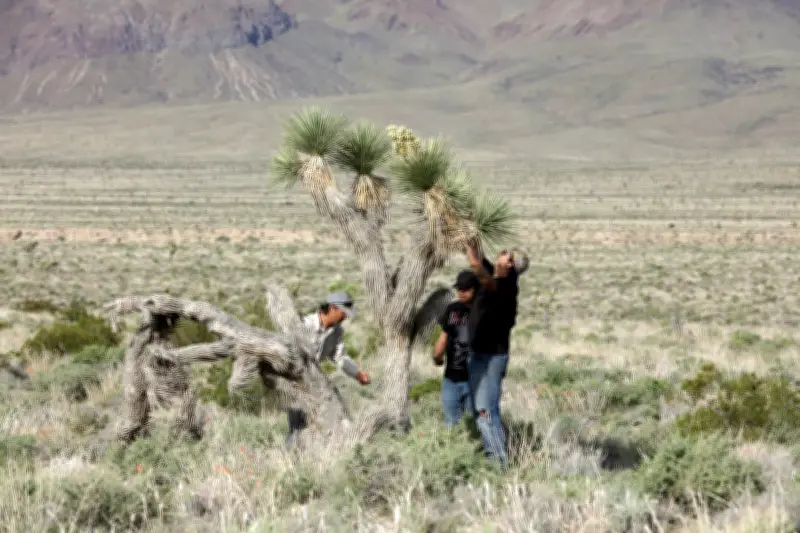
Jeremiah Joseph, a tribal monitor for the Paiute Shoshone, drove across rocky roads to check on Conglomerate Mesa. He pointed out ancient petroglyphs and grinding stones, and his nephew collected pine nuts and Joshua tree roots. "When I'm on those sites, I'm representing a nation, a history," Joseph said. The mesa is home to vulnerable plants like the Inyo rock daisy and is a climate refuge for the western Joshua tree. In 2020, Joseph uprooted 38 Joshua trees from K2's path and replanted them afterward.
As evening fell, Joseph prayed to the mountain. "I'm fighting for the relationship I have with that mountain as it is," he said. "It's simple as the food that's up there, or the natural hunting blinds. We're not giving generations after us a chance to know the land, or give the landscape the dignity it deserves."