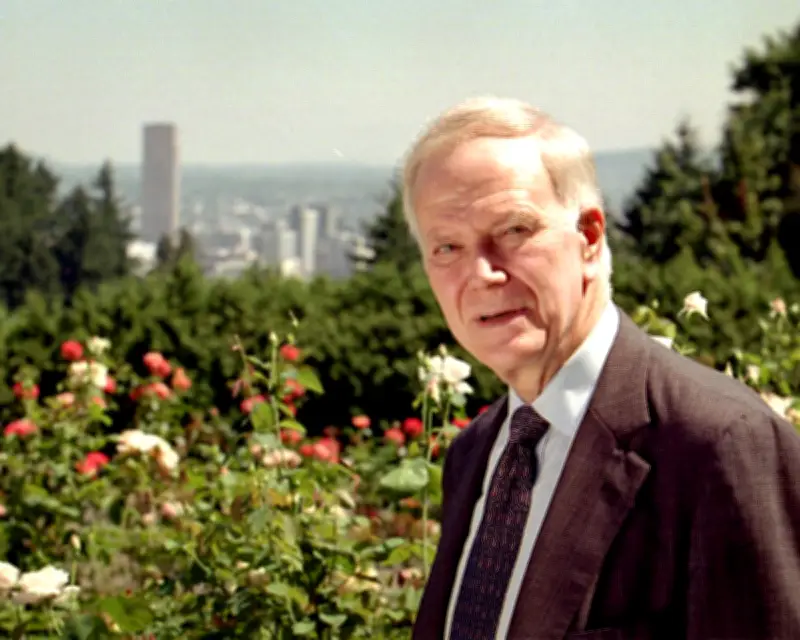
Former US senator Bob Packwood, a moderate Oregon Republican whose reputation as a champion of abortion and women’s rights was spoiled at the end of his career by allegations of sexual harassment, has died. He was 93.
Packwood’s death on Saturday was announced in an obituary sent to media outlets by his family. The release didn’t include additional details.
Packwood was a political scrapper who first refused to quit the chamber in which he had served for 27 years, saying he didn’t want to be remembered only for that controversy. Before the era marked by the #MeToo social justice movement, Packwood stood out as an example of private behavior undermining a man’s public image. He had been praised by Planned Parenthood and others.

The great-grandson of a member of the 1857 Oregon Constitutional Convention, Packwood established himself as a social moderate and fiscal conservative who often voted across party lines. He considered running for president in 1980.
Elected to the Senate in 1968, Packwood was best known as the leading Republican advocate of abortion rights – and was widely admired by women’s groups throughout the US until the Senate ethics committee launched an investigation into the allegations of sexual and official misconduct in 1993. More than two dozen women, former employees and acquaintances, accused him of making unwanted or uninvited sexual advances.
The allegations remained the target of an ethics investigation that widened to include other alleged acts of official misconduct. He resigned in September 1995 – then went to start a lucrative lobbying business in Washington.
Democratic senator Ron Wyden, who replaced Packwood in 1996, said while he should be praised for his record on abortion rights and tax reform, how he treated women overshadows it all. “His horrible history as documented in his own diaries will forever overshadow that public record. Simply put, historians’ first line about Bob Packwood must include those women who he abused and assaulted for years and years,” Wyden said in a statement.
As chair and then ranking Republican on the Senate finance committee, Packwood was a master of cutting deals and forging compromises needed to pass tax legislation through Congress. He was most proud of the lead role he played in a sweeping tax reform of 1986 that lowered the top income tax bracket and eliminated many itemized deductions.
Over his career, he was described as a blunt, independent, outspoken politician who was a maverick, boat-rocker, loose cannon, skilled partisan, and, above all, political survivor. “I think they probably all ring true,” Packwood told the Associated Press in December 1992. “I would like to think that I am nobody’s lackey. I try to reach conclusions independently and then I’m willing to fight for those conclusions; if necessary, having to fight against my party or my party’s president,” he said.
As Congress became increasingly partisan after his departure, Packwood continued to advocate a centrist tact and called for Oregon to create nonpartisan elections in his a 2010 speech at the City Club of Portland.
Packwood’s wife, Elaine Franklin, was his former chief of staff who became a political consultant in Portland. The couple had homes in the Portland area and Washington.
In a November 2002 interview with the Salem Statesman Journal, Packwood said he had gotten past the scandal that forced him out of office. “People have told me it must have been tough on me, or it seems unfair,” he said. “But you cannot go through the rest of life and say look what happened. Pretty soon you become a bore to your friends. I told myself I was not old enough to retire, so I have got to get at life and not complain about it.”