Do you recall the early 2000s, when Silicon Valley brimmed with idealism and tech entrepreneurs proclaimed they would save the world? Google's unofficial motto was "Don't be evil," and its 2004 IPO prospectus declared that doing "good things for the world" outweighed "short term gains." Similarly, Mark Zuckerberg wrote in Facebook's 2012 IPO letter that the social network was "built to accomplish a social mission – to make the world more open and connected."
As was evident to anyone paying attention, this was largely performative nonsense. Nevertheless, it is hard not to feel nostalgic for that era, which definitively ended in 2018 with the Cambridge Analytica scandal. By and large, billionaires and CEOs still cared about public opinion. They were self-aware enough to realize that, despite their vast wealth, there are far more of us than them.
Now, however, a seismic shift has occurred. Donald Trump has made cruelty fashionable and normalized greed and corruption. Tech titans have lined up to kiss the ring and extract as much profit from his administration as possible. Elon Musk has transformed from a quirky rocket entrepreneur into a right-wing agitator. Zuckerberg is in his macho phase, urging companies to unleash their "masculine energy" and expressing regret for apologizing too much in the past.

The Guardian view on the Pope and Claude: Leo XIV’s encyclical on AI is right to put humanity first | Editorial
As for the mantra "Don't be evil"? Ha. Now tech companies are unapologetically fueling unimaginable evil. Project Nimbus, for example, a $1.2 billion contract awarded by Israel to Google and Amazon, has been accused of playing a role in the ongoing genocide in Gaza. Sergey Brin, Google's co-founder, has called using the term genocide in connection to Gaza, which numerous leading human rights organizations and scholars do, "offensive."
Amid this shift, something odd has happened: the Vatican City has replaced Silicon Valley as ground zero for disruptive thinking. The Catholic Church, dripping with gold and burdened by a sordid history of sexual abuse and cover-ups, is becoming a beacon of light in a very dark world. Even for nonbelievers like me, the pope has become a reassuring – and all too rare – voice of moral clarity.
Pope Francis, who died last year, started this transformation. He was not exactly an unproblematic LGBTQ+ ally, but he maintained that people should not be marginalized for their sexual orientation and called laws criminalizing homosexuality "unjust." He was vocal about caring for immigrants, spoke out about climate justice, and criticized the Trump administration's mass deportations. He told churches in South Sudan that they could not remain neutral amid injustice. And he condemned Israel's assault on Gaza. "This is not war. This is terrorism," he said in November 2023. One of his last requests was that his popemobile be turned into a health clinic for the children of Gaza. Israel, of course, has still not allowed it in.
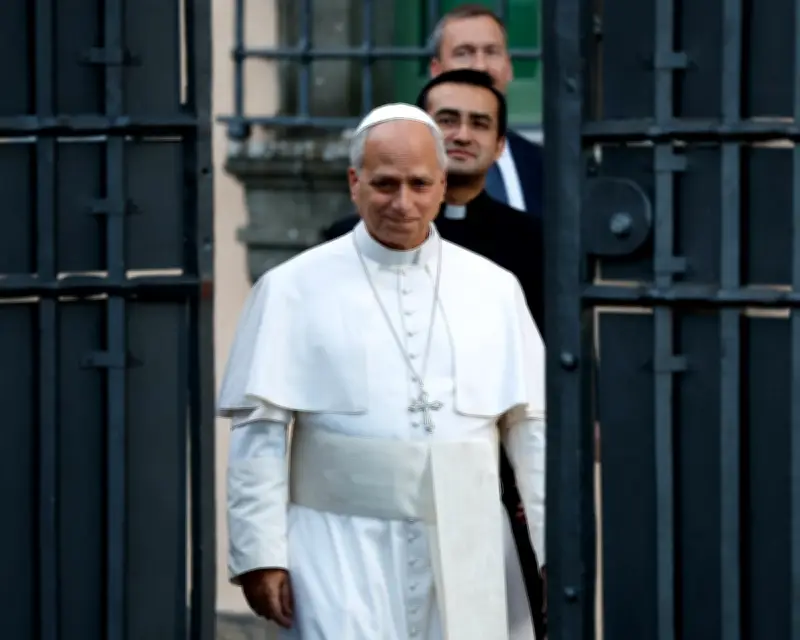
When Pope Leo XIV succeeded Francis, many wondered whether he would continue to advocate for the most vulnerable. To the Trump administration's chagrin, he has. Leo has spoken out against the war on Iran and MAGA's use of religious justifications for it. He has reminded the world that "the people of Gaza are still not receiving humanitarian aid," a fact that most world leaders seem keen to ignore. He has rattled Trump and his supporters so much that the president accused him of being "WEAK on crime," and Fox News's Sean Hannity wondered on-air whether the pope had "even read the Bible."
Now, Leo is becoming a thorn in Silicon Valley's side. On May 25, the pope released his first encyclical, an official statement outlining the church's stance on an important topic. Titled Magnifica Humanity: On Safeguarding the Human Person in the Time of Artificial Intelligence, it warns about the dangers of unregulated AI, noting that "the growing dominance of a technocratic paradigm" risks "reducing creation to an object of exploitation and human beings to mere cogs in a system driven toward ever greater efficiency."
The encyclical is very long (more than 40,000 words) and full of interesting nuggets. But here is one of the sections I think is most crucial:

"The search for truth is an essential element of democracy … When questions about what is true lose their appeal, and a pragmatism takes hold that is content with what appears useful or effective, then democratic life is weakened … Indifference to the truth leads, slowly but surely, to a descent into totalitarianism. As the philosopher Hannah Arendt wrote, the ideal subjects of such regimes are not so much those who are ideologically convinced, but rather 'people for whom the distinction between fact and fiction (i.e., the reality of experience) and the distinction between true and false (i.e., the standards of thought) no longer exist.'"
Social media, which has been used for good as well as evil, should not be blamed for all our woes. But it seems quite clear that the moral rot eating away at the world set in as social media enveloped the planet, turning us all into data points that could be manipulated. A fact is a fragile thing, and in her essay Truth and Politics, Arendt warned that a flood of lies undermines our sense of reality. AI, of course, is already supercharging this – eroding our critical thinking, casting doubt on everything, collapsing the distinction between fact and fiction. This is why the Trump administration loves AI so much: it helps make the rich richer, and the rest of us more compliant.
Leo's note about a dangerous "pragmatism" taking hold is also important. The world seems to be run by the gleefully evil and the pathetically pragmatic. On one hand, you have people like Stephen Miller, Donald Trump, Benjamin Netanyahu: people who revel in cruelty. Then, just as bad, albeit not as brazen, are the people who are just going along with it all, because it is easier that way.
In a January piece in the Wall Street Journal, of all places, former US treasury secretary Robert E. Rubin lamented the fact that business leaders are quiet about Trump's trampling of democracy. "In my experience, many leaders harbor deep concerns about Mr Trump's lawlessness, weaponization of the government, and interference in markets," Rubin wrote. "They refrain from public criticism not because they find nothing to criticize but because they're intimidated."
We are ruled by cretins and cowards. From our universities to our courts, our institutions have not met the present moment with courage. Thank God, then, for the pope. He is still a mere mortal, he is not perfect, but he is proving to be a much-needed force for good. He is speaking truth to a higher power.