‘If an officer can point at them and say they are not press, the First Amendment ceases to have meaning.’ This stark warning comes from Adam Rose, deputy director of advocacy at Freedom of the Press Foundation, in response to recent events at Delaney Hall in Newark, New Jersey.
Police Overreach at Delaney Hall
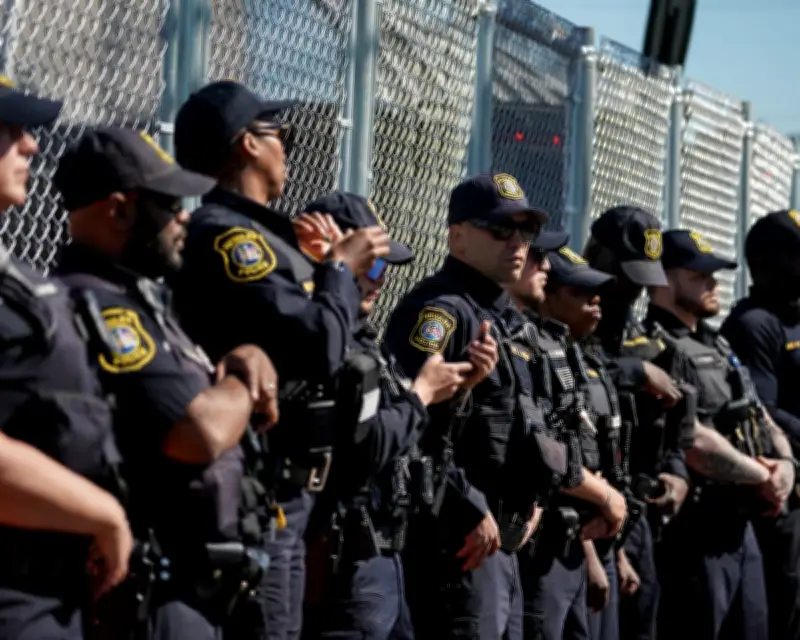
New Jersey state police blocked every exit on a street near Delaney Hall, forming a kettle with clear plastic riot shields. Inside were a few dozen people, including protesters defying a curfew and journalists attempting to document the situation. A helmeted officer parted the shields and barked: ‘If you are press, you got the opportunity right now – and that’s it – to leave. If you don’t leave out here in an orderly fashion, you are coming with us.’ He pointed to someone and snapped: ‘You are not press.’
Who Decides Who Is Press?
Under Newark’s curfew, journalists were exempt if they displayed ‘verified credentials’. But what counts as verified? And who gets to decide? Media workers had descended on Delaney Hall to document an ongoing hunger strike by ICE detainees over dangerous conditions inside. As protests swelled, law enforcement’s response contributed to dangerous conditions outside.

Attacks on Journalists
In one week, the US Press Freedom Tracker documented 30 assaults by officers on journalists near the facility. ICE doused several photographers with pepper spray and beat them with batons. State police yanked a WNBC crew from their vehicle, exposing them to tear gas. Newark PD forced Ali Velshi and his crew beyond sight of the protest while they were live on MSNBC. An independent photographer was allowed access only after submitting to a police pat-down and being driven in the back of a police car.
The Role of Livestreamers
Newsrooms face a difficult calculation whenever police threaten arrests at demonstrations. Editors want the story, but they also want their reporters to make it home safely. Increasingly, the public learns what happens at protests through independent livestreamers. While rarely employed by major outlets, some sell footage to the world’s largest news organizations. Whether they work for a television network or stream on TikTok, they are engaged in journalism.
Constitutional Protections vs. Snap Decisions
On paper, both laws and courts tend to respect that press are exempt from curfews and dispersal orders. They recognize that media require ‘sight and sound access’ to do their job. But on the street, constitutional protections for those livestreamers can boil down to an officer’s snap decision. Near Delaney Hall on Sunday, some of those decisions could be seen inside the kettle on five live video feeds. None came from traditional TV cameras.
Journalists Detained
New Jersey state police quickly released most of the press and ordered them about 100 feet away. They posed no risk of obstruction from that distance, yet Newark police stepped in and ordered them even further down the road. Journalists objected, realizing they would again be denied sight and sound access. Moments before, protesters had chanted ‘press don’t leave,’ hoping someone would bear witness to their arrests. An officer grabbed his radio to report that press wouldn’t go any further. A voice crackled back: ‘If they refuse to move, push them back yourselves.’
Back in the kettle, at least three journalists were stranded. Each would spend a full day in custody while lawyers were denied access to see them. One of the arrested journalists was injured and taken to a hospital. There, he saw two arrested protesters being treated. Without press cameras rolling, it wasn’t immediately clear how or if they were hurt while being detained.
Credentials Not Verified
Before being handcuffed, the other remaining journalist had worn a blue vest emblazoned with the word ‘press’. An ID from his company dangled around his neck. Like the injured journalist, he was a member of the National Press Photographers Association. Officers on the scene told him that his credentials were not verified.

Lack of Clarity on ‘Verified’
Hours earlier, I’d asked the New Jersey governor’s office what ‘verified’ meant. A day later, I asked the Newark mayor’s office. Neither answered. Nationwide, it’s unusual for police departments to issue press passes. Of the few that once offered them, most have long since abandoned the practice. Not that it was ever a good idea for police to pick who gets to cover the police.
The Indicia Approach
Officers do need a way to distinguish press from protesters. As a better alternative, courts increasingly have ruled that law enforcement should look for ‘indicia’ of who is press. This might be a police- or employer-issued ID, but it can also include business cards, letters of assignment, distinctive clothing with ‘press’ labels, or professional-looking equipment. Officials sometimes complain that this makes it harder to be sure who’s a journalist. But the First Amendment wasn’t intended to make an officer’s job easier. And their credibility erodes each time an officer is caught swinging a baton at a camera.
Protecting the Act of Informing the Public
The indicia approach affirms that journalists are not special because a central authority says so. The point of press rights isn’t simply to protect a chosen class of people. It’s to protect the act of informing the public. In the late 1700s, the authors of the Bill of Rights could not have envisioned cable news or wire services. They knew Thomas Paine’s pamphlets and Benjamin Franklin’s twice-weekly newspaper. These were independent publishers using the communications technology of their day to influence public debate. Fast-forward 250 years. Paine and Franklin would be right at home on Substack or YouTube.
If an officer can point at them and say they are not press, the First Amendment ceases to have meaning.