A new survey suggests that European confidence in an American "security guarantee" has hit a historic low. Across 15 countries, only one in 10 people now view the United States as an ally, and majorities in every country doubt that Washington would come to their aid if they were attacked.
Deep European Distrust in the US
The survey, published on Wednesday by the European Council on Foreign Relations (ECFR) thinktank, reveals what the authors describe as "deep European distrust in the US." The findings come before critical G7 and Nato summits in France and Turkey over the coming weeks.
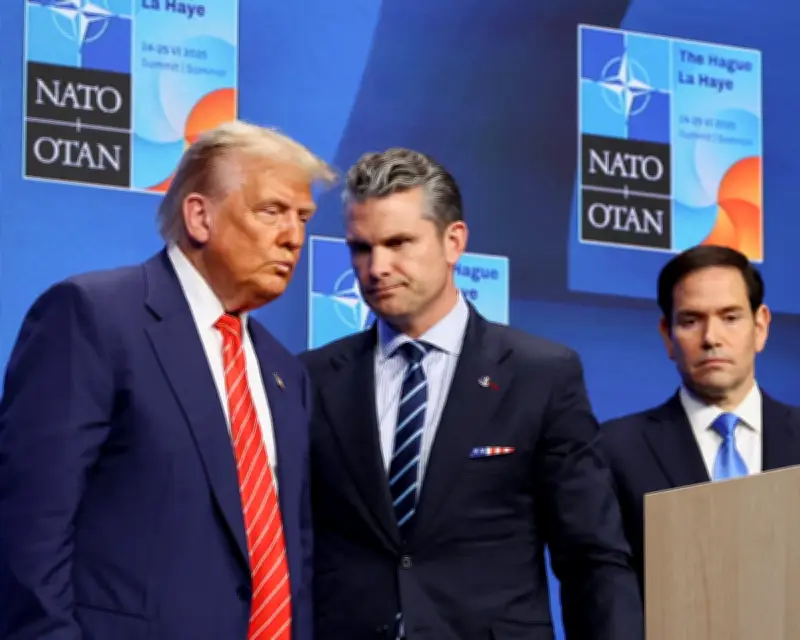
The report also indicates that while many Europeans believe relations with Washington will improve once Donald Trump leaves office, they are increasingly ready to protect themselves against US unreliability by bolstering Europe's defence capabilities.

Growing Pragmatism on European Self-Defence
The US president's Middle East aggression, threats against Greenland, vows to withdraw troops from European bases, and scepticism about the future of Nato have prompted a growing European pragmatism, according to the report. "Across the continent, there's clear support for reducing dependence on Washington," said Jana Kobzová, a co-author and ECFR senior policy fellow. "Europeans are increasingly open to higher defence spending and, crucially, show a striking degree of confidence that neighbouring countries would come to their aid in a crisis."
Paweł Zerka, Kobzová's co-author and also an ECFR senior policy fellow, said the clear public demand for greater self-reliance and the need to hedge against US defence guarantees have "created a window for Europe's leaders to go further and faster" on security.
Survey Results: Trust in US at Record Low
The survey, based on polling conducted in May in Austria, Bulgaria, Denmark, Estonia, France, Germany, Hungary, Italy, the Netherlands, Poland, Portugal, Spain, Sweden, Switzerland, and the UK, shows an average of just 11% of respondents across all countries now view the US as an ally. This is down from 16% six months ago and 22% in November 2024. The prevailing view is that the US is now a "necessary partner," although 13% of the European public say they consider the US a rival and 12% a direct adversary.
Majorities in every country are no longer confident that the US would come to their aid in an attack. Except in Bulgaria, most people—including in countries with large far-right parties such as France, Italy, the Netherlands, and Sweden—believe that "at least some European countries" would help them in a similar scenario.
Support for Higher Defence Spending
Europeans are now on average 4% more likely to support higher national defence spending than last year, the survey finds. Italy is the only country where a clear majority remains opposed. On average, 47% of respondents back the idea of collective EU borrowing to finance greater defence spending, with 35% opposed. Support is strongest in Portugal (59%), Denmark (56%), the Netherlands (55%), and Spain.
In almost every country polled, most respondents say their country should reduce its strategic dependence on US military hardware. Support for "buy European" is highest in Denmark (75%), the Netherlands (72%), Sweden (70%), Portugal (69%), France (66%), Switzerland (64%), the UK, and Spain (both 62%).
Mixed Views on Domestic Spending and Nato
There is markedly less support for cutting domestic public spending to pay for higher national defence budgets, with opposition strongest in Italy (63%), Austria (59%), Germany (56%), Spain (54%), and Denmark (52%). There is also little backing (29%) for replacing Nato with a new EU-only defence body. The dominant view in almost every country except Bulgaria is that US-European relations will "probably get better" once Trump leaves—a view held by 60% or more in France, Spain, Denmark, the Netherlands, and Sweden.
Energy and Ukraine Issues
Despite rising energy costs, 44% of Europeans say it would be a "rather bad" or "very bad" idea to resume importing oil and gas from Russia. However, Ukraine's ambition to join the EU continues to divide European opinion. Respondents in countries including Hungary, Bulgaria, Austria, Germany, and even Estonia—one of Kyiv's staunchest supporters—are more likely to oppose admitting Ukraine "in the current context" than favour it.