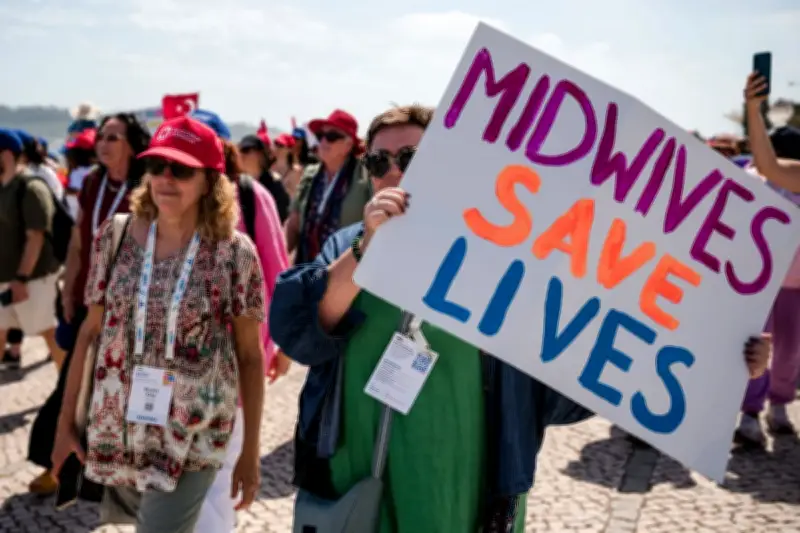
Midwives on the frontline of the childbirth deaths crisis have been denied visas for a key summit, sparking outcry from global midwife leaders who warn that visa rejections threaten progress on mother and baby health.
Visa Denials Block Experts from High-Mortality Countries
Politicians, donors, and UN agencies gathered this week at the International Confederation of Midwives (ICM) congress in Lisbon, Portugal, a crucial conference addressing the millions of preventable mother and baby deaths each year. However, last-minute visa refusals prevented eminent midwives from Africa and Asia—where the majority of these deaths occur—from attending.
Urgent appeals were lodged for delegates from Nigeria, Ghana, Rwanda, Burundi, Uganda, Tunisia, Ethiopia, Sierra Leone, Bangladesh, India, and Indonesia, among others.

ICM advisor Kate Stringer said: “These midwives are leaders working in countries that bear the highest burden of deaths. A mother dies every two minutes due to pregnancy or birth. How are we going to intervene if the researchers and professors at the heart of it are banned? This defies logic. It is a life and death situation, perpetuated by colonial bias.”
Ugandan Midwife Silenced
In Uganda, midwife Harriet Akello runs a lifesaving initiative that has attracted the attention of the World Health Organization (WHO). She was scheduled to speak in Lisbon about how fragmented, high-risk maternity systems can transition to a “midwifery model of care,” where a mother is kept safe by a small team of skilled midwives. Through her work with the NGO Mother Health International, Akello helps overwhelmed public maternity centers adopt WHO standards in a remote post-conflict region near the border with South Sudan, 95km from a referral hospital.
Akello said: “The world’s policymakers are in Lisbon, yet here I am in Uganda, trying to explain to an embassy why I should have the right to travel. I am gutted and insulted. The WHO says we need ‘midwifery models of care.’ I have a rare example of this, but I’ve been silenced.” Having recently traveled to Sweden for work, she added: “I was in a Schengen country in the past year. I didn’t overstay—I have too much to do for mothers in Uganda.”
Other Affected Delegates
Two Bangladeshi midwifery union leaders were denied visas despite a male government official flying to Lisbon to pledge 25,000 additional midwives for the country. Similarly, Dr. Arthur Munkana from the Democratic Republic of the Congo expressed frustration for four midwives who had to stay behind. “Our country is devastated by mothers dying. Good quality midwives are a key solution—yet only I got a visa.”
Stringer called this “gender inequity laid bare.” Alison Perry, a researcher at Imperial College London, said a Ugandan midwife she collaborates with was also excluded. “This represents overt discrimination against equitable participation in international conferences,” she said.
Official Response and Global Context
Portugal’s Ministry of Foreign Affairs stated that visa assessments were conducted “rigorously, objectively and factually” in line with Schengen rules.
Globally, about 260,000 women die every year in childbirth, 1.9 million babies are stillborn, and there are 2.3 million newborn deaths. Approximately 70% of maternal deaths occur in sub-Saharan Africa, with much of the remainder in Asia. The WHO has called on governments—including the UK—to make “midwifery models” a core service. The ICM reports that the world is a million midwives short of safe staffing levels.
At the congress, the ICM also addressed childbirth bleeding, which affects 27 million women annually, kills 43,000, and costs countries over £7bn. New data published in The Lancet identified six critical factors for survival, including accurate, timely diagnosis and access to blood transfusions.