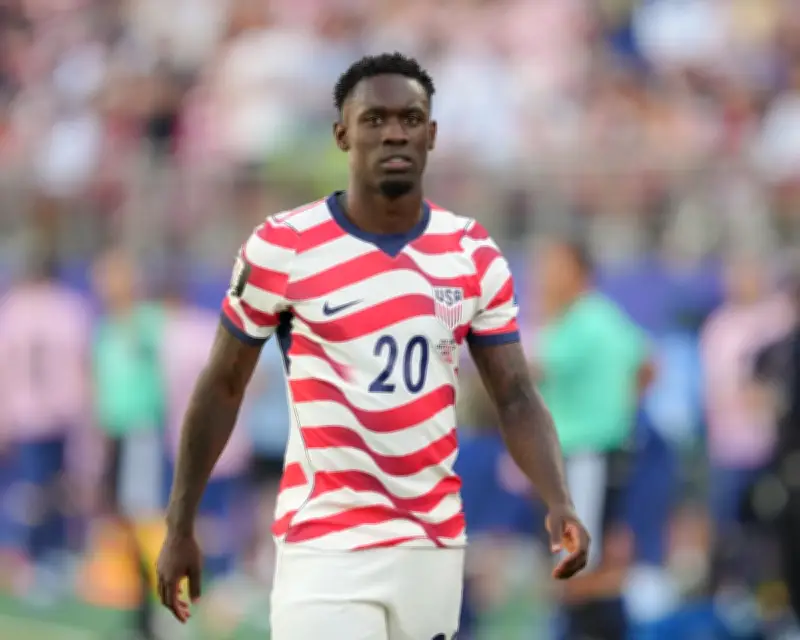
Folarin Balogun is available to play for the USA in Monday's last-16 match against Belgium after Fifa suspended his one-match ban, a decision that followed direct intervention by President Donald Trump. The surprise move, announced on Sunday, rescinded the red card issued to the Monaco striker for a challenge on Bosnia and Herzegovina defender Tarik Muharemovic in the USA's 2-0 victory in the round of 32.
Trump's Role in the Decision
Trump, who had been largely absent from the World Cup spotlight, took to Truth Social to thank Fifa for what he called "reversing a great injustice." Sources told the Guardian that Trump made three calls to Fifa starting from Wednesday to ensure the change was made. The White House has not responded to a request for comment, and Fifa declined to comment. Reports also emerged that the White House World Cup taskforce, chaired by Andrew Giuliani, launched a legal challenge against Balogun's suspension focused on the use of slow-motion replays in VAR decisions.
Details of the Incident
Balogun was sent off after video review by referee Raphael Claus for serious foul play. The Brazilian official initially did not award a free-kick despite being close to the incident, but was prompted by his video assistant to review the tackle. Slow-motion replays showed Balogun's foot landing on Muharemovic's upper ankle. The decision was widely condemned as extremely harsh, with many arguing it did not warrant a straight red card. Fifa initially confirmed a one-match ban, but later invoked Article 27 of its disciplinary code to suspend the suspension.

Fifa's Rationale and Precedent
Article 27 allows Fifa's judicial committee to "fully or partially suspend the implementation of a disciplinary measure," effectively granting veto power over refereeing decisions. This clause was previously used to allow Cristiano Ronaldo to play in Portugal's first two World Cup group games after his initial three-game ban for a red card against the Republic of Ireland was reduced to one match. Ronaldo had been a guest of Trump at the White House the week before his ban was revoked. In 1962, Brazil's Garrincha played in the World Cup final despite a red card in the semi-final.
Belgium's Fury
Belgium made no attempt to disguise their anger. Manager Rudi Garcia was left with little more than 24 hours to prepare his team to face an opponent with a key striker they thought would be suspended. The Royal Belgium Football Association issued a strongly worded statement accusing Fifa of breaking its own rules and leaving open the possibility of legal action. "We are astonished by this decision," the statement read. "This decision is in direct contradiction to the provisions of the World Cup 2026 competition regulations. The automatic nature of such a suspension was also explicitly reaffirmed in World Cup 2026 Circular No 16, which was distributed to all participating member associations on 12 May 2026. The same rule is reiterated at every match coordination meeting before each match and all World Cup 2026 workshop presentations. In order to safeguard the legitimate rights of all participating teams and to protect the fundamental principles of fair play in our sport, both at this World Cup and at future editions of the tournament, the Belgian FA is investigating all potential options."
Broader Implications
The use of Article 27 to overturn a red card based on presidential lobbying raises questions about the integrity of disciplinary processes. If the White House taskforce's legal challenge focused on slow-motion replays is accurate, it could open the floodgates for multiple legal challenges to VAR decisions in future tournaments. The saga is likely to continue, with Belgium exploring all options to contest the decision.