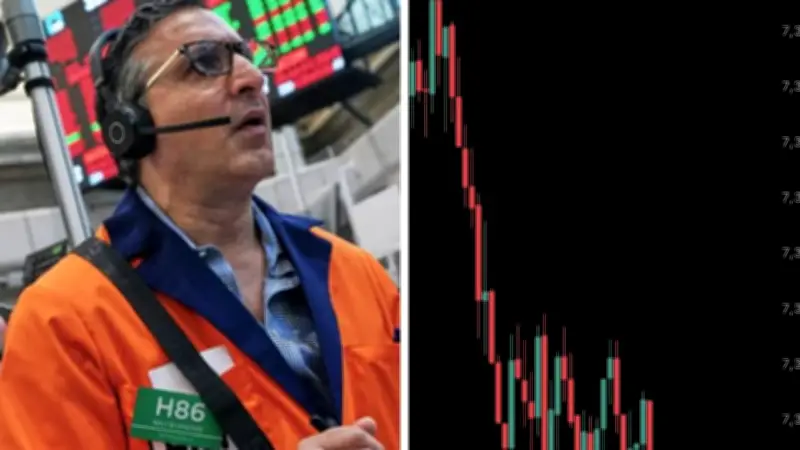
More than $3.3 trillion has been wiped from America’s biggest companies in a devastating nine-day streak that worsened overnight as inflation in the US hit a three-year high.
America’s annual inflation rate was 4.2 per cent in May, up from 3.8 per cent in April and the highest since April 2023.
The US Bureau of Labor Statistics showed prices in the US have been skyrocketing amid the US-Israel war against Iran, which launched in late February.

The conflict has sent energy prices soaring after Tehran retaliated by virtually closing the vital Strait of Hormuz, through which roughly a fifth of global oil and gas normally passes. The figures are concerning because it may mean the Federal Reserve might have to jack up rates later this year following red hot employment data last week. That would be bad, not only for everyday Americans who will have higher inflation and mortgage payments to deal with, but for the giant AI companies that are desperately trying to raise trillions of dollars to fund their expansion.
The stock market, meanwhile, had been on a rough streak since its high on June 2, but it mostly shrugged off the inflation report.
The resilience in early trading overnight did not last long, with all three major indices finishing sharply lower. The S&P 500 slumped 1.62 per cent and the Dow dropped nearly 2 per cent. That means the S&P 500 has erased more than $3.3 trillion since its all-time high on June 2, as investors appear spooked by new developments in the Middle East.
The war appears to be ratcheting up again, as Donald Trump is holding a White House Situation Room to discuss additional possible strikes on Iran, per Axios.
Two American sources reportedly claim that President Trump is considering a large-scale but short-term operation which is aimed at pressuring Iran in negotiations.
The declines reflected “profit-taking in technology after a very strong two-month rally”, said Angelo Kourkafas from Edward Jones. “I don’t think anything fundamental has changed in terms of the artificial intelligence outlook and spending but it’s more so (...) a natural pullback.”
‘I love inflation’: Trump
Asked by reporters if he was concerned by Wednesday’s data, President Trump said “the numbers were great … I love the inflation”. He repeated his prediction that it would “come down like a rock” after the conflict ends. Economists have disputed that claim, with oil prices expected to take months to return to pre-war levels, depending on when hostilities end.
Analyst Stephen Innes noted that the data was not as worrying as it first appears.
While the headline figure jumped, the core reading that excludes energy prices that have surged due to war in the Middle East held steady at 2.9 per cent. “The inflation fire is burning, but it has not yet jumped every fence in the neighbourhood,” he said.
Besides the inflation data, markets digested the latest military back-and-forth between the United States and Iran.
However, the latest developments on the war front dimmed the prospects for a peace deal that could reopen the Strait of Hormuz to oil tanker traffic. This combined with the inflation data is leading to fears rates could go higher sooner than expected.
New Federal Reserve chair Kevin Warsh will preside over his first rate-setting meeting of the central bank’s policymakers next week. Investors see no chance of a rate hike next week, according to the CME FedWatch tool, but that rises to roughly a third in September.
Tech bloodbath
Technology shares led declines across Asian markets as investors weighed lofty valuations and concerns about persistent inflation. European equities mostly followed Asia lower as oil prices climbed about 2 per cent.
“The oil market is trading on hope that a resolution can be found, and on a loosening of oil supply,” said Kathleen Brooks, research director at trading group XTB. She noted that declining onshore Middle Eastern oil inventories suggest “a significant amount” of oil is leaving the Gulf, although exports remain well below pre-war levels as the Strait of Hormuz remains largely blocked. “This supply boost explains why the oil price is not surging on the latest outbreak of fighting in the Gulf,” she said.

Data from the maritime tracking firm Kpler showed on Wednesday that the first Europe-bound oil tanker managed to exit the Gulf at the end of last month.
Soaring costs are a key issue for voters as they head to midterm elections in November, when President Trump’s Republican Party will be aiming to maintain its control of both houses of Congress. Should Democrats retake one or both houses, it will limit President Trump’s ability to bulldoze policies through Congress as he has done throughout his second term.
What the US inflation data showed
May’s consumer inflation data showed energy prices had risen 23.5 per cent over the same time last year, with fuel rising by 40.5 per cent. Grocery prices also rose significantly for the second month in a row, up 2.7 per cent over a year ago.
Other prices to increase over the month included medical care, personal care, airline fares and recreation.
Americans have been dealing with years of higher prices, with inflation continuing to remain elevated long after the pandemic.
Prices have been fuelled by repeated shocks, including the Russian invasion of Ukraine, President Trump’s tariffs and now the war on Iran.
However, analysts said that fuel prices at the pump have recently stabilised, potentially indicating a favourable outlook for overall inflation. “Higher energy prices again pushed up inflation last month, but we estimate that inflation has peaked and will trend lower in the second half of the year,” said Kathy Bostjancic, chief economist at Nationwide. She added that this was assuming there was a “near-term resolution with Iran to reopen the Strait of Hormuz”.
Core CPI inflation, which excludes volatile food and energy prices, came in at 2.9 per cent in May, up from 2.8 per cent the month before. “For now, there appears to be little passthrough of higher energy cost onto core inflation, outside of airfare,” said Gregory Daco, chief economist at EY-Parthenon.
‘No position to cut rates’
The US Federal Reserve has a long-term 2 per cent target for inflation, and the central bank’s key interest rate-setting committee will meet next week. It will be new chairman Kevin Warsh’s first meeting since taking office last month, and he will be under pressure from President Trump to reduce interest rates. Markets, however, expect the Fed to keep rates steady at this meeting, and are now pricing in rate hikes for later in the year, spooking equity investors.
Before the war, markets had priced in rate cuts for later in the year, with expectations that inflation fuelled by President Trump’s tariff policy would begin to fade. The war, however, has complicated the outlook, with more Fed policymakers saying they were concerned about rising inflation, which the central bank would typically address by raising rates. The Fed’s preferred inflation gauge, the Personal Consumption Expenditures (PCE) prices index, also hit a three-year high in its last reading.
“The Fed will be in no position to cut rates if this continues,” said Chris Zaccarelli, chief investment officer for Northlight Asset Management.
Here in Australia, ASX 200 futures are down 65 points, or 0.8 per cent to 8601.