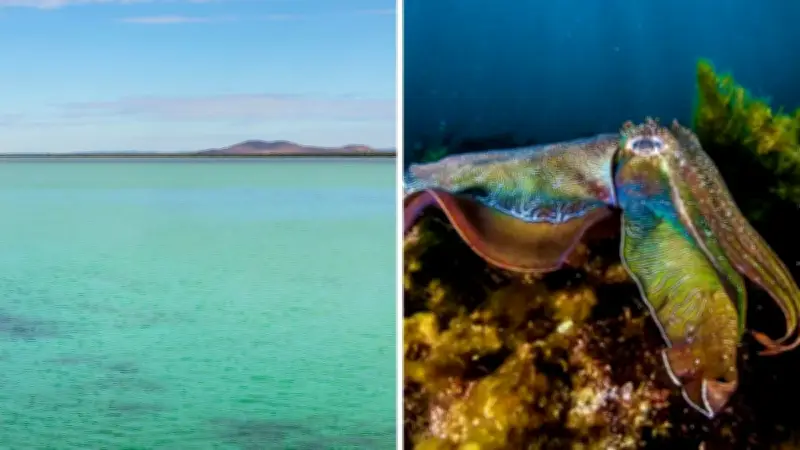
The South Australian government has announced a sweeping three-month closure of a popular coastline to protect the endangered giant Australian cuttlefish after a dramatic population collapse. The exclusion zone extends from Black Point to Stony Point in the upper Spencer Gulf, the only known breeding ground for the species. Beginning Wednesday, all in-water recreational activities—including swimming, snorkelling, diving, vessel anchoring, and tour operations—will be banned within the sanctuary zone.
Emergency Closure Amid Record Low Numbers
Environment and Tourism Minister Emily Bourke said the emergency measure was triggered by survey results showing “significantly low” numbers. Divers reported only occasional cuttlefish in areas usually teeming with males competing for mates. “Safeguarding these amazing creatures is critical,” Bourke said. “This temporary closure gives them the best chance to breed and thrive at a time when numbers are considerably lower than previous years.”
Last year’s official count recorded approximately 64,000 giant cuttlefish off Whyalla. This season, fewer than 50 have been observed. The species gathers in the upper Spencer Gulf each winter to breed, making the site vital for their survival.

Impact on Tourism and Local Businesses
Tourism operator Matt Waller has ended his tour season early due to the cuttlefish decline. “At the end of the day, we run a business, and we run the risk when we work with the environment; we have good years and bad years,” he told 891 ABC Adelaide. “We take onboard those losses because we think it’s important. It’s difficult, not everyone agrees on the whole process, but everyone does unanimously agree these cuttlefish need to be protected.”
Tour operators can still run trips at Point Lowly, outside the restricted area. The government has also made its algal bloom small-business support grant available to affected operators. Whyalla Mayor Phill Stone acknowledged the disappointment but backed the closure. “If there’s a major issue, they need protection. They need us to stay away from them,” he said. “Everyone has to roll with the punches — we can’t argue with nature.”
Heavy Penalties for Breaches
Authorities have warned that breaches of the exclusion zone could result in penalties ranging from warnings to fines of up to $100,000. The government says the ban may be lifted early if cuttlefish numbers recover.
Environmental Factors Behind the Collapse
Marine scientists point to several environmental factors that may have caused the population crash, including warmer water, reduced food availability, and a severe algal bloom that spread across northern gulf waters during December and January. The bloom, which began in March 2025, is one of the longest-running and most destructive ever recorded in South Australia. Over the past year, thick green water repeatedly blanketed large sections of the northern gulf, triggering an estimated 600,000 fish deaths and causing dead fish to wash ashore. Experts told 7NEWS that warm conditions and nutrient-rich water allowed algae to multiply rapidly and persist far longer than typical seasonal events.
Scientific Response and Hope for Recovery
Professor Mike Steer from the South Australian Research and Development Institute (SARDI) described the situation as alarming. “The divers came back last week — we’ve seen significantly reduced numbers, in fact just the odd cuttlefish here and there,” he said. Steer said protecting eggs and hatchlings is now the priority. “What we want to do is encourage the small amount of spawning that’s happening. The best thing we can do is leave them undisturbed.”
Despite the grim start, scientists note that the species has bounced back before. After a dramatic crash in 2013, the cuttlefish population recovered within three years. The current closure aims to replicate that recovery by minimizing human disturbance during the critical breeding period.