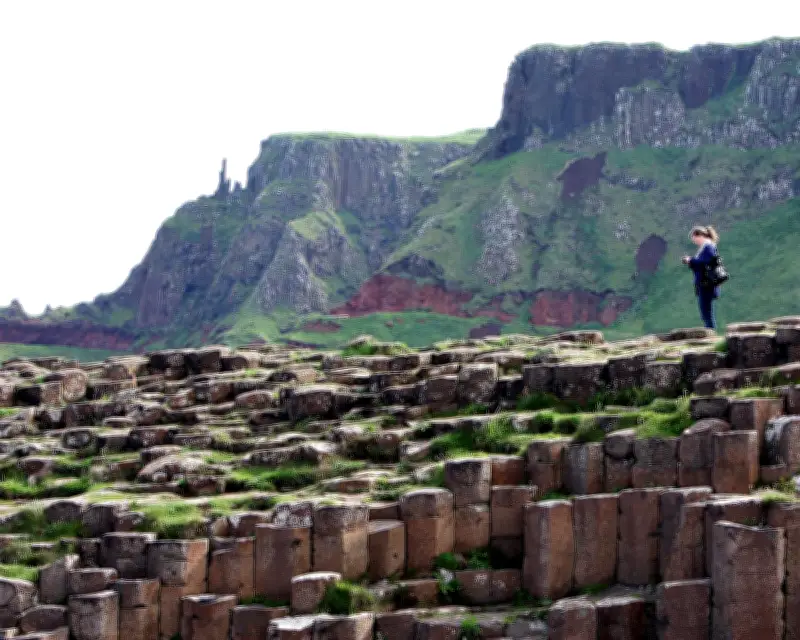
For centuries, the tale has been passed down through generations: how the Irish giant Finn McCool built the Giant's Causeway in Northern Ireland to battle his Scottish rival, Benandonner, by hurling chunks of the Antrim coastline into the sea. Now, scientists have revealed that intense volcanic activity during a "major globally impacting volcanic event" — not a legendary battle — led to the formation of the coastline's 40,000 distinctive interlocking basalt columns about 60 million years ago.
New Timeline for Volcanic Activity
Geochronologists investigating the creation of the Giant's Causeway have discovered it formed over 5.5 million years — 8 million years less than previously estimated. They also found that the processes forming the Causeway were linked to a globally significant volcanic event recorded in rocks as far away as Greenland. For the first time, researchers definitively connected the first lava flows on the Northern Irish plateau to the same volcanic activity that formed the giant basalt columns in Fingal's Cave on the Scottish Hebridean island of Staffa — rocks previously thought to have formed millions of years after the Causeway.
Global Geological Context
Rock formations on the nearby Mourne mountain range and on the Hebridean isle of Rùm, as well as magmatic activity on Skye, can also be linked to this volcanic activity. This places the formation of the Giant's Causeway within a more precise global geological context for the first time, enabling scientists to create a new timeline for volcanic activity across Northern Ireland.

Dr Simon Tapster, a geochronologist at the British Geological Survey (BGS), said: "Fundamentally, what we've done is by piecing together this tapestry of volcanic rocks all across the North Atlantic, but focusing on Northern Ireland, we have been able to reassess a major globally impacting volcanic event. In doing that, and in reassessing the timescales, we have shown that actually it occurred in a much shorter duration."
The Legend vs. Science
The Giant's Causeway is a Unesco World Heritage site and has been named one of the greatest natural wonders of the UK. According to Irish folklore, Finn McCool created the causeway to cross to Scotland to confront Benandonner, who was threatening his homeland. However, when he saw the Scot was a much larger and more impressive giant, he retreated back to Ireland, chased by his rival. Legend has it that Finn's quick-thinking wife, Oonagh, disguised Finn as a giant baby, scaring Benandonner into believing the infant's father would be large enough to beat him. The Scottish giant rushed back across the causeway, destroying as much of it as he could on his way.
Although visitors may prefer to believe the legend, scientists have shown the Causeway formed when thick molten rock rose through cracks in the Earth's crust. As the lava cooled and contracted, stress and tension built up, forcing the rock to fracture into mostly hexagonal columns, though some have four, five, seven, or more sides.
Broader Research Implications
Tapster's research is part of a wider BGS initiative to improve understanding of UK geology by better quantifying geological time in the rocks around us. He said: "By looking at the timescales and the high-resolution timeline, we're able to match it up with various other locations, particularly in the Inner Hebrides in Scotland, the volcanics of Mull, Rum, the Isle of Skye, and taking a bigger view, looking at Greenland and the Faroe Islands."