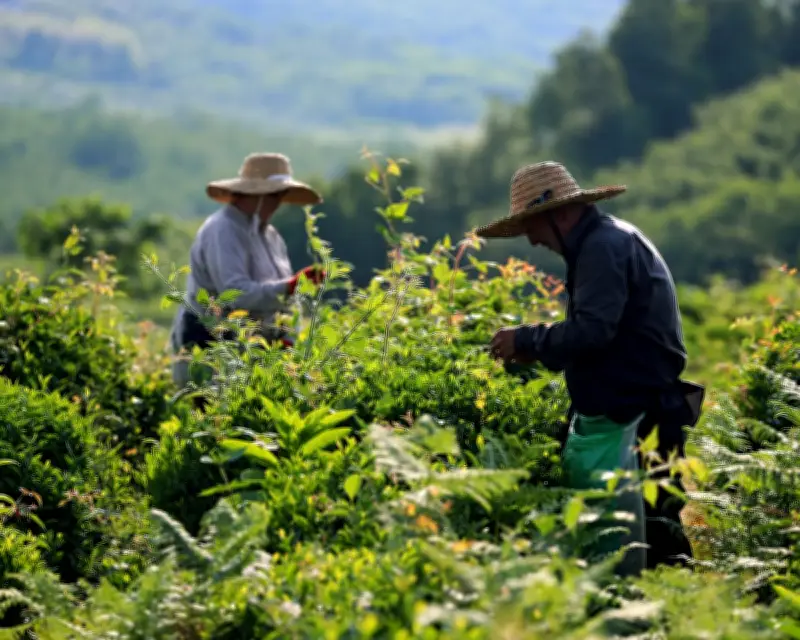
Rainclouds shroud the Caucasus mountains as the day's harvest begins on a rural estate in western Georgia. A tea picker moves quickly between bushes with confidence, her hands plucking only the greenest, most recent growth on each plant.
When Pati began picking tea leaves as a teenager this was a collective farm in the Soviet Union – following its collapse it was abandoned and the bushes swallowed by the surrounding forest until new growers began cutting them free in the 2010s.
From Soviet Volume to Modern Quality
Today those leaves are in high demand as luxury tea importers across Europe and the US discover what the Soviets already knew: Georgia's humid Black Sea air and cold Caucasus winters make it an ideal location to grow tea, but now with a focus on quality above Soviet-era volume.

“These plants are obviously very happy where they are because it just tastes incredible,” said Ana Dane of the New York-based In Pursuit of Tea, the supplier to Michelin three-star restaurant Eleven Madison Park. “They were just exquisitely-produced teas,” she said, describing her first taste of teas from Renegade Tea Estate, a farm based in Georgia's Imereti region.
Ideal Growing Conditions
Its subtropical coast makes Georgia one of the northernmost places in the world where tea will grow. Its cold mountain winters force the bushes into a seven-month dormancy that serves to boost its polyphenol content, producing a noticeably sweeter leaf. The winters also kill off pests, allowing Georgian growers to easily commit to organic standards.
Georgia's tea renaissance was boosted also by the EU, which poured money into the industry in the hope of revitalising its economy. That stalled when the Kremlin-leaning Georgian Dream party withdrew from accession talks, but Georgian growers are still making significant inroads.
Historical Roots
Tea may have been carried along the Silk Road to Georgia but the first recorded instance of cultivation was in the early 1800s, when a Georgian prince began planting bushes outside today's city of Ozurgeti. The Russian empire then looked to Georgia when it wanted a steady tea supply and later Soviet collectivisation designated the Guria region, the USSR's centre of its production. By the 1980s, it was the fifth-largest tea producing country in the world.
It is an era remembered by Lika Megreladze, who as a girl growing up in the 1970s, would sometimes visit her mother at work at the Institute of Tea and Subtropical Cultures, taking a winding 8km path from her multi-generational family home through the lush Gurian forest. “All big empires, they really want to have their own tea,” she says. “The Russian Empire really wanted to have their own tea. And every empire starts to grow tea and cultivate tea in different parts, like Portugal, the British in India, Sri Lanka, like the French in Indonesia or Vietnam.”
Post-Soviet Revival
When the Soviet Union collapsed, so too did Georgia's tea industry amid wider economic troubles. Its revival was spurred by a young engineer in Tbilisi, Shota Bitadze, who imported Chinese herbs during a medicine shortage in his hometown and then turned to tea, first as a trader but then wondering if tea could once again be grown in Georgia.
“We had situations where people had tea bushes in their garden, but they didn't know how to make tea with their hands,” said Giorgi Bitadze, Shota's son. In 2006, the Bitadzes sought to change that – founding the Georgian Organic Tea Producers Association alongside 16 other families committed to growing high-quality tea, and opening the Bitadze Tea Museum in Tbilisi.
Growth and Export Challenges
From 800 hectares of active tea production in 2014 that number rose to 1,900 hectares in 2019 with a government programme to finance up to 70%-90% of costs to rehabilitate abandoned Soviet-era tea plantations.
While tea drinkers in Ukraine, Poland, Belarus and other countries once part of the Soviet bloc have been quick to purchase tea through the Bitadze's organic association, “getting past the Iron Curtain is a struggle,” said Timothy Merkel, an American tour guide living in Tbilisi who created the Georgian Tea Makers website and previously ran a company aiming to sell Georgian tea in the UK.

Yet, a growing number of Georgian growers are managing it. In Paris, specialty tea shop, Palais des Thés, extols its “exceptional” Georgian tea lines and has increased the amount of tea it orders from Georgia 12-fold since 2019. In New York City, the fine tea importer Royal Cathay has joined In Pursuit of Tea in stocking leaves from Georgian growers.
Innovation and New Markets
“The first step and first thing when we started the business was not to export to Russia,” said Nika Sioridze, who co-founded growers GreenGold with his childhood friend Baka Babunashvili in 2017. “It's not a stable market.”
From the moment Sioridze and Babunashvili began clearing the 25 hectares of former tea plantations their aim was to experiment and to find something for a new generation of tea drinkers. They renovated a Soviet-era silk factory to process tea leaves, began fermenting tea in the clay qvevri traditionally used for wine, courted a contract with a seller on Amazon and opened a tasting room in Tbilisi.
Through experimentation, the pair developed new teas that spoke to the cycle of death and rebirth that has long followed the Georgian tea industry. In one case, while drying leaves for green tea, Sioridze recalled seeing smoke and worrying he had burnt the leaves. “And then we realised that we have not burnt the tea, we have roasted it,” he said, speaking of the Phoenix tea in GreenGold's catalog. “I'm burning it and it's alive again, a new life.”