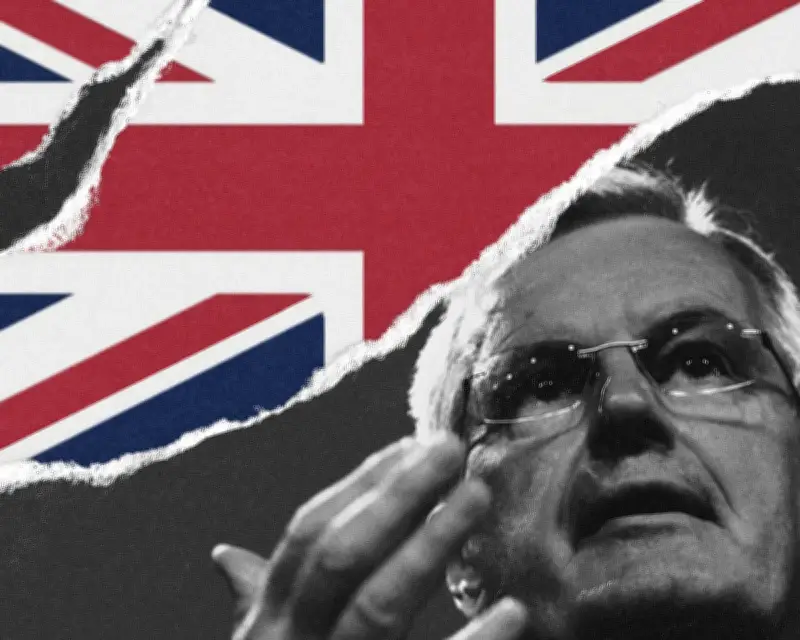
Michel Barnier, the European Union's former chief Brexit negotiator, has suggested that a future British government could rejoin the bloc while retaining many of the special terms it previously enjoyed, including opt-outs from the euro and the Schengen free-travel zone. In an interview, Barnier also described Boris Johnson's motivation for backing Brexit as "cynical" and aimed at gaining power.
Barnier's Weekend with Stanley Johnson
Barnier recalled spending a weekend with Boris Johnson's father, Stanley, at a French chateau owned by a mutual friend. The two discussed the former prime minister's reasons for supporting Brexit. "It was interesting. Boris was much more European at the beginning. Even if he was critical. I don't see it as a motivation but it is, perhaps, a method or attitude: to be pragmatic in some way. Cynical. Cynical to get power," Barnier said.
Brexit Negotiations and Aftermath
Barnier, who now represents a Paris constituency in the National Assembly, led the EU's negotiating team after the 2016 Brexit referendum. He navigated four years of fraught talks with a series of British counterparts, including David Davis, Dominic Raab, Steve Barclay, and David Frost. He also met with Tony Blair and Nigel Farage during that period.

Barnier dismissed the idea that the UK's problems are solely due to Brexit but argued that "all these problems are more difficult because of Brexit." He criticized the "great lie" that everything was Brussels' fault and noted that Nigel Farage "has no longer the capacity to say the fault is in Brussels."
UK Rejoining the EU
On the possibility of the UK rejoining the EU, Barnier said it is "perfectly possible" for Britain to regain its previous special status, including opt-outs from the euro and Schengen. However, he was less definitive about the budget rebate secured by Margaret Thatcher, noting that "the DNA of the EU is solidarity."
When asked if the UK will rejoin in his lifetime, the 75-year-old Barnier said, "I think day after day the British people will see in the current world that it is more dangerous, more fragile, more unstable, that we cannot be alone. It is true for France, it is true for Germany, it is true for everyone. Every day it will be more clear."
Warnings Against Far-Right Exploitation
Barnier warned against allowing far-right leaders like Marine Le Pen or Jordan Bardella in France, or Matteo Salvini in Italy, to use the UK's special treatment as a precedent. "We can never give any kind of argument for Mrs Le Pen or Mr Bardella or Mr Salvini to ask for the same treatment: 'Look at the UK, they have no consequence, they pay nothing, they are cherrypicking.' Never, never. At that moment it is the end of the EU – and Mr Farage wins," he said.
Defence Cooperation and New Proposals
Barnier is working to create a European Council for Defence and Security, which would include the UK, Ukraine, Norway, and EU members. The body would enable joint borrowing for military projects and initiatives in artificial intelligence and other disruptive technologies. He recalled a dinner where Boris Johnson threatened to walk away from a trade deal but offered defence cooperation, only to be reminded that Johnson himself had ruled out such cooperation.
Reflections on the EU and Brexit
Barnier acknowledged the EU's historical "mistakes," including excessive bureaucracy and failure to secure external borders. He praised new EU policies on migrant screenings and deportations but noted that the UK was complicit in earlier failures. "I still don't understand why the UK, which always had a very strong influence, left rather than use its influence to correct the EU – it is for me incomprehensible," he said.
Barnier, who served as France's prime minister for three months in 2024, expressed sympathy for Theresa May's parliamentary struggles. He is now focused on campaigning and hoping to be "useful" in the future.