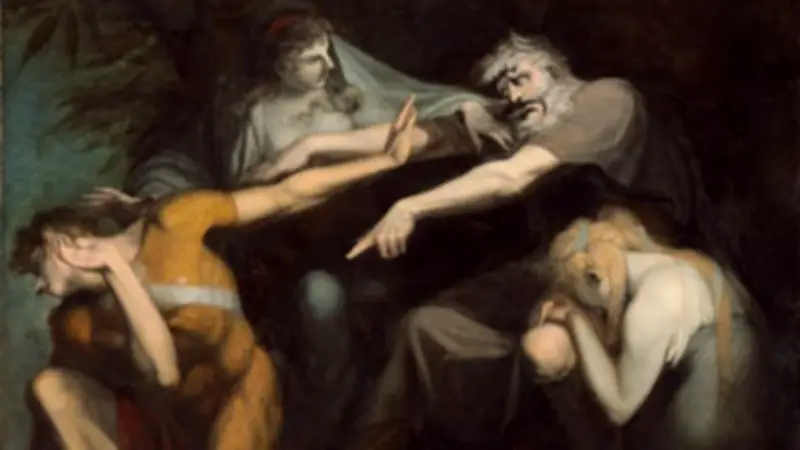
Oedipus cursing his son Polynices – Henry Fuseli (1786) Public domain, via Wikimedia Commons Generational conflict has been around forever – just ask the ancients. Published: June 25, 2026 5.44am AEST
The Ancient View of Generations
“It is the law of human life and of human nature that a new generation is ever coming forth,” said the Roman statesman Cicero (106–43 BCE). His view was echoed by the poet Simonides of Ceos (6th to 5th century BCE): “As is the generation of leaves, so is that of men.” The metaphor was a simple one. One day we are full of life, green and fresh, but soon we start to wither and die. Fresh leaves take our place, but they too will fall, only to be replaced by new leaves in their turn. In the ancient world, there were many different views about the relationship between younger and older generations. Greek and Roman texts reveal that, just like today, generational conflict was rife. At the same time, however, ancient texts also suggest ways the young and old can profitably get along – a message that is perhaps needed for our times.
Causes of Generational Conflict
In ancient times, there were many causes of generational conflict. One was that the old sensed things were changing in ways contrary to their hopes and wishes. The Roman comic playwright Caecilius (219–168 BCE) described the feelings of an old man watching and reflecting on the new generations coming up. In a play (whose title is unknown), the old man is exasperated and frustrated, and decides to complain: “Old Age, if you bring no other defects with you, when you come, this one’s enough: by living long a man sees much he doesn’t want to.” Another source of conflict was that the young felt society had been ruined by the previous generation. For this reason, the young had little hope of making a way within that society for themselves. The Roman poet Horace (65–8 BCE), for example, criticised his parents’ generation with these harsh words: “Our fathers’ age, worse than our grandfathers’, gave birth to us, an inferior breed, who will in due course produce still more degenerate offspring.”

Different Character Types?
The most extensive ancient attempt to explain the causes of generational conflict is supplied by Aristotle (384–322 BCE). According to Aristotle, conflicts between young and old can partly be attributed to the different characters people have when they are young and old. The young, Aristotle tells us, are lustful, changeable in their desires, passionate, hot-tempered, impulsive, ambitious, simple-natured, hot-blooded and inexperienced. “All their errors are due to excess and vehemence,” he argued: “they think they know everything, and confidently affirm it, and this is the cause of their excess in everything. If they do wrong it is due to insolence not wickedness.” The young, said Aristotle, are “fond of laughter, and therefore witty; for wit is cultured insolence.” The old, on the other hand, are positive about nothing. They are, according to Aristotle, lacking in energy, hesitant about everything, maliciously negative-minded, selfish and excessively suspicious. “They are not generous,” he claimed, “for property is one of these necessaries, and at the same time, they know from experience how hard it is to get and how easy to lose.” Moreover, they are “cowardly and inclined to anticipate evil.” Old people live in memory rather than in hope; for the life that remains to them is short, but what is past is long, and hope belongs to the future, memory to the past […] they are incessantly talking of the past, because they take pleasure in recollection. Aristotle thinks this conflict of character is at least partially responsible for some generational conflict within society. But balance is afforded by the middle-aged, whose characters “preserve the due mean” between the young and the old. To be middle-aged is to combine “all the advantages that youth and old age possess separately”; excesses and defects are replaced with “due moderation and fitness.”

What Do the Young Owe the Old?
In ancient Greek and Roman society, the traditional expectation was reverence toward one’s parents and elders. As early as the 6th century BCE in Greece, care for elder relatives was enshrined in law. Mistreatment of parents, which included failure to feed and house one’s mother and father, had strict penalties and often resulted in jail time. Among the Romans, fathers had complete legal control over their sons and daughters, through the power of patria potestas. This included the right to inflict capital punishment on children. This power only ceased on the father’s death or when a daughter was married. A prominent source of generational conflict was the feeling, among older generations, that young people no longer showed older people any respect. This point is brought up by the Greek comic playwright Aristophanes (450–380 BCE). In his play Clouds, one of the characters gives a list of things young people do that irritate older people, including failing to offer their seats to elders and behaving rudely towards their parents.
What Do the Old Owe the Young?
For the ancient Greeks and Romans, one of the expectations people had about older members of the population, who controlled the majority of the wealth and had the most political influence, is that they would maintain social stability by making sensible political decisions and enacting sensible laws. Generational conflict increased in times when older generations failed to manage political affairs well. During the turmoil of the Peloponnesian War (431–404 BCE) between Athens and Sparta, which ended in Athens’ disastrous defeat, the younger generations of Athenians became increasingly disobedient towards the older generations. This was largely because of a sense that political affairs had been mismanaged. The Greek philosopher Thrasymachus of Chalcedon (late 5th century BCE), gave an oration in which he criticised older generations for their failures of governance, implying this was the main reason why young people were starting to dissent. At a time when “we must obey others as rulers but must suffer the consequences ourselves”, he argued, it becomes necessary for the young to speak up.
Mitigating Generational Conflict
Mitigating generational conflict is not an easy thing to do, but the Greeks and Romans did have a suggestion about how to achieve some kind of generational harmony. Their advice was to focus on reason and rational debate. People should use reason to determine collectively what is good and best for all, and people of all generations should be encouraged to put reason and the common good above their personal interests. As the Greek orator Isocrates (436–338 BCE) said in his oration Archidamus, older people do not always know what is best and younger people are not always wrong. Thus decisions needed to be based on shared deliberation and the use of reason, as “it is not by the number of our years that we differ in wisdom from one another, but by our natural endowments and by our cultivation of them.” Idealistic words, but ones worth remembering in our own time of fractured generational relations. After all, the young will eventually become the old, at which point they too will complain that the world is going downhill, that nobody listens anymore, and that the next generation has forgotten the basic rules of civilisation – such as giving up one’s seat, not talking back, and not spending so much time on whatever alarming new technology replaces TikTok. Clearly, the ancient evidence does not offer a simple solution to generational conflict.