Every time you think the idiocy has hit rock bottom, it discovers a new level. It turns out there’s an even deeper hole you can dig for yourself than climate-science denial: heat-stress denial. Across the billionaire press last week, columnists and leader writers minimised the health impacts of the heatwave, particularly in schools. Expect more of this next week, when temperatures are forecast to soar again.
Telegraph Editorial: 'Hot Weather Alarmism Treats the Public Like Children'
An editorial in the Telegraph (which represents the newspaper’s view) titled “Hot weather alarmism treats the public like children” maintained that “unlike in the seventies, when people were largely trusted to look after themselves, officialdom now feels the need to lecture the public about the risks of hot weather at every opportunity”. Extreme heat warnings are issued and weather maps are “painted in an alarming red”. Outrageous! Instead of issuing warnings, the government should just trust people to “take the appropriate precautions”. We should all “learn to live” with it. Quite right too: whatever happened to the bulldog spirit of ignorance and needless death? Cricket, warm beer, excess mortality: these are the markers of national character.
Columnists Nostalgic for 1976
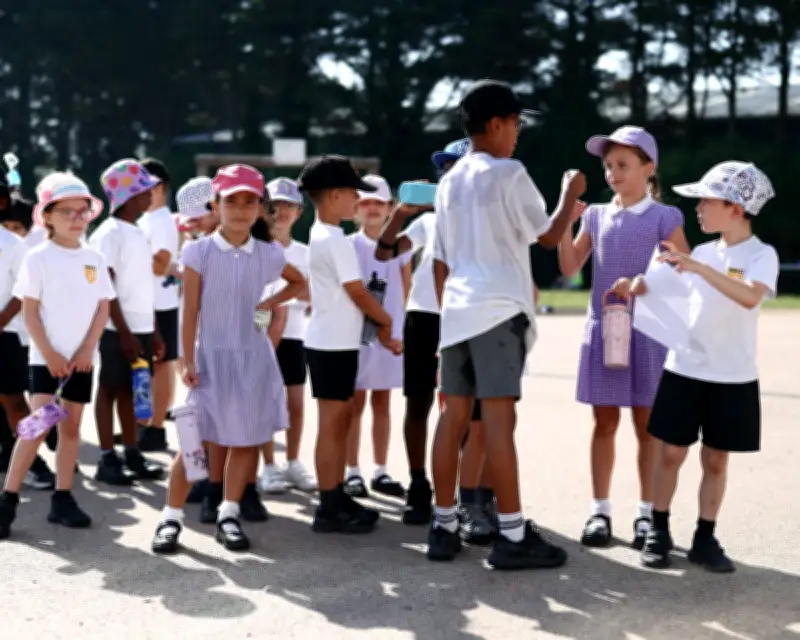
Also in the Telegraph, under the headline “Heatwave hysterics wouldn’t have lasted a day in 1976”, the columnist Ysenda Maxtone Graham insisted that during the heatwave that year – which she remembers as “two months of blissful messing about” – “common sense was applied by most without the need for nannying intervention”. Now, however, “health messages range from the patronising – tube announcements imploring travellers to carry a bottle of water – to the preposterous, as if a healthy adult is liable to drop dead from a little bit of sun exposure”. Never mind the unhealthy adults. Or disabled people, or elderly people, or children, all of whom are likely to be more vulnerable. She claimed that in 1976, “schools didn’t close because of the heat”, and that children and teachers heroically “sweltered in 30-degree classrooms”.

Maxtone Graham’s column was remarkably similar to Jane Moore’s in the Sun, titled: “Why on earth do schools need to CLOSE in hot weather? Forget today’s nannying, alarmist state – let’s go back to ’76.” Moore remembers 1976 as “the best summer of my life”. Apparently there was a “gung-ho spirit” that “should be used as a standard benchmark for common sense”.
The Daily Mail ran an article whose subheading claimed “in 1976 … the schools DID stay open”. In fact, as Leo Hickman of Carbon Brief points out, schools DID at least close early during the 1976 heatwave, even though June temperatures never reached the records set last week. And in 1976 the heat was dry, whereas last week humidity was high, compounding the health risks. But as soon as such a hole is dug, the entire rightwing media seems obliged to jump into it. It’s often said that the left preaches solidarity and fights like cats in a sack. But the right preaches individualism while reciting daft and unevidenced claims in unison.
Evidence Shows Warnings Save Lives
There is a powerful body of evidence showing that warnings and advice save lives. The Red Cross discovered in 2023 that there’s a strikingly poor understanding of the health risks of heatwaves in the UK, where they used to be rare. A survey reported in the journal Energy Research & Social Science last year found that 49% of participants had “little to no knowledge on how to cope with extreme heat”. Nevertheless, government warnings, doubtless to the delight of the Telegraph, remain vague, hard to interpret and unsupported by effective action. Let the bodies pile high.
Class Politics of Extreme Heat
Fondly recalling the halcyon days of your youth is never a great basis for empirical comparison. But what accentuates this issue are the unacknowledged class politics. There’s nothing new about feather-bedded columnists in nice homes in leafy streets or air-conditioned offices instructing other people to tough it out. But the class disparity in heat shielding is especially acute in Britain, where homes and public buildings are woefully unsuited to extremes.

The paper I mentioned above also found that 82% of households reported difficulty in keeping at least one room cool during the summer. The rate of overheating for the poorest half “was twice that of householders in the top half of higher-income earners”. Many other studies have produced similar findings. Steady temperatures are the preserve of the rich.
Children Most Vulnerable
Extreme heat hits children – who have higher metabolisms and lower sweating rates – harder than most adults. Their thermal comfort levels are, on average, 1.9-2.8C lower. There are many reports of children vomiting and losing consciousness in class during heatwaves. Temperatures above 25C limit their cognitive performance. The government’s Climate Change Committee finds that “taking an exam on a 32C day leads to around a 10% lower likelihood of passing compared to a 22C day”. Yet another advantage for private schools, which can generally afford better buildings and air-conditioned exam rooms.
But, as the government confirms to me, it sets no maximum temperature limit for schools. Otherwise it might have to do something. Instead, it advises schools to open and close doors and windows and minimise heat from equipment: advice that leaves teachers with sealed windows and impossible heat loads in despair.
Study: Two-Thirds of Classrooms Present Cognitive Impairment Risk
A new study of schools in Hampshire finds that 66% of classrooms present a “cognitive impairment risk”. If action isn’t taken, this will rise to 92% by 2050. Already, “heat strain” – physiologically dangerous temperature levels – afflicts 6% of classrooms. Many school buildings, especially the “lightweight, overglazed, single-sided” models favoured from the 1950s onwards, are grossly ill-suited to hot summers.
Thanks to years of austerity, many classrooms are in a terrible state. School buildings that should have been replaced decades ago are still in use. It is unlikely to have escaped the Conservative architects of the programme that declining public provision further privileges their class. No wonder they fetishised competition, which they so blatantly rigged in their favour.
So now, as ever, the rich lecture the poor, and demand the removal of the feeble protections that might enhance and defend their lives. Their claim that “we need to be tough” seems always to translate into “they need to be tough”, while our lives become only cushier. Performative ignorance is the default state of such journalism. But I can’t help wondering whether there’s also an element of gleeful, snobbish cruelty: I’m all right, so let the great unwashed get what they deserve. George Monbiot is a Guardian columnist.