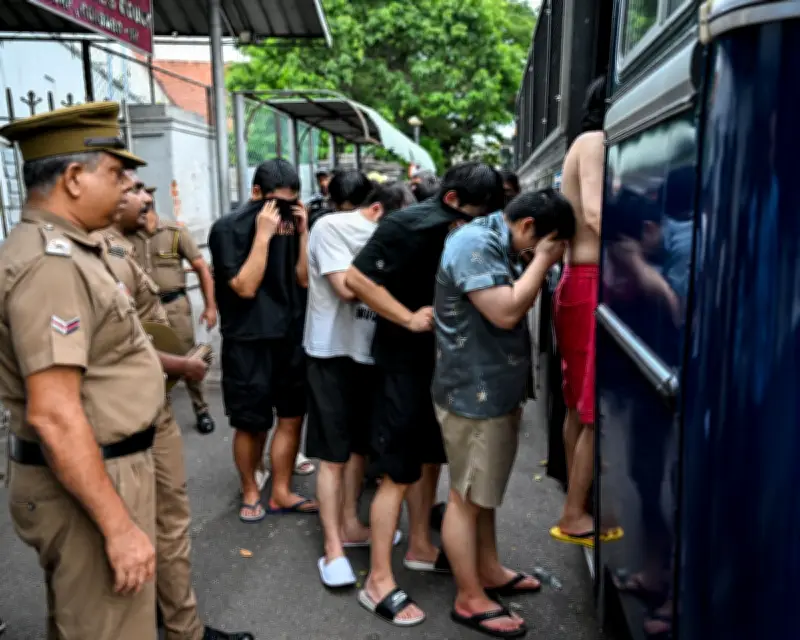
Experts have warned that Sri Lanka is emerging as a hub for transnational cybercrime, following a crackdown in Southeast Asia that pushed Chinese-run criminal networks to relocate their vast scam operations. Sri Lankan police spokesperson Fredrick Wootler stated that the country is witnessing an "alarming increase of cybercrimes" perpetrated by individuals entering as tourists and then illegally setting up scam operations targeting people worldwide.
Raids and Arrests
Since the beginning of the year, authorities in Sri Lanka have conducted more than a dozen raids on alleged scam operations, arresting and deporting nearly 700 foreigners accused of involvement. On Thursday, the Sri Lankan police carried out its latest raid in the capital Colombo, detaining 18 Chinese citizens and one from Laos. The Guardian visited the raid site and found dozens of fake documents left behind, including falsified legal certifications, fake US Treasury documents, and fake company registrations claiming a company worth $10 billion.
An officer from the crime investigation bureau who conducted the raid, speaking on condition of anonymity, said they also discovered 62 passports, mostly for Chinese nationals. "They had phones, laptops, pen drives, RAMs, a processor, a stamp to forge documents, and so many forged documents. One certificate, which we found was also forged to show that they were a business registered in the US, was framed and hung on the wall," he added.

Transnational Scam Industry
The majority of those arrested and deported this year have been Chinese citizens, but individuals from Vietnam, India, Indonesia, Laos, the Philippines, Malaysia, and Myanmar have also been detained. Police said all those arrested had entered Sri Lanka on tourist visas. The transnational scam industry that flourished in Southeast Asia over the past decade has become one of the largest organized crime enterprises globally, mostly run by Chinese gangs and staffed by hundreds of thousands of workers, many trafficked or coerced into the job.
From vast fortified compounds in Cambodia and Myanmar, large-scale fraud factories orchestrate operations ranging from romance scams and crypto fraud to online gambling and money laundering on a global scale. The United States estimates that Americans lost $10 billion to Southeast Asian scam centers in 2024.
Shift to Sri Lanka
As political pressure has grown on host countries in Southeast Asia, scam compounds have faced significant crackdowns, pushing Chinese operatives and crime syndicates to find new locations. According to experts, Sri Lanka has emerged as a favored new destination due to the ease of obtaining tourist visas and newly introduced "digital nomad" visas. There is also limited regulation on SIM cards and internet connections, as well as a wide availability of low-cost offices and hotels for rent.
Mark Bo, a cybercrime researcher and author of "Scam: Inside Southeast Asia’s Cybercrime Compounds," said he noticed a shift in operations toward Sri Lanka starting two years ago, as it began to be mentioned in posts on the messaging app Telegram and in recruitment drives. "After the crackdown really ramped up in Cambodia, I saw a lot more posts on Telegram channels of people saying they were moving to Sri Lanka," Bo said. "There’s clearly been some kind of transplanting of the exact same set-up there. It shows the challenge of controlling the industry because one of its defining characteristics is how mobile and how adaptable it can be."
Operations Accelerating
The operations have been accelerating beyond the control of authorities. Businessmen in Colombo complained that rents for office spaces had more than doubled in some complexes due to the surge in demand and high prices paid by groups from China. Rather than setting up visible compounds, police found these operations tried to avoid detection by working in small groups of five people, rotating among different hotels, apartments, and offices every three months. The officer said the operations they had busted recently were clearly backed by huge sums of money, with eight floors of an apartment building rented out in one incident.

Superintendent of Police Kamal Ariyawansa confirmed that a Chinese crime syndicate was behind the operation, which attempted to scam American victims into investing in a fake US company. The Chinese embassy in Colombo has publicly acknowledged the involvement of its citizens in telephone fraud gangs, which they said had moved to Sri Lanka after the crackdown in Southeast Asia. "Cases like these pose immense harm, and the Chinese embassy provides full support to Sri Lankan law enforcement agencies in resolutely cracking down on suspects," they stated.