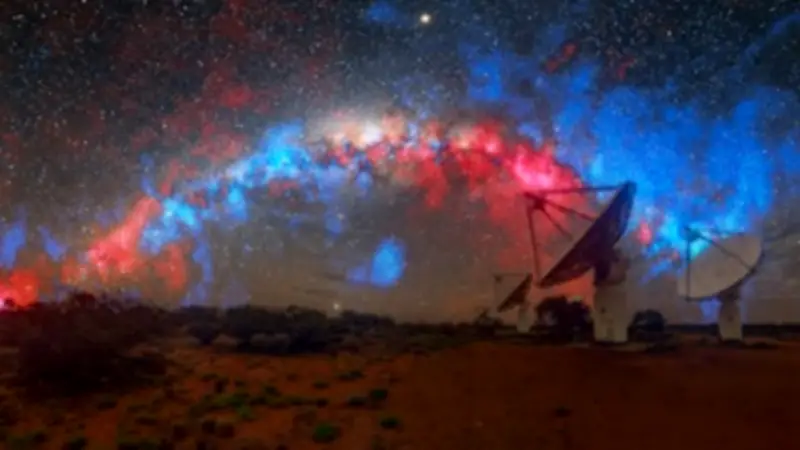
Australian scientists have unveiled the largest and most detailed map of magnetic fields in the universe ever created, using the nation's most powerful radio telescope. The new map, known as SPICE-RACS, was produced by a collaboration between two survey teams using CSIRO's ASKAP radio telescope in Western Australia.
Magnetic fields: The invisible force shaping the cosmos
Magnetic fields are a fundamental part of the universe, governing how small particles move through space and playing a crucial role in the evolution of galaxies. Despite their importance, magnetic fields remain invisible to the naked eye. Astronomers detect them by observing the polarisation of light from distant galaxies, which is twisted as it passes through magnetic fields.
The new map contains data from 350,000 galaxies, nearly ten times more than the previous largest map from 2009. This vast increase in data allows scientists to study the structure and strength of magnetic fields across the universe with unprecedented detail.

How the map was created
The ASKAP telescope, located at Inyarrimanha Ilgari Bundara on Wajarri Yamaji Country in Western Australia, consists of 36 dishes that can each see a huge section of the sky simultaneously. The flagship project to map magnetic fields is called the Polarisation Sky Survey of the Universe's Magnetism (POSSUM), and the new map comes from its precursor surveys.
The team identified nearly 4 million distant galaxies in the Rapid ASKAP Continuum Surveys (RACS), then looked for signs of changing polarisation caused by magnetic fields. Of these, 350,000 galaxies showed clear signals, providing the data for the new map.
What the map reveals
The map uses colours to show the direction of magnetic fields: red indicates fields pointing towards Earth, while blue shows fields pointing away. Much of the swirling structure visible is from our own Milky Way galaxy, but the fine details reveal signatures from even more distant parts of the universe.
Magnetic fields vary enormously across the universe. Extremely dense objects like neutron stars and black holes have fields billions of times stronger than Earth's, while the space between stars hosts fields a million times weaker. Despite their weakness, these fields act like giant batteries, storing huge amounts of energy and influencing star formation.
Future prospects
The new map is already enabling new scientific research worldwide, with data publicly available online. The team plans to combine all versions of RACS to create an even larger and more detailed map. Meanwhile, the POSSUM project is expected to complete observations by 2030, offering an even sharper view of distant cosmic magnetic fields and a window into the history of the universe.