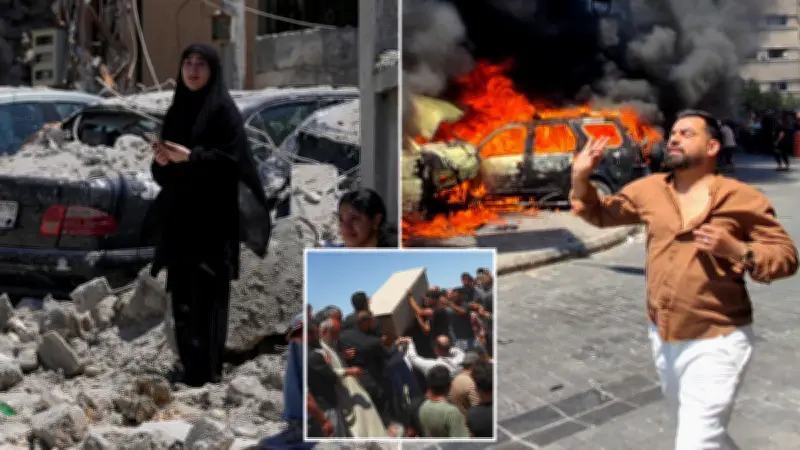
While the world watches for a potential US-Iran peace deal, the Lebanese diaspora is desperately pleading for international help to end a decades-long conflict that has claimed thousands of lives. Israel, aiming to destroy the Iranian-backed militia Hezbollah, has leveled villages across southern Lebanon and attacked apartment complexes in Beirut's suburbs.
According to Lebanese officials, more than 4,000 people have been killed, 12,000 injured, and 1.2 million displaced since Hezbollah reignited the conflict in March. "That's a third of the population. We all know someone who has been affected," Lebanese Diaspora Network member Carine Kahwagi told 7NEWS.com.au.
Diaspora's Trauma and Plea for Support
Kahwagi, born in northern Lebanon and now an Australian resident for over two decades, is among millions in the global Lebanese community watching helplessly as casualties climb. "I think this has been the biggest trauma that we as expats experience, looking at the death toll rise. These numbers are huge and catastrophic," she said.

The diaspora feels deeply for those in southern Lebanon, long cut off from the rest of the country due to Hezbollah's activity sparking skirmishes for four decades. "We never really got to connect with them and they are the biggest victims of all that's happening," Kahwagi added.
Scarcity and Suffering in Southern Lebanon
Food in the region has become scarce and expensive due to ongoing attacks, forcing locals to take up arms to defend resources. Threats come not only from Israeli attacks but also from Hezbollah members using towns as cover while ransacking supplies. "They have to find some kind of security options, they have to find some kind of connection with the outside world," Kahwagi said.
The militia's influence extends beyond remote villages. Israel has launched attacks on densely populated buildings in Beirut, claiming to target Hezbollah operations but catching civilians in the crossfire. One of Kahwagi's friends lost her home and her aunt in such an attack. "She lived in a very prime location in Lebanon, comes from a wealthy background and has nothing to do with the resistance. Her house was bombed, all the memories have gone. There's a lot of these physical traumas, but also emotional traumas," Kahwagi recounted.
Hezbollah's Entrenched Influence
The Iranian-backed militia has long been a thorn in the Lebanese government's side, skirmishing with Israel as a proxy for Iran and endangering locals. Despite previous attempts to remove Hezbollah's influence, Iranian funding has entrenched it in politics and the military. "Lebanese expats feel like we have two enemies in a way. We're not with the Israelis but we're also not with Hezbollah. We've had enough," Kahwagi said.
However, a cautious hope is emerging. During her first trip back to Lebanon since the conflict began, Kahwagi noted a visible shift in public opinion. "In the past, there were a lot of signs supporting southern resistance but this time around there has been nothing. It's the first time in recent Lebanese history that we feel there is a government, a president and a prime minister working for the best of the country," she said.
Challenges to Peace and Hezbollah's Future
Removing Hezbollah is proving harder than ever, as Iranian officials consider the militia's safety a cornerstone in peace talks with the US. This demand effectively grants Hezbollah clemency across the Middle East, where states are trying to maintain a shaky ceasefire with Iran. Strikes between Hezbollah and Israel continue, including a recent Israeli ground invasion of southern Lebanon, raising concerns for the future.
In an effort to rally global support, the Lebanese Diaspora Network announced that 400 Lebanese figures signed a joint statement titled "A Call to Save Lebanon." The statement reads: "Lebanon stands today at a critical crossroads, with its territory transformed into an open arena used by Hezbollah to fight the wars of others. Israel threatens its security, occupies a precious part of its land, continues to kill and target its citizens, and pursues a destructive policy aimed at depopulating the land and erasing memory. Iran, meanwhile, violates Lebanon's sovereignty, seeks to hijack its decision-making process and drags the country into wars and political bargains in service of its own ambitions and interests."

The statement calls on countries like Australia to support the Lebanese government in detangling itself from Hezbollah's deep roots and finding peace. The conflict has steadily eroded support for Hezbollah, as most Lebanese know someone directly killed, injured, or displaced. Kahwagi remains cautiously hopeful: "We understand the challenges are very big, because Hezbollah has been embedding itself within the country for the last 40 years, but the intent is there so we're hopeful."