For football fans, the FIFA World Cup transcends mere sport. Every four years, it creates a unifying moment, bridging divides of language, culture and geography through a shared passion for the game. For host nations, the tournament often acts as a soft power supercharger, offering a global stage watched by billions to showcase their country, culture and values. This is the essence of sport diplomacy, or in this case, football diplomacy. Beyond the trophies, governments invest in football to achieve off-pitch victories: fostering better relations, attracting investment and earning global prestige.
There is no doubt the United States could benefit from such a boost, especially after 18 months of Donald Trump's polarising leadership. However, a crucial distinction exists between soft power and mere spectacle. Early indications suggest the 2026 World Cup will offer more of the latter for Trump's America—an event highlighting power (not the soft kind), tribute, exclusion and vested interests.
The Soft Power of Sport
The term "soft power" was coined in the 1990s by Harvard political scientist Joseph Nye Jr. It describes a country's ability to influence through attraction, rather than military force or economic weight (hard power). Examples include South Korea's K-pop phenomenon, the United Kingdom's prestigious universities, and the Nordic countries' embrace of sustainability and progressive values. Essentially, soft power is the intangible capacity to make others sit at your table and consider, perhaps even support, your worldview.

Since Nye developed the concept, it has evolved significantly and faced heavy criticism. Critics highlight its subversive potential, especially when used by authoritarian states with less benign motives. Political scientists Christopher Walker and Jessica Ludwig introduced "sharp power" to describe how states like Russia and China use influence not to attract, but to manipulate. Nye himself acknowledges that soft power has become more complicated, subject to gaming, misreading or inward turn that undermines the openness it depends on. This distinction is crucial today, reflecting a broader shift in how nations use culture and spectacle as instruments of self-interest and dominance in a zero-sum world.
Trump, Infantino and the 2026 World Cup
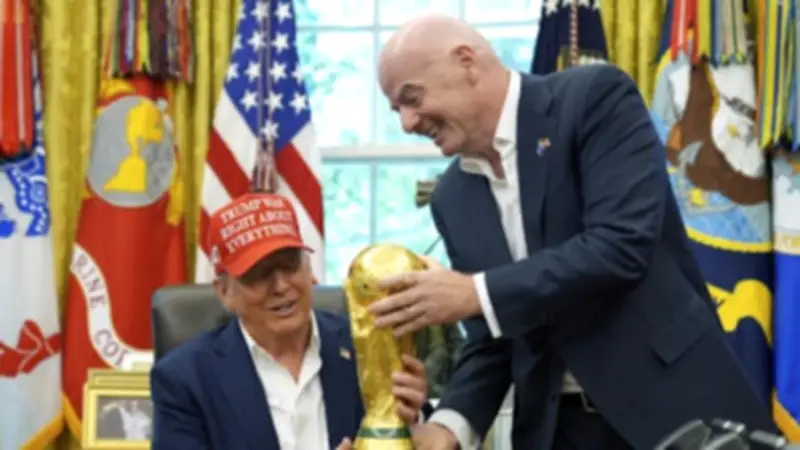
Enter Trump and the 2026 World Cup. With an expanded format of 48 teams playing a record 104 matches across 16 cities in three countries, FIFA President Gianni Infantino has labelled this year's tournament as the "greatest event that mankind has ever seen." Yet, as the tournament begins, it already represents a lost opportunity from a sports diplomacy and soft power perspective.
For starters, the event should celebrate North American partnership among the three hosts: the US, Mexico and Canada. But tensions have been high since the Trump administration imposed 25% tariffs on goods from both Canada and Mexico. Rather than de-escalate in the spirit of unity, Trump needled his counterparts, claiming the tariffs would make the World Cup "more exciting" and that "tension's a good thing." Canadian Prime Minister Mark Carney's statement on the World Cup opening makes only perfunctory reference to the United States. Mexican President Claudia Sheinbaum did not attend the opening match in Mexico City, in solidarity with regular Mexicans unable to afford exorbitant ticket prices set by FIFA.
The vision of football uniting the world—FIFA's own mantra—has given way to a tournament defined by who gets to participate and who does not. Professor Jules Boykoff, author of Red Card: The 2026 World Cup, Sportswashing and the FIFA Greed Machine, describes it as a "massive paradox": more teams than ever are participating, but due to Trump administration policies, it looks more like a World Cup of exclusion than inclusion. This goes beyond soaring ticket prices. Many supporters from qualified African and Middle Eastern nations had their visas rejected without explanation. Some of the Iranian team's support staff also faced visa rejections. Somali referee Omar Artan was denied entry in Miami, dashing his dream of being the first Somali official at a World Cup.

To make matters worse, these concerns have been met with shrugs by Infantino. When asked about Artan's situation, Infantino called it "unfortunate" but added, "sometimes it's good to just chill, relax." He had little to say about US treatment of the Iranian team, which was abruptly moved from its US training base across the border to Mexico, with tickets for its fans revoked by FIFA at the last minute. Infantino's response? He said he would drive the team on a bus himself from Iran to ensure they could play—but apparently not the team's fans.
A Stage for Self-Glorification
Soft power, at its best, works through genuine openness, two-way dialogue and collaboration—building understanding, trust and respect. During Australia's hosting of the 2023 Women's World Cup, Foreign Minister Penny Wong brought global leaders together to take a stand on gender equality and highlight the plight of women under the Taliban in Afghanistan. But the 2026 Men's World Cup appears to offer something else. The stage is set for self-glorification, managed by a political leader who frames division and tension as entertainment, and a governing body too invested in commercial gain to care about the social divisions it creates. This is not soft power. But there will be plenty of spectacle.