Desperate Search for Survivors After Twin Earthquakes
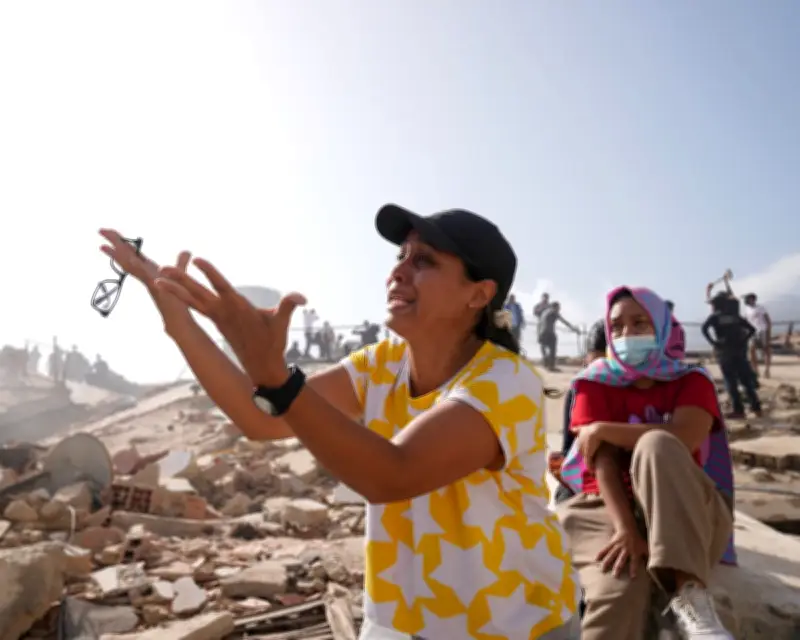
Since last Wednesday's twin earthquakes struck Venezuela's Caribbean coast, the search for missing loved ones has not stopped for scores of Venezuelans. Officially, more than 1,700 people have died, but tens of thousands remain missing. Desperate relatives are walking up and down streets lined by rubble and collapsed buildings with photos of those they cannot find, asking for help.
One week on, people are still being pulled from the rubble. On Monday, 21-year-old Aaron Levi Cantillo Vargas was rescued after spending 106 hours trapped under a collapsed building. But with every passing second, hope is fading in a nation already fragile due to economic crises, corruption, and the capture of its former dictator Nicolás Maduro by US forces earlier this year.
Journalist Clavel Rangel's Firsthand Account
Clavel Rangel, a Venezuelan journalist reporting for the Guardian, was back in Venezuela for her birthday when the earthquake struck. She had not been home for six years. Her family gathered under the impression they were celebrating her cousin's graduation, but Clavel was there to surprise them. She was hiding before the party when the shaking began.

"We really thought the building would collapse," she said, describing how her family huddled under an arch in the kitchen. "The shaking went on for so long, maybe two minutes. We all thought we were going to die." Mercifully, all came out unscathed.
Scale of the Disaster
During the 7.2 and 7.5 magnitude earthquakes, thousands of scenes of desperation played out along Venezuela's Caribbean coast. Entire apartment blocks collapsed in several towns and cities with people inside. La Guaira, a rundown port city near Venezuela's main international airport, was devastated. Fissures have opened up on roads, and homes have been destroyed.
Official statistics belie the true scale of the disaster, says Clavel. Mortuaries are overwhelmed, with a steady flow of bodies turning up in the back of cars, pickup trucks, and motorcycles. The UN is trying to source 10,000 body bags to help the country deal with the disaster. Civil society groups have banded together to create websites to help people find missing family members. "It is very important not to trust the official statistics, especially in Venezuela," says Clavel. "Over the past 10 to 15 years, opacity has been the rule in this country. In the civil society databases, family members have reported more than 40,000 people missing so far."
Community in Action Amid Government Inaction
The aftermath of the earthquake has highlighted some of the absurdities of Venezuela's current regime. Heavily armed military police patrolled the worst-hit areas, their faces covered with balaclavas. Under Maduro, these same police forces would kidnap opponents to the regime, forcing Clavel to flee to Miami. Venezuelans are suspicious of their presence. In videos on social media, people question why they have come with guns, not focused on the search for survivors.
"The military police have been very successful at repressing people fighting for democracy or their human rights, we have not seen the same effort trying to save people under the rubble," says Clavel. "When I was visiting the most affected areas on Saturday, people were walking along the streets with photos saying 'this is my grandmother, this is my dog'. The police were just there with their faces covered. They have guns but the government does not have equipment to respond to this kind of emergency. No power tools or drones for the search. People feel abandoned."
International Aid and Tensions
Since the earthquake, there has been a major international effort to get search teams on the ground. From Argentina to the UK, specialists have been sent to help locate and recover victims with sound detectors, dogs, and thermal imaging equipment. But many Venezuelans have resorted to picking through the rubble themselves.

The US has pledged more than $300m in funding for water, sanitation, food, and medical care. US marines are working to repair the port in La Guaira to aid the delivery of supplies by sea. Venezuela's acting president Delcy Rodríguez, put in power with the blessing of the Trump administration, has shared videos of survivors being saved on social media. Clavel says observing the US and Venezuela working together has been surreal, but tensions remain. Diosdado Cabello, Venezuela's feared security chief with a $25m US bounty, was filmed berating US rescue teams, prompting fury online. But most Venezuelans are grateful for the help, even if they wish for a greater push to replace the current regime.
"Without the US and all the international aid, this tragedy could be much, much worse. At least the Venezuelan government is letting them into the country," says Clavel. "Many think that America should be doing more to promote democracy. It would give us the possibility of having a government that is able to respond to this kind of tragedy."
No Accountability
With many still trapped under the rubble, attention has not yet turned to rebuilding. Aftershocks continue to terrorize survivors. On Monday, a 5.2 tremor shook the site of the original earthquake. Venezuela was once the wealthiest country in Latin America, with the most advanced seismic monitoring systems in the region, now in disrepair. Clavel says the disaster has highlighted what Venezuela has become.
"We haven't had proper health data about the country for about 10 years. We don't have proper economic data. We haven't even had a proper census since 2011. There is so much opacity. This is important information for guiding where the humanitarian aid needs to go," says Clavel. "Ultimately, we need freedom of expression and the right to demand accountability. Some of the buildings that collapsed were built by Chavez and Maduro for the socialist revolution. I remember as a journalist many years ago, my colleagues looked at corruption when they were being built. They had used cheap materials. And in the earthquake, many of these places collapsed. We need a proper investigation."