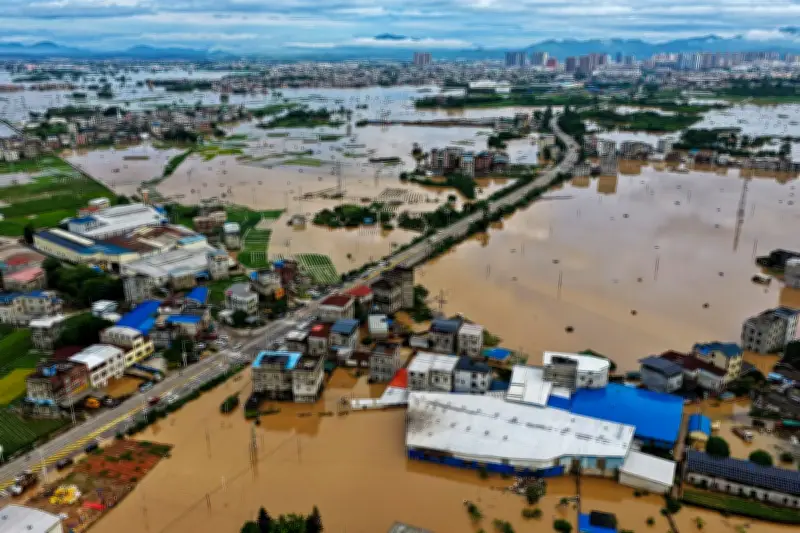
China has been battered by a series of extreme weather events over the past week, with typhoons, tornadoes, and landslides killing at least 45 people and displacing over 200,000 others, according to the Ministry of Emergency Management.
Typhoon Gaemi Brings Destruction
Typhoon Gaemi made landfall in Fujian province on Tuesday, packing winds of up to 160 km/h. The storm triggered widespread flooding and landslides, destroying hundreds of homes and submerging vast areas of farmland. At least 18 deaths have been reported in Fujian alone, with 12 more in neighboring Jiangxi province.
In the city of Fuzhou, rescue workers used boats to evacuate residents trapped in flooded neighborhoods. "The water rose so quickly, we barely had time to escape," said local resident Li Wei, 62, whose home was inundated. The typhoon has since weakened into a tropical depression but continues to bring heavy rain to inland areas.

Tornadoes Tear Through Central China
Separately, a series of tornadoes struck central China's Henan province on Thursday, leaving 15 dead and more than 100 injured. The strongest tornado, rated EF-3, carved a path of destruction through several villages near the city of Zhoukou, flattening homes and uprooting trees.
"I've never seen anything like it," said farmer Zhang Ming, 45, who lost his house and livestock. "The sky turned black, and then the wind just ripped everything apart." The tornadoes also damaged power lines and communication towers, leaving thousands without electricity.
Landslides Bury Villages in Sichuan
In southwestern Sichuan province, heavy rains triggered a massive landslide that buried a village of about 50 people. Rescue teams have recovered 12 bodies, with 20 others still missing. The landslide, which occurred early Friday morning, swept away homes and blocked a nearby river, raising fears of further flooding.
"We are racing against time to find survivors," said rescue official Chen Yu. "The terrain is difficult, and more rain is forecast, making our work extremely challenging." The government has deployed military personnel and heavy equipment to assist in the search and rescue efforts.
Economic and Humanitarian Impact
The combined disasters have caused an estimated 10 billion yuan (about $1.4 billion) in damages, with agriculture and infrastructure hit hardest. The Ministry of Emergency Management has allocated emergency funds and relief supplies, including tents, food, and water, to affected areas.
Climate scientists warn that such extreme weather events are becoming more frequent and intense due to climate change. "China is experiencing a new normal of deadly weather," said Dr. Wang Li, a climatologist at the Chinese Academy of Sciences. "We must adapt our infrastructure and emergency response systems to cope with these challenges."