Deep-diving sea turtles equipped with oceanographic sensors have provided unprecedented observations inside powerful tropical cyclones, offering a new way to improve storm forecasting and protect lives and property in northern Australia.
How Oceans Affect Cyclones
Tropical cyclones draw their energy from warm seas, extracting heat and moisture from the ocean surface. Higher sea surface temperatures generally fuel stronger storms. As a cyclone passes overhead, its powerful winds and waves churn the water, mixing warm surface water with cooler deeper water, leaving a 'cool wake' that can reduce the storm's intensity. Traditionally, forecasters have focused on sea surface temperatures, but the depth of warm water matters: if cooler water lies just below the surface, mixing can rapidly cool the sea surface, weakening the storm; if warm water extends deeper, the cooling effect is diminished.
Observing Northern Seas
The Timor and Arafura seas between Australia and Indonesia are vast, remote, and shallow, making traditional ocean observation methods difficult or expensive. Ships and underwater gliders can only sample small areas, and nobody wants to collect measurements in the middle of a cyclone. To address this data desert, a collaboration between the Australian Institute of Marine Science, the Integrated Marine Observing System, CSIRO, Macquarie University, the University of Western Australia, UNSW, and traditional owners turned to an unlikely ally: deep-diving sea turtles.

Turtle Power: How It Works
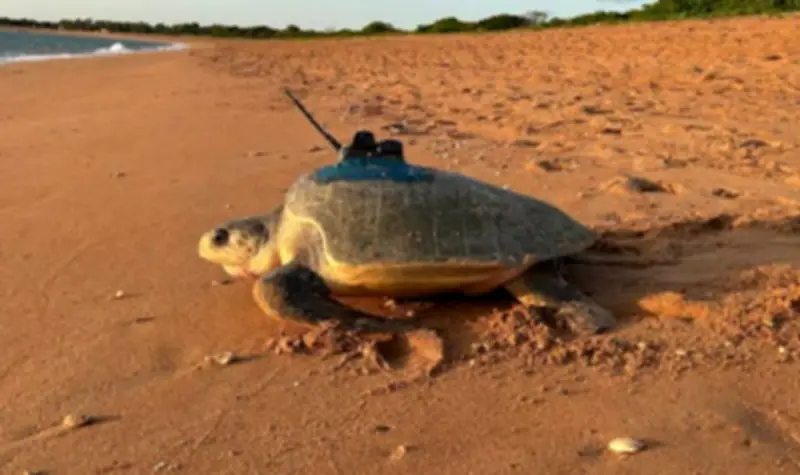
Olive ridley and flatback sea turtles, which lay their eggs on beaches around tropical Australia, have been tracked for decades using miniaturised GPS tags. Building on overseas experience, researchers paired a GPS tracker with an oceanographic probe that measures temperature when the turtle dives, sometimes as deep as 80 metres. The temperature data is transmitted almost immediately by satellite, making it available to forecasters in near real time. Over several deployments on 46 animals between 2014 and 2024, the turtles took more than 8,000 ocean temperature snapshots across northern Australia, from the Pilbara to the Gulf of Carpentaria.
Into the Maelstrom
In April 2023, Tropical Cyclone Ilsa formed off the Kimberley coast, eventually becoming a Category 5 cyclone and registering the Bureau of Meteorology's fastest-ever recorded sustained winds: 219 kilometres per hour. Tragically, two fishing vessels were caught in the storm, and eight people died. As Ilsa drew energy from the warm Timor Sea, it passed directly over one of the instrumented turtles. The reptile, seemingly unbothered by the maelstrom above, collected sub-surface observations before, during, and after the storm's passage. From the turtle observations, researchers found Ilsa's cold wake cooled the ocean surface by about 2°C. Had the storm remained stationary, this cooling could have reduced Ilsa's strength from Category 5 to Category 4.
Revealing Model Weaknesses
Matching turtle observations with the Bureau of Meteorology's historical storm database, researchers found that the turtles had taken real-time observations within the core of five tropical cyclones, including Category 4 Cyclone Rusty. In all but one case, turtles observed strong cooling of the ocean as the storm passed overhead. When compared with a state-of-the-art ocean model, the turtle data indicated a potential weakness: the model did not capture the mixing of deeper, cool water with the warm surface, the very process that causes the cold wake. According to the researchers, this can lead to overestimates of cyclone intensity.
Sentinel Turtles
To improve tropical cyclone forecasts, reliable sub-surface ocean observations are needed. But ocean observation is expensive, and developing an all-weather observing system is beyond the capabilities of many nations most vulnerable to tropical storms. The instruments used can be deployed on land with minimal equipment, and the Olive Ridley turtle lives in tropical seas. Sea turtles could become a key part of observing cyclone weather systems, protecting lives and livelihoods across the tropics.