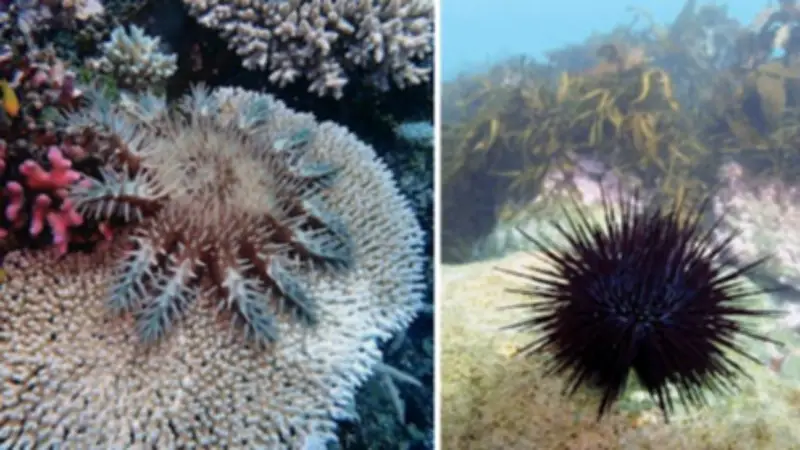
A new study has found that crown-of-thorns starfish and long-spined sea urchins are decimating Australia's reefs, but targeted investments in control programs and innovative research could mitigate the threats. The research, led by Peter Doll and Scott Ling, highlights that while both species are native and can boom in numbers, they pose high but differing risks to tropical and temperate reef ecosystems.
Two Prickly Threats to Australia's Reefs
Australia is home to some of the world's most beautiful reefs, including the lush Great Southern Reef wrapping around the southern coastline and the world-renowned Great Barrier Reef. However, both are plagued by voracious starfish and sea urchins. The coral-eating crown-of-thorns starfish is one of the greatest threats to the Great Barrier Reef, while long-spined sea urchins have eaten their way through thousands of hectares of kelp forests on the temperate Great Southern Reef.
Both species are native but can boom in numbers. The urchins have spread to new areas due to climate change, as Tasmanian waters, once too cold, have warmed, allowing the urchins to move south in their millions. Scientists tend to study these two species as isolated threats, but the new study shows that while they pose high but differing risks, investing in control programs and innovative research could help curb these prickly problems.

Overabundant Species and Their Impact
Crown-of-thorns starfish are native to the Great Barrier Reef and follow a boom-and-bust cycle. Since data were first available in the 1950s, their numbers have surged by more than 1,500 per square kilometre roughly every 15 years. Once they eat all available coral, the population crashes. When the starfish eat too much coral, this represents another threat to reefs already stressed by climate change.
Long-spined sea urchins are native to seas off mainland Australia. Their spread into Tasmania in recent decades has caused extensive damage to kelp forests. The urchins can build up to densities hundreds of times higher than peak crown-of-thorns starfish densities. Because of their flexible diet of microalgae, drifting seaweed, and invertebrates, they can survive in a semi-starved state, resulting in barren reefs persisting for decades.
Differences in Management Challenges
From a conservation perspective, tackling long-spined sea urchins differs from tackling crown-of-thorns starfish for three main reasons:
1. Fluid borders: Crown-of-thorns starfish are monitored and managed by federal institutions on the Great Barrier Reef, including the Australian Institute of Marine Science and the Great Barrier Reef Marine Park Authority. In contrast, long-spined urchins are spread across multiple jurisdictions from northern New South Wales to southern Tasmania. Authorities in each state manage urchins in different ways and to varying degrees, but urchin larvae travel south for hundreds of kilometres on prevailing ocean currents, making this a national problem.
2. Commercial interests: Crown-of-thorns starfish have no economic value, but urchins can be harvested for their roe, considered a delicacy in countries such as Japan. While demand for this high-value seafood product continues to grow, it is not yet at the scale required to combat the problem. Developing the urchin industry further would see more urchins removed from the water, enhancing reef protection.
3. Inconsistent funding: Sustained, large-scale investment is necessary. The roughly $20 million-per-year federally funded crown-of-thorns starfish control program is locked in years in advance, but funding for urchin control in Tasmania is about 40 times lower. Researchers, managers, and politicians have been calling for federal investment into the urchin fishery, but to date no substantial funding has been delivered. Investment into developing a profitable and larger sea urchin industry would deliver a long-term, low-cost solution.

Natural Defenses and Predator Protection
To protect precious reefs, one strategy is to protect natural predators. A 2026 study showed the spangled emperor is the key predator of crown-of-thorns starfish on the Great Barrier Reef. This fish species is found throughout the Indo-Pacific region but is sought after by fishers. On the Great Barrier Reef, there are six times more spangled emperor in areas protected from fishing, suggesting protecting their populations can help control crown-of-thorns starfish.
Similarly, the highly valuable southern rock lobster is a predator of long-spined sea urchins in Tasmania. Although these lobsters are widespread, they are highly sought after by fishers. When given a break from intensive fishing, lobster populations can build up, helping to limit urchin populations. Rebuilding predator populations can form part of a whole-of-ecosystem reef management approach, where priority is given to the overall health and balance of ecosystems and communities.
Plotting a Positive Future
As climate change continues, Australia's reefs face an uncertain future. Outbreaks of coral-eating starfish and kelp-grazing sea urchins can rapidly transform healthy reefs into degraded ecosystems. Yet this future is not inevitable. By investing in collaborative research, we can find ways to restore and protect these iconic environments.