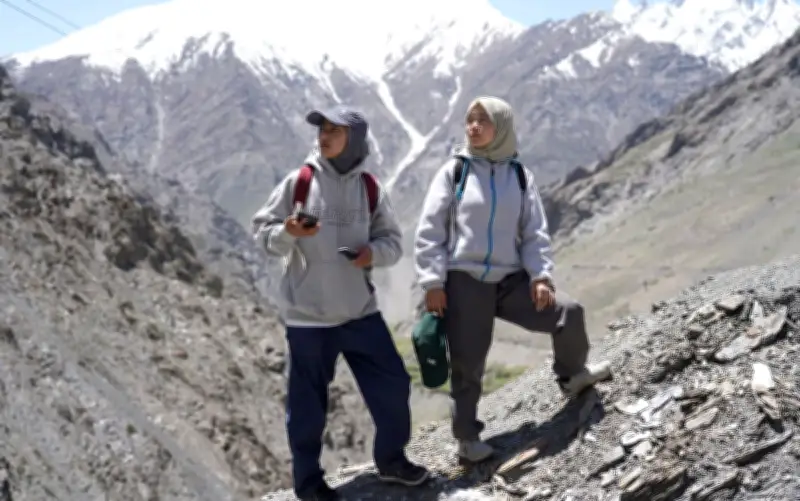
In the remote Himalayan region of Kargil, a quiet revolution is underway. Young Muslim women, draped in colorful hijabs, are scaling steep mountain trails, challenging centuries-old gender norms and redefining what it means to be a woman in conservative Kashmir.
A New Movement Takes Root
Every weekend, a group of women aged 18 to 30 gathers at the base of the towering peaks that surround Kargil town. Led by 24-year-old Fatima Bano, they hike for hours, often reaching altitudes above 4,000 meters. The group, which started with just five members in 2024, has now grown to over 50 regular participants.
“We were told that mountains are for men, that women belong in the kitchen. But we wanted to prove them wrong,” says Bano, who works as a schoolteacher. “Hiking gives us a sense of freedom and strength that nothing else can.”

Challenging Stereotypes with Every Step
The women wear traditional attire, including the hijab, during their hikes. This has sparked conversations both locally and globally. For many, the sight of women in hijab conquering rugged terrain challenges the Western stereotype of Muslim women as oppressed or passive.
“The hijab is my choice, and it doesn’t stop me from climbing a mountain,” says 22-year-old Ayesha Khan, a university student. “If anything, it reminds me of my identity and faith while I push my physical limits.”
Safety and Social Barriers
The group faces significant challenges. In the early days, they encountered verbal harassment from some men who accused them of “acting like men” or “bringing shame” to their families. Some parents initially refused to let their daughters join, fearing for their safety in the isolated terrain.
To address safety concerns, the women hike in groups and carry first-aid kits, satellite phones, and extra food. They also coordinate with local authorities to ensure safe routes. According to Bano, no serious incidents have occurred, and the community’s attitude is slowly shifting.
Growing Support and Recognition
The movement has garnered attention from national media and even international outlets. The Jammu and Kashmir government’s tourism department has expressed interest in promoting women-led trekking initiatives to boost adventure tourism.
“These women are role models for the entire region,” says Dr. Naseem Ahmad, a sociologist at the University of Kashmir. “They are showing that tradition and modernity can coexist, and that empowerment comes in many forms.”
Impact on Local Women
The ripple effect is evident. Several younger girls in Kargil have started expressing interest in hiking, and some schools have incorporated outdoor activities into their curriculum. The group has also inspired similar initiatives in neighboring districts like Leh and Drass.
“When I first started, my mother was worried,” recalls 19-year-old Zainab Ali. “Now she tells her friends that her daughter is a mountaineer. It feels amazing to change minds one step at a time.”
Beyond the Mountains
The women’s hiking group has evolved into a broader social network. Members discuss career aspirations, education, and women’s rights during their treks. They have also organized clean-up drives to preserve the pristine environment of the Himalayas.
“This is not just about hiking,” Bano emphasizes. “It’s about building a community where women support each other and break free from the limitations imposed on them. The mountains are just the beginning.”