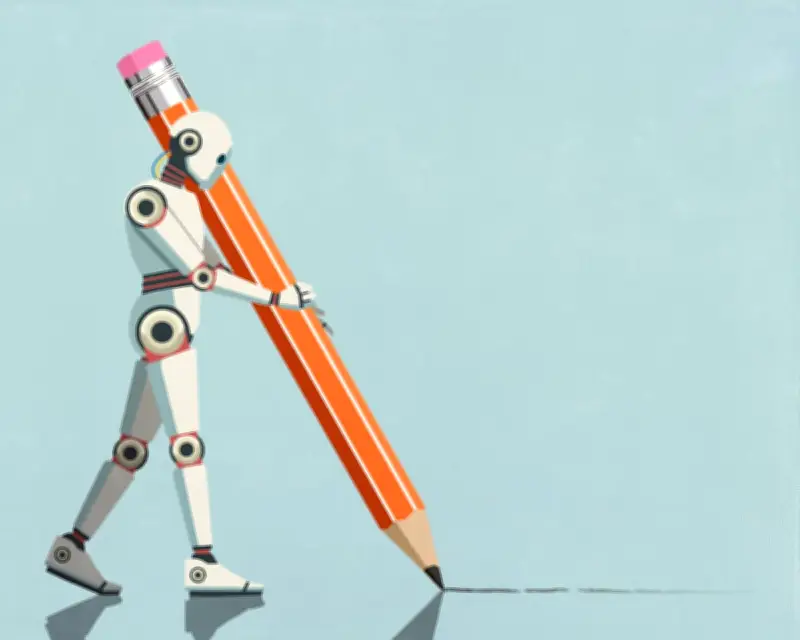
Writing is an exercise in the art of persuasion. If we use AI, we lose the art, writes Alan Finkel. Every reader deserves to be informed about whether what they are reading is human or AI-generated.
A few weeks ago, Dr Kylie Moore-Gilbert, an academic in political science at Macquarie University, wrote an opinion piece in the Sydney Morning Herald in which she reported on excessive use of AI chatbots by students to write their essays. In it, she raised her concern that universities are qualifying lawyers, nurses, financial advisers, engineers and teachers who do not have the essential skills required to perform their roles. If that is the case, the societal consequences are obvious.
Not everybody in the university sector agrees, and the University of Western Sydney’s pro vice-chancellor for quality and integrity, Prof Cath Ellis, wrote an opinion piece in rebuttal. There was a problem, though. Ellis’s piece itself was written by AI – which was not disclosed to the newspaper. Readers spotted the telltales of AI phraseology, and social media lit up with negative comments.

Ellis defended her opinion piece, saying it was written “with” AI, not “by” AI. From the perspective of the university, Ellis was entitled to use AI as she did. A spokesperson for the university acknowledged that Copilot produced the early drafts and provided editing, structure and language refinement. The university was unapologetic, arguing her use of AI was sophisticated, appropriate and reflected her own thinking, ideas and opinions.
This defence is flawed. Most readers do not read opinion pieces purely for the distilled points of view; for that, a list of dot points would suffice. An opinion piece is an exercise in the art of persuasion. We read to weigh the insights of the writer, to appreciate their prose and ultimately consider their specific points. The writer has power to influence policy and decision-making.
Every reader deserves to be informed about whether what they are reading is written by the presumed author or not. In my case, if I am informed, I would choose not to read an article or a book written by AI. Others might be happy to do so; that is their right. The essential issue is that the reader be informed, in advance.
The next issue is the semantics of what it means for an article to be written or not by a human. To me it is clear. AI can be used to research facts and test ideas, to conduct menial tasks such as spellchecking, grammar checking, formatting tables of content and formatting bibliographies. But AI must not write the sentences and paragraphs.
These boundaries are what we at my company, Proudly Human, are calling de minimis standards. Universities should adopt de minimis standards. The standards must be specific rules rather than statements of principle so that there is no argument about what is acceptable and what is not.
Without these conditions, an AI-generated article might motivate somebody else to use AI to create a reply, and so it goes. Pretty soon we will find that human authorship has not merely skidded down a slippery slope but jumped off a cliff into irrelevance.
The SMH and The Age responded by taking down Ellis’s piece and stating that in future new contributors would be asked to guarantee that AI had not been used to write or construct articles. Such a policy is welcome. Most important, these and other mastheads should be encouraged to publish their de minimis standards. If some contributors do not abide by the standards, then more formal procedures should be implemented such as technological verification of the human authorship of every article.
As a former university chancellor, I stay in touch with the sector. I know that universities are well-intentioned and working to integrate AI into teaching and learning while ensuring that learning outcomes are achieved. However, they have approached the problem with nothing like the speed at which students have adopted AI tools.
The Castlereagh statement issued earlier this year by representatives from most Australian universities and many educational associations is a case in point. It clearly articulates the way that AI is affecting teaching and learning, and discusses goals and approaches to prepare our students for “an AI-transformed future”, but nowhere does it propose specific rules or rapid timelines.

Specific rules are needed. The AI future has arrived. The time to act is now, by adopting concrete policies for acceptable AI use to ensure the articles, essays and papers that are claimed to be written by academics and students are unquestionably written by those human beings rather than subcontracted to an AI.
My final words: AI had no role in the drafting or writing of this opinion piece. Alan Finkel AC PhD is founder and executive chair of Proudly Human. He was formerly the Chancellor of Monash University, Australia’s chief scientist and founder of Stile Education.