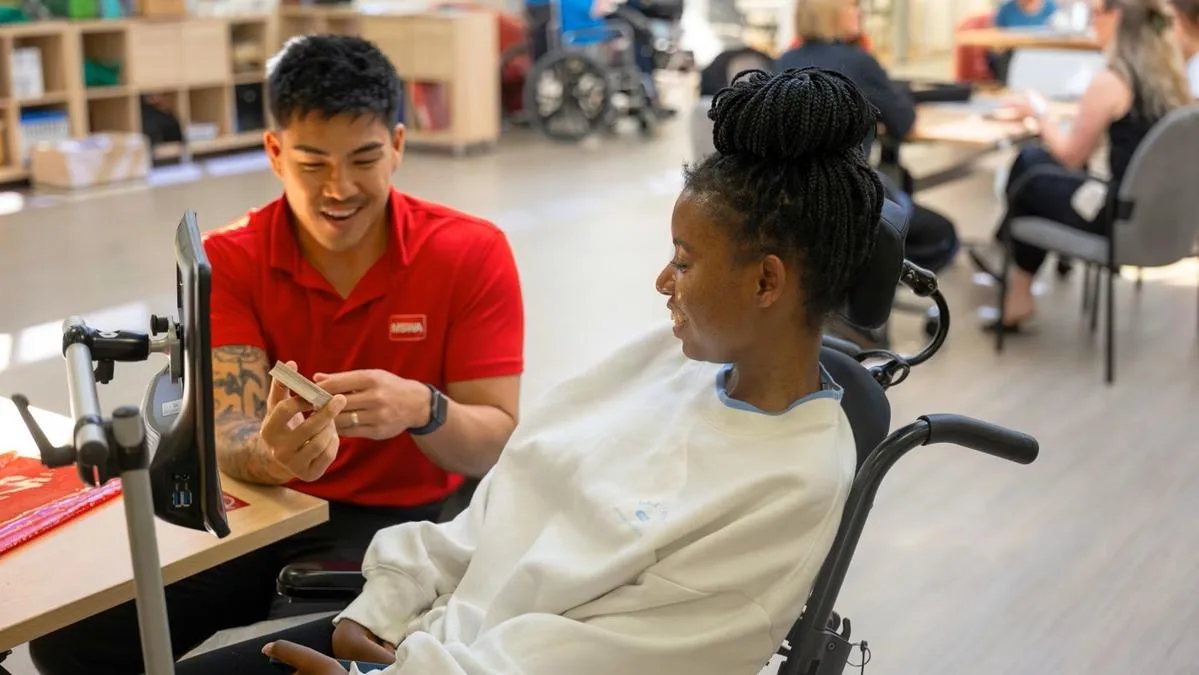
A 30-second video discovered on an old MacBook was all that remained of Elena's voice after motor neurone disease took away her ability to speak as a teenager. However, it was enough for Perth speech pathologist Bradley Pang to bring it back using new AI technology to recreate her voice and integrate it into her communication device.
"It was really exciting," Mr Pang said. "I've been treating Elena ever since I started out as a speech pathologist, so helping restore her voice and hearing her use it for the first time was pretty amazing."
Mr Pang has been treating the 24-year-old over the past four years as a speech pathologist for MSWA, a non-profit organisation providing vital support and services to those living with neurological conditions in Western Australia. It was only recently that advances in artificial intelligence opened the door to restoring voices for people like Elena.
Among the technologies making this possible is ElevenLabs, a software that uses AI to produce highly realistic and emotionally nuanced voices. Voices can be generated through cloning technology that allows users to duplicate their own voice with as little as 10 seconds of audio.
"I had heard a bit about ElevenLabs but I hadn't come across any prior examples of people using it in the way we had for Elena," Mr Pang said. "I was speaking with the developer back and forth to try and figure out how to integrate it into her communication system."
Having developed MND at a young age, finding footage or audio of Elena speaking was difficult to track down. But after some digging, Elena uncovered a short video of herself speaking, recorded on an old MacBook. "It was a 30-second clip, which I then had to edit down as other people could be heard in the video so it was just Elena's voice," Mr Pang said. "And then in the software you can go in and tweak the settings, which we spent a bit of time on, to make it sound as close to Elena's voice as we could."
Mr Pang then installed the voice technology onto Elena's eye gaze device, a specialised tool that tracks pupil movement, allowing users to control a computer screen and communicate via text-to-speech. "It was amazing," Mr Pang said. "It has kind of given her more independence where she's now able to use her own voice to communicate. Elena has a big family with eight siblings and they were all really excited, asking her questions and just wanting to hear her voice a bit more. She has a young niece who had never heard her speak before, so being able to communicate with her in her own voice means a lot to Elena and it feels really rewarding to help make that possible."
On Saturday, Mr Pang was recognised for his incredible efforts at the National Disability Services WA Disability Support Awards, where he received the Allied Health Professionals Award. "Honestly, it just feels like I'm doing my job," he said. "But it is nice to be recognised and I do feel proud."
While he described the award as unexpected, Mr Pang said the recognition highlighted the growing role of AI in improving quality of life for those with disabilities. "AI can be scary sometimes but this is definitely a good thing that's come out of it," he said. "And we're definitely trying to use it for all our clients now that will, or are expected to, lose their voice. Everyone has been really excited about it. I'm looking forward to helping others explore this option and help restore that feeling of identity for them."