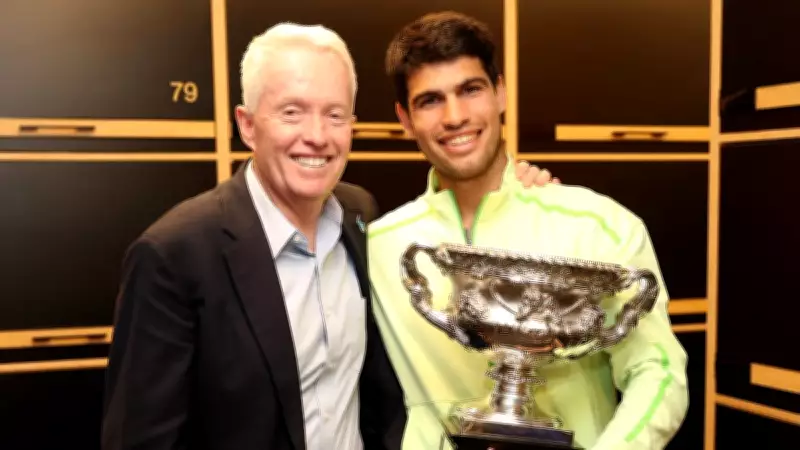
Craig Tiley Defends Combined CEO Role as He Prepares for USTA Move
Craig Tiley has firmly stated that his successor at Tennis Australia must continue to occupy the dual roles of chief executive and Australian Open tournament director, following confirmation of his departure to lead the United States Tennis Association later this year.
After months of speculation, Tennis Australia officially announced on Wednesday that Tiley will step down from his position as CEO to take up a new role with the USTA. Tiley, who began his tenure with Tennis Australia in 2005 as player development chief, became the Australian Open director in 2006 and ascended to the CEO role in 2013.
Unprecedented Growth Under Tiley's Leadership
The South African-born former US college coach has overseen a period of remarkable expansion for tennis in Australia, transforming the Australian Open into the nation's premier sporting event. Despite occasional criticism that Tiley held too much responsibility by combining the CEO and tournament director positions, the 63-year-old insists this perception is misguided.

"A couple of things that I could say unequivocally on behalf of our chair and the board, because I've been part of the meetings this week, is that it is going to be one role," Tiley told AAP. "And it actually is one role. I think that's very much a misunderstanding."
Tiley emphasized that employees within Tennis Australia understand and support the combined role structure, while acknowledging that external observers may not fully comprehend its logic.
Defending the Combined Leadership Model
The outgoing CEO argues that having the same person lead both the organization and its flagship event makes complete sense from an operational perspective.
"Because the CEO is the face of the organisation and is responsible for the conversation with the externals, whether it be the members, boards or the public or the media," Tiley explained. "It would be like having a head coach of a team and then having someone in the back office talking to the media about how the team's playing. It just doesn't make any sense."
Tiley will remain in his current position to assist with the transition process and help select his replacement. He indicated that while the ideal candidate will likely come from within the tennis community, this isn't an absolute requirement.
Legacy of Transformation and Future Vision
During his 21-year tenure, Tiley has not only boosted participation levels and nurtured Australian talent—including retired women's world number one Ash Barty and top-ranked men's players Alex de Minaur, Nick Kyrgios, and Bernard Tomic—but has also transformed the Australian Open into a billion-dollar enterprise.
"It's definitely a formula that's worked well," Tiley said, while assuring that the Australian Open will maintain its reputation as the "Happy Slam" and "Players' Slam" long after his departure. "It'll be even bigger and better. I'm 100 percent confident we've got a plan for the next four or five years for the Australian Open, so it's just about executing on that plan."
Personal Reasons for the Move
Australia's highest-paid sports administrator acknowledges he's leaving behind a comfortable lifestyle in Melbourne to relocate his young family to Orlando, Florida—a significant change at age 63.
With an American wife, Ali, Tiley says the time is right for his tennis-loving 12-year-old twin sons and 13-year-old basketball-playing daughter to experience life closer to extended family.
"People say, 'You're mad'. I mean, I do have a great life here," Tiley admitted. "I've got a great team. We're achieving some awesome things and I'm incredibly proud of what's already been achieved here. The big thing for me was—I do like a challenge. I like change."
"It's also a personal decision to have the family close to their aunts and uncles, grandparents on that side, which they haven't had the last 20 years," he added. "When your kids are young, it's a good opportunity. Otherwise they miss that."