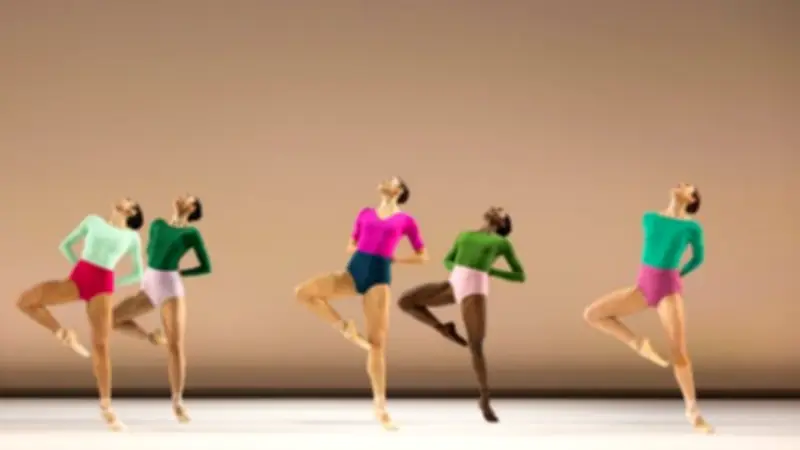
In Justin Peck’s Copland Dance Episodes, 30 dancers of The Australian Ballet move through 22 episodes to music by legendary American composer Aaron Copland, performed by Orchestra Victoria. Born in 1900, Copland created a new American classical music idiom earning him the title of “Dean of American Composers”. The ballet features his orchestral work Fanfare for the Common Man (1942) and excerpts from his ballets Rodeo (1942), Appalachian Spring (1944) and Billy the Kid (1938). All draw heavily on American folk music, and the coming together of these separate compositions feels right.
Contemporary Choreography Meets Classic Americana
While the music is from almost a century ago, the ballet vocabulary is contemporary. Peck, currently resident choreographer with the New York City Ballet, is continuing the innovations of American choreographers such as George Balanchine and Jerome Robbins. Fast, joyous and unrelenting, the dancers kick and flick, slide and point – and sometimes even chill and chat. But the ballet never stops. The 22 episodes allow space for solos, duos, pas de deux and trios. Many are masterful. The often quirky, fast and difficult choreography, with unusual original steps and lifts, is precisely executed by the dancers.
A Sense of Space and Narrative Openness
Like many works from Balanchine and Robbins, there is only the hint of a narrative. Two couples repeatedly appear throughout the ballet – one couple struggling in their relationship, the other strengthening theirs. They offer some story, although not an overarching one. There are also two trios: one of three men; one of three women. These trios interact playfully with each other in mini scenarios, and we sense their different personalities. Many singular characters also emerge fleetingly, teasingly and then are reabsorbed into the flow of bodies again. Peck says “this is a ballet that meets the audience halfway” and that he wants the audience “to find their own way”. The openness of the narrative invites us in the audience to create and interpret what we see on stage.

Gender and Structure in Two Acts
The ballet is in two acts, but it feels like three: the first danced by the men, the second by the women and the third all together. The breaking down of parts of the ballet by gender creates strong traditional gender identities in this ballet. We are introduced to two different worlds: the world of the men and the world of the women. The ballet opens with the world of the jovial blokes in long leggings set to strutting hoedown music from Rodeo. It then moves on to the world of the cheeky women who are in short shorts and pointe shoes. The music from Appalachian Springs has much lighter tones and speed, and coquettishness defines this part of the ballet. The final chapter of the ballet has more dancers. There are flocks and crowds, as well as regular and irregular patterns dotted across the stage.
Visual and Musical Landscape
One constant across all scenes is a sense of space. Jeffrey Gibson’s all-white bright set visually captures the vastness of the American plains. Copland’s music was inspired by the American plains and frontier lands, and it audibly captures the vastness of those places. The empty white space also provides the perfect backdrop for the brightly coloured mix and match costumes designed by Ellen Warren, creating the sense of the dancers as elements of a weave of patterned geometric fabric. This kaleidoscopic colour scheme is set up by Gibson before the ballet even begins with a boldly patterned curtain.

A New Ballet Vocabulary for Australia
Copland Dance Episodes is 21st century contemporary American choreography, set to classical mid-20th century frontier land Americana music, performed by an Australian ballet company and orchestra in Australia. Australian ballet has long had a stronger relationship with Britain and Europe than with America. While a plethora of European companies have toured Australia over the last century, the New York City Ballet has only ever had one tour in 1958. Our national company dancing a Russian or British ballet passes unnoticed. But dancing an American one feels different. The Australian Ballet is committed to staging new works by emerging international artists. This certainly fulfils that brief. More than that, this performance of Copland Dance Episodes, the first outside New York city, also represents a moment of post-colonial solidarity. And the dancers wear it well.
Copland Dance Episodes is in Melbourne until July 2, then Sydney in November.