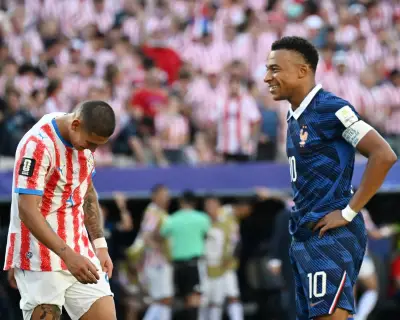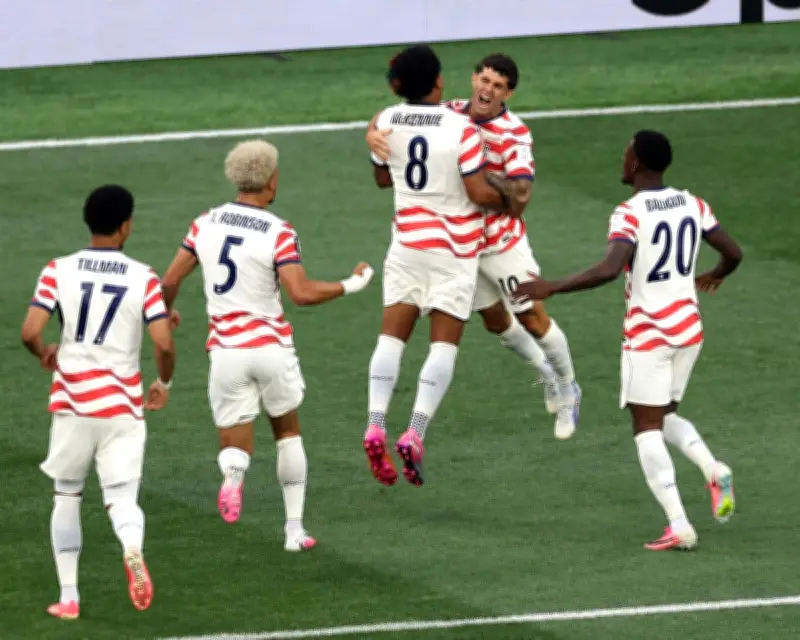
The United States men's national team enters the 2030 World Cup cycle with a mix of promise and uncertainty. Following a strong performance at the 2026 World Cup that ended in disappointment, the program faces critical decisions about its future direction. Head coach Mauricio Pochettino's contract is up for renewal, and US Soccer has made an extension offer, but both parties are taking time to decide. Meanwhile, sporting director Matt Crocker abruptly left before the World Cup to take a similar role with Saudi Arabia, raising further questions about the sport's trajectory in the United States. Although most of the 2026 squad's core is expected to contend for 2030, four years is a long time in soccer.
2027: Concacaf Nations League and Gold Cup
The US returns to regional competition needing to sustain momentum. The Nations League begins in September, though the US will likely enter in November as one of the region's top four teams, earning a bye to the quarter-finals. The semi-finals and final are scheduled for March 2027. The US won the first three Nations Leagues but failed to reach the final in 2025, losing to Panama and then falling to Canada in the third-place match. The next edition offers a chance to prove that the summer's strong form was not an aberration but a new normal: effective soccer with plenty of entertainment.
The Gold Cup follows in the summer, historically a testing ground for bubble players. In 2019, the US bounced back from missing the previous World Cup by giving tournament debuts to Christian Pulisic and Weston McKennie. Pochettino's only Gold Cup helped integrate Malik Tillman, Sebastian Berhalter, Alex Freeman, and Matt Freese into the squad. Players who were among the hardest cuts from Pochettino's squad—such as Aidan Morris, Diego Luna, Tanner Tessmann, and the injured Patrick Agyemang—could use it as a launchpad to become core contributors. Those too inexperienced for the summer, like Zavier Gozo, Niko Tsakiris, Adri Mehmeti, and Julian Hall, will push for early introductions.

Goalkeeper is a position to watch. Despite a Gold Cup under his belt, Freese looked unseasoned this summer and failed to meet the moment against Belgium. Matt Turner turned 32 in June, leaving the door open for alternatives. Establishing a reliable backstop by next summer would give them multiple tournaments to build cohesion with the team.
The US also enters World Cup qualifying in November 2027, joining in round two with the region's top-ranked teams. They will be the top team in a group of four, where finishing first or second (with games in November and March 2028) advances them to the final round. There is no excuse for failing to advance from this stage.
2028: Copa América and the LA Olympics
The Copa América is penciled in for 2028, though no official confirmation exists that Conmebol will stage its flagship tournament in the United States for a second consecutive installment. Brazilian newspaper O Globo reported that the 2024 and 2028 tournaments were awarded in tandem, with the US and other Concacaf nations having paths into the tournament field even if held in South America. A more hallowed competition than the Gold Cup, the Copa would be a vital mid-cycle checkpoint to test the group's mettle. It would be a gut-check for starters to reaffirm they should be leaned on with an eye toward 2030, as the final stage of World Cup qualifying looms. Players nearing their 30th birthday will need to be especially sharp, as younger alternatives will be eager to force their way into the lineup.
Then there is another tournament on home soil: Los Angeles 2028, with Olympic soccer held in several MLS stadiums. This will be a mostly under-23 tournament, with teams able to select three over-age players. Discount Olympic soccer at your peril. Paris 2024 did not unearth any World Cup starters but did wonders for Tessmann's stock as he captained the team to a quarter-final. It could be even more informative as the program readies for a likely generational shift after the 2030 World Cup. Affording a squad of rising players to star in big international games is a great opportunity to broaden and deepen the player pool.

2029: Concacaf Qualifying, Nations League, and Gold Cup
For the Nations League and Gold Cup, the brief is similar: play with a similar style to the A-team while vetting rotational or fringe players. Qualifying is where things get interesting, assuming the US does not suffer a historic setback in the second round. After 2028, the US coach will have recent tournament performances to study from 46 players: 26 from Copa América and 20 younger hopefuls from the Olympics. That is a sizeable pool to start with as players come in and out of qualifying windows due to injuries and form.
As the US learned in 2018, qualifying is not a given. But since they last entered in 2022, the expanded field has made Concacaf qualifying more forgiving. Rather than the round-robin Hexagonal or Octagonal of yesteryear, Concacaf now draws the final twelve hopefuls into three groups of four for a six-match stage. The top two from each group advance to the World Cup, while the two best third-place finishers have a play-in game for a spot at the inter-confederation playoff. Qualifying is tense worldwide, but keen planning across the entire cycle can foster confidence. A crystallization of team style and clarity at goalkeeper by the end of 2027, an assessment of the A-team at the Copa, and seasoning the next wave at the Olympics in 2028, followed by refining combinations and building chemistry with a successful qualifying run ending in 2029.
After a cycle without some of these crucial gut-checks, the US has a chance to build a head of steam and momentum well before the 2030 World Cup. It is up to the program to make the right decisions at coach and possibly in the backroom to start on the right foot.