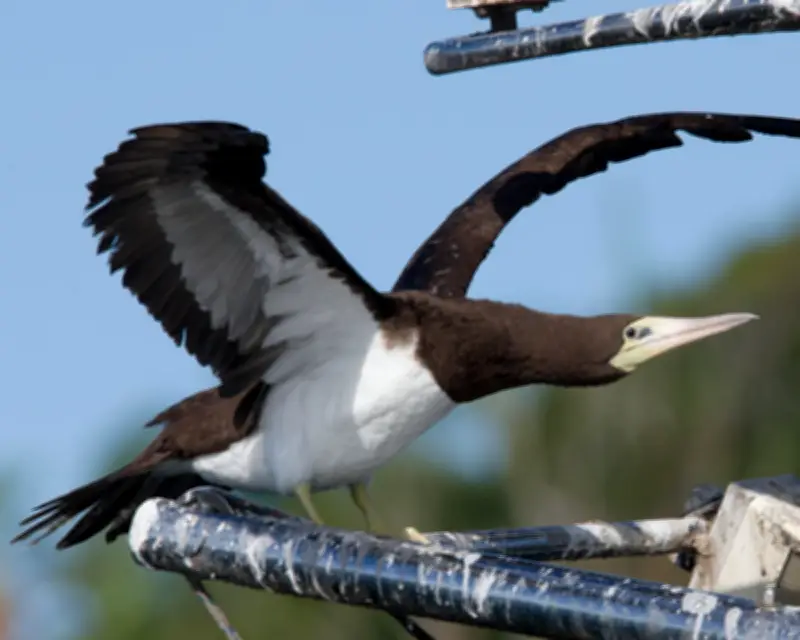
The Cocos booby, an eastern Pacific seabird, has taken up residence on the New South Wales Central Coast, sparking a frenzy among Australian birders. Photograph: Chris Rehberg
Why the Cocos Booby Has Birders in a Frenzy
Andrew Stafford, a semi-reformed twitcher, explains the excitement. The discovery of a black-headed gull in Geraldton, Western Australia, has also caused a stir. Normal people might wonder why a common northern hemisphere bird is so special, but twitchers are proudly not normal.
As a semi-retired twitcher, Stafford notes that flying across the country for a black-headed gull is no big deal. Every year, Australian birding elites travel to every corner of the continent and extralimital territories like Christmas, Cocos, Torres Strait, and Macquarie Islands to add birds to their lists.

The gull, recorded at least 10 times in Australia, isn't the biggest twitching frenzy. That honor goes to the first Cocos booby, identified on 26 May. An estimated 200 twitchers have kayaked out on Lake Macquarie to add the booby to their Australian and NSW lists.
The Rise of the Cocos Booby
Initially, “Coco” was mistaken for a brown booby, common in tropical Australian waters. The Cocos booby was only recently recognized as its own species by scientists, based on genetic and morphological differences. Thanks to these taxonomic vagaries, the number of birds known to breed in Australia that Stafford has yet to see ballooned from four to more than a dozen.
Big twitches involve vagrants like the gull and the booby—foreign species blown off course by extreme weather or with scrambled internal compasses.
Extreme Twitching Adventures
Stafford recalls his most extreme twitching adventure in 2001, sailing from Broome to Ashmore Reef. The trip was confronted by a listing hulk with about 200 Afghans on board, plus a customs vessel. His journalism instincts led him to ask questions, resulting in a story in the Sydney Morning Herald. He was banned from returning by the tour operator.
In 2007, he flew from Brisbane to Perth, hired a car, and drove 1,638km to Whim Creek in the Pilbara to twitch a red-legged crake. The crake had been blown in by a cyclone but became a meal for a feral cat before Stafford arrived.
The Twitcher's Life
Stafford had to slow down due to financial and environmental costs. But the urge hasn't passed. He's seen plenty of black-headed gulls, but not on his Australian list.
The term “twitcher” originated from British birder Howard Medhurst, who chased rarities on a motorcycle and arrived shivering, mistaken for excitement. Mike Carter brought twitching to Australia, holding the record for most birds seen within Australia until his death in 2024. Sean Dooley, author of The Big Twitch, notes that twitchers are often derided but have expanded ornithological knowledge.
Twitchers, among the first citizen scientists, have pushed back frontiers in field identification and understanding bird distribution in the age of extinction. Their extralimital commitment is commendable.