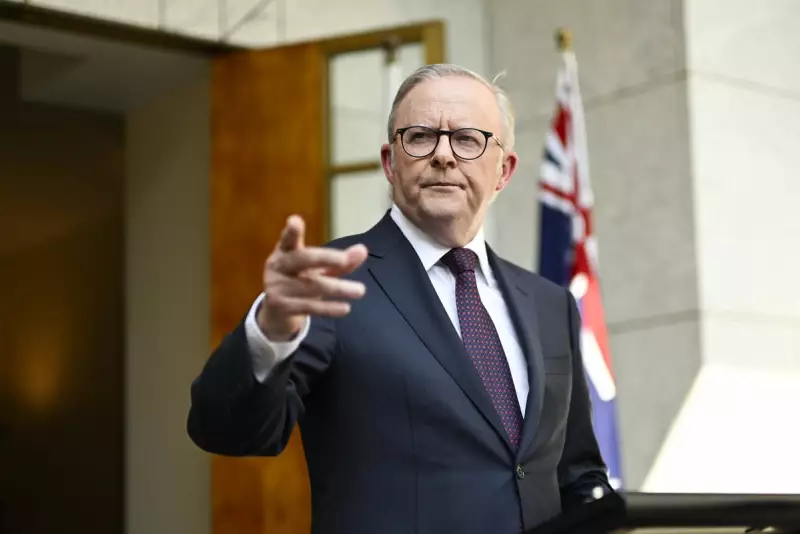
Prime Minister Anthony Albanese has finally capitulated to intense public and media pressure, announcing a federal royal commission into the Bondi terror attack. This decision comes after a protracted 25-day period where the Labor leader staunchly resisted calls for the highest level of public inquiry into the tragedy.
The Long Road to a Royal Commission
Albanese's resistance defied a well-known political maxim, often attributed to former Blair advisor Alastair Campbell, which suggests a public figure can prevail if they withstand 11 consecutive days of media scrutiny. The Prime Minister managed to survive that initial period and held out for another two weeks before ultimately relenting.
For nearly a month, Albanese employed what critics have called the "five Ds of Dodgeball"—dodge, duck, dip, dive, and dodge—to avoid committing to a royal commission. His media advisors likely warned that such intransigence created the perception he had something to hide, ensuring that every future mention of the inquiry would be paired with the phrase "which Mr Albanese fought against."

The Prime Minister's argument against the commission, that he was relying on advice from "actual experts," rang hollow when he declined to name those experts. These are the same individuals whose potential failings would likely be scrutinised by the very commission he opposed.
Why the Reluctance? The Inherent Risk of Royal Commissions
To understand Albanese's hesitation, one must grasp another political rule: never call an inquiry unless you can predict the outcome. Royal commissions are notoriously unpredictable and can unearth career-ending revelations. Having witnessed more than a dozen federal royal commissions during his three decades as the Member for Grayndler, Albanese is acutely aware of their destructive potential.
While independent reviews, like the one being conducted by former security chief Dennis Richardson, act like X-rays identifying broad issues, royal commissions are more akin to detailed CT scans. They probe deep into the heart of decision-making, exposing every flaw. Commissioners also have a history of expanding their investigations beyond initial briefs, chasing the scent of corruption or incompetence wherever it leads.
This raises daunting questions for the government. What advice did the Australian Federal Police (AFP) provide when Minister Tony Burke negotiated the repatriation of ISIS brides? Did ASIO caution against Labor's move to recognise Palestine, warning it might incentivise Islamic fundamentalists locally? Has the AFP's counter-terrorism capability been weakened by budget pressures, despite Albanese's boasts of "record funding"—a claim that is true in nominal terms almost every year?
The Uncomfortable Core: Extremism, Faith, and Politics
The most compelling reason for Albanese's opposition, however, may be the commission's inevitable focus on the root causes of anti-Semitism and the role of extremist Islam in Australia. It is impossible to thoroughly investigate the former without examining the sharp edges of the world's fastest-growing religion.
This presents a profound discomfort for Albanese, a founder of the Parliamentary Friends of Palestine, and for a Labor left that often attributes extremism to socio-economic factors like poverty, rather than religious ideology. This commission will force a direct examination of whether fundamentalist Islamism was the immediate and tangible force that radicalised the perpetrators, Sajid and Naveed Akram.
The coming months will test the government's resolve as Virginia Bell's royal commission begins its hearings, likely serving up answers that will cause significant political indigestion. For a Prime Minister who has sometimes appeared more concerned about Islamophobia than anti-Semitism, the inquiry's findings could redefine the national conversation on security, faith, and tolerance.