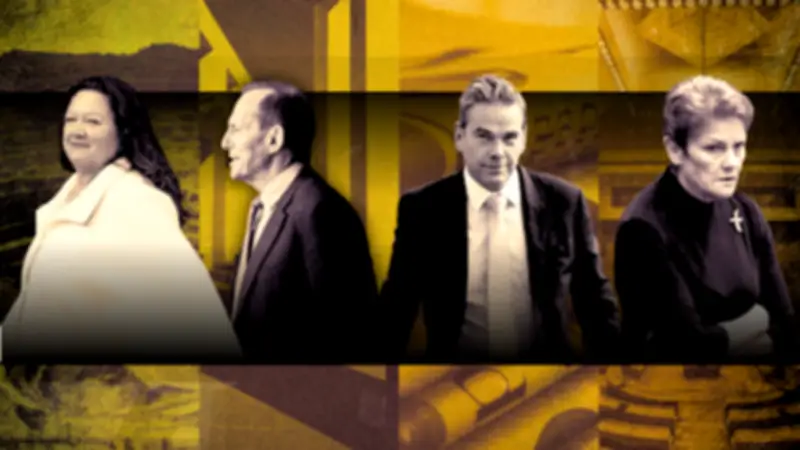
Gina Rinehart, the billionaire heiress to the Lang Hancock mining empire, is financing the acquisition of a 9.5% stake in Southern Cross Media by Bruce McWilliam, a former News Corp executive and ex-Seven Network executive. This venture costs Rinehart $26 million. While it does not grant her a direct stake in Southern Cross, if McWilliam fails to uphold his side of a security deed, she could take control. Southern Cross is one of Australia's largest media organizations, owning the Seven Network, 7news.com.au, Triple M and Hit radio brands, numerous regional radio stations, and West Australian Newspapers.
A New Power Axis
The Rinehart-McWilliam-Murdoch axis represents a formidable force, part of a new combination of media, political, and mining interests reminiscent of the coalition that formed the Liberal Party in the 1940s. Key figures include News Corp chair Lachlan Murdoch, One Nation leader Pauline Hanson, and Liberal Party director Tony Abbott. This lens is instructive for assessing media coverage of One Nation's rise since the Farrer byelection on May 9.
Rinehart is a benefactor to Hanson, recently purchasing her a light aircraft worth $1 million. She is also a benefactor to Lachlan Murdoch; her company Hancock Prospecting sponsors Sky News, owned by Murdoch's News Corporation, with over $1 million for an event called the Bush Summit in Dubbo. Lachlan Murdoch, chairman of News Corporation, appointed Tony Abbott to the board of Fox Corporation in 2023, a day after Rupert Murdoch announced his retirement. In May, Abbott was elected unopposed as federal president of the Liberal Party.

Lessons from the 1940s
Parallels with the 1940s are evident in Sally Young's Media Monsters, which describes the machinations leading to the Liberal Party's formation. The right was in disarray after Robert Menzies' United Australia Party was trounced by Labor in 1943. Menzies was backed by Collins House, a collection of companies dominating mining and manufacturing. An influential figure was Lachlan Murdoch's grandfather, Keith Murdoch, managing director of the Herald and Weekly Times newspaper group. The HWT and other major media proprietors anointed Menzies and his new Liberal Party at a dinner of Collins House magnates in 1944.
The difference today is that two right-wing parties contend for supremacy: the Liberal Party and One Nation. Rinehart seems to hedge her bets, supporting both. However, if The Australian's recent coverage is any guide, Lachlan Murdoch has decisively cast his vote for the Liberal Party.
Media Sober Up on One Nation
For a fortnight after One Nation's historic win in Farrer, the media, including News Corp, were intoxicated by the excitement: the shredding of Liberal support, Hanson's ambition to be prime minister, and the possibility of a Liberal-One Nation coalition. Then, led by The Australian, the media began to sober up. On May 23, editor-at-large Paul Kelly wrote that the Nationals, Liberals, and One Nation were locked in a bitter competition with life-or-death consequences.
The Australian applied journalistic scrutiny to One Nation, and The Age and Sydney Morning Herald followed. The Australian reported that One Nation's South Australian parliamentary team looked like a "rainbow coalition," with one MP coming out as gay with a partner who was an Indonesian Muslim. It then pursued serious public-interest journalism, investigating the party's handling of rape allegations against an adviser, Sean Black, and accusing Hanson of shirking parliamentary duties by being absent from 88% of Senate estimates hearings over the past decade. It also highlighted One Nation's failure to lodge audited financial records for three years in Queensland and disparaged its policy for citizen-initiated referendums.
On June 3, The Australian published a thundering editorial, stating One Nation was drifting to the fringes, would be divisive and disruptive, and that Hanson was not fit in any sense to be prime minister. On June 6, it led page one with a full-frontal attack under the headline "Hanson hit," saying she had misled voters. The Age and SMH took up the theme, reporting that Hanson was unsure about pitching for the prime ministership, had closed party branches infiltrated by extremists, and insisted she would not be influenced by Rinehart despite adopting one of Rinehart's key policies.

On June 6, political editor Peter Hartcher described Hanson as a firebrand provocateur specializing in grievances without solutions, turning to scapegoats like Asians, First Nations people, and Muslims. He noted Hanson had answered "no" when asked if she could think of any error Donald Trump had made. Another commentator, Paul Sakkal, wrote about the right-wing forces barracking for Hanson, including white supremacists, neo-Nazi supporters, and supporters of Dezi Freeman, who had killed two policemen. "A serious governing party cannot retain these relationships," he wrote.
A Right Mess
The big question is how the forces brought together through the new media-politics-mining combination will resolve tensions in creating an effective right-wing force. Murdoch, through The Australian, has signaled contempt for One Nation and already has Abbott on his team via Fox Corporation. Rinehart, with her holdings in Southern Cross Media, could back either Hanson or the Liberals. Her history indicates she would use her power to influence editorial decisions. In 2012, she became the largest shareholder in Fairfax with 14.99% but refused to sign the charter of editorial independence, leading to a board seat denial. She sold out in 2015. This suggests she would want the option to influence editorial decisions on any media board.
The old Fairfax newspapers—The Age, the SMH, and the Australian Financial Review—are now owned by Nine Entertainment and stand outside the new cabal. A crucial question is whether they might prove a countervailing force. One Nation set off an earthquake in Australian politics, but how the media play into the aftershocks will significantly shape the new landscape.