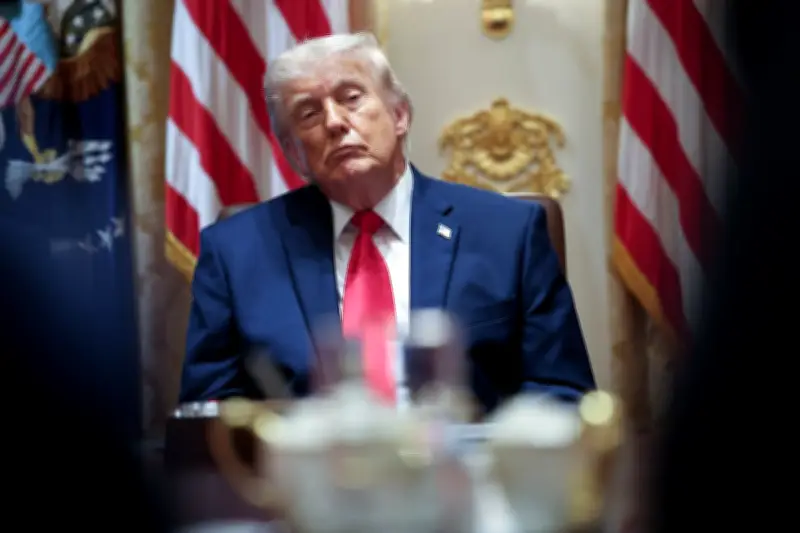
The White House has quietly proposed sweeping policy changes that would allow political appointees to vet every federal grant issued to universities and non-governmental organizations based on their adherence to 'American values' as defined by President Donald Trump. The proposal, published by the Office of Management and Budget (OMB), has triggered broad alarm among scientists and researchers who warn it would deal a devastating blow to scientific progress.
Proposal Details
The lengthy document, published on Friday without a press release, states that all federal grants approved by Trump's political appointees must 'demonstrably advance the president's policy priorities.' It claims that during the Biden administration, federal awards were often used to promote a 'woke' policy agenda that did not reflect the values of the majority of Americans, wasting taxpayer resources and harming public trust in government.
Under the proposed rules, political appointees at federal agencies would have the power to cancel any grant deemed not 'in the national interest,' raising fears that rigorous peer review processes could be undermined. The changes would codify many executive orders from Trump's second term, including bans on support for diversity, equity, and inclusion activities and respect for LGBTQ+ gender identification.

Impact on Science
Andy McCammon, a chemistry research professor at the University of California, San Diego, and a member of the National Academy of Sciences editorial board, wrote in a public comment that the proposal would bypass peer review in favor of political oversight. He warned it would allow grants to be terminated at any time for any reason and largely prevent the use of federal funds for publishing, attending meetings, or international collaboration. 'I see first-hand the displacement of good submitted manuscripts from the United States by manuscripts from other countries, notably China. I hope the United States will stop its campaign against science before it's too late,' McCammon said.
Amy Sharma, executive director of Science for Georgia, an advocacy organization, expressed deep concern. She noted that under the new regime, OMB could continue activities similar to the aborted Doge initiative, where interns searched grants for keywords like 'equality' and 'diversity' and revoked funding. 'Some underpaid intern did Ctrl-F on every single grant that had been pushed out by the NIH and looked for words like 'equality' and 'diversity' and 'sex' and 'gender identity' and they just yanked those grants,' Sharma said.
Practical Challenges
Researchers point to practical problems with the proposal. Barbara Nikolajczyk, a professor at the University of Kentucky studying obesity and diabetes, noted that the requirement to list conferences to be attended over a five-year grant period is impractical and inhibits good science. 'If you're really doing the same science that you put in a grant application six years ago for a five-year grant, you're not moving forward quickly enough,' she said. 'It's adding insult to injury... The problem is going to be that it's just going to slow down our ability to push innovation forwards because we will need additional approval.'
The proposal also bars certain collaborations with foreign entities. Nikolajczyk said she is already seeing researchers leaving the US for other countries. Agencies would operate under these rules as binding regulation, centralizing policy under OMB head Russell Vought. The formal rule-making process began with publication in the federal register and would take effect in October.
Concerns Over Academic Freedom
Sharma, who previously served on grant panels at the National Science Foundation, described the current process as meritocratic, with subject matter experts evaluating applications based on well-spelled-out criteria. She said the idea of political officials overriding scientific decision-making is akin to Soviet communism. 'It's like, well, Stalin doesn't believe in this, so we're not going to give money for this anymore, right?' Sharma said.

As of Tuesday afternoon, more than 3,000 public comments had been submitted, almost exclusively in alarmed opposition. The White House deferred comment to OMB, which did not immediately respond. The proposal represents a significant shift in federal grant administration, sparking fears that it could stifle innovation and academic freedom.