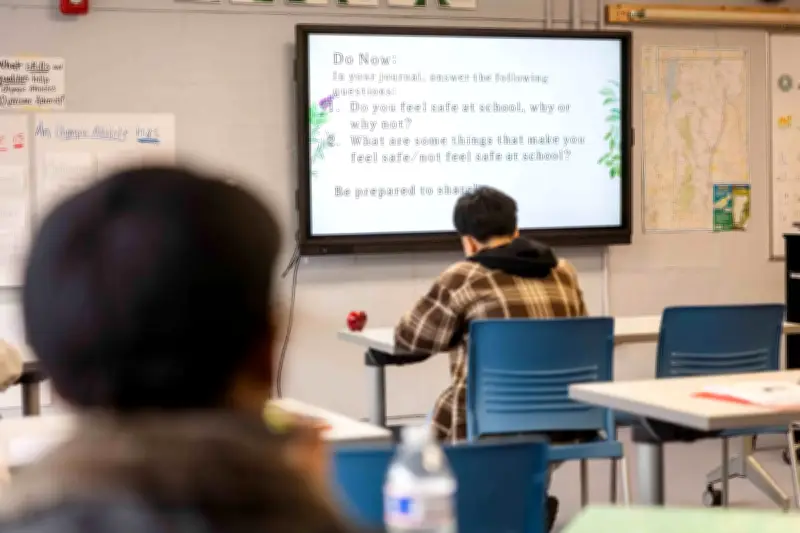
On an April morning at Winooski High School in Vermont, a writing prompt asked students: "Do you feel safe in school? Why or why not?" Their answers revealed a hard-won sense of security. "I feel safe in school because I saw the school doors are locked every time," one student said. Another added, "ICE can't come in."
These students come from families across the globe, speaking Arabic, Nepali, Spanish, Somali, and more. The feeling of safety is the result of deliberate actions by the Winooski school district, which has taken a stand against federal policies under the second Trump administration. While many districts have chosen to stay quiet or self-censor, Winooski and its superintendent, Wilmer Chavarria, have done the opposite.
A Sanctuary Policy for Students
Last year, Winooski became the first district in Vermont to pass a sanctuary policy protecting students from immigration enforcement at school. The policy formally states that staff will not share student data with immigration officials and restricts agents' access to campus without a signed judicial warrant. Chavarria also refused to sign a federal document confirming compliance with the ban on diversity, equity, and inclusion (DEI) efforts in schools.

This defiance came despite direct impacts from federal policies. Chavarria, a naturalized citizen, was detained by immigration officials at a Houston airport last year. Over Thanksgiving break, a second-grader was detained with his mother by federal agents. In early December, the district faced racist messages and phone calls after a video of a student raising the Somali flag went viral.
Preparing for Funding Loss
Federal funding accounts for 6% of Winooski's annual budget. Chavarria said he is preparing for the possibility of losing it. "When somebody wants us to lose funding, we're going to lose it anyways. The difference is, did we lose it while bending the knee, or did we lose it while standing up for our values?" he said.
Winooski, a 1.5-square-mile community along the Winooski River, is the most diverse district in Vermont, one of the nation's whitest states. Nearly 60% of students are people of color, and more than a third are English learners. The region has been a refugee resettlement community for decades, accepting hundreds of immigrants annually from countries like Bhutan, Somalia, Bosnia, and Syria.
Community Support and Statewide Impact
Chavarria's actions have built widespread local support. "Wilmer has been a brave voice in a time in our country where that's being punished," said Robin Merritt, a parent of three children in the district. In May, the Vermont legislature passed a law modeled after Winooski's policy, requiring all schools in the state to have immigration enforcement protocols.
Ignacia Rodriguez Kmec, policy counsel at the National Immigration Law Center, said clear policies protect both students and staff. "You want to be able to show that you support all families, including immigrant families, that they ideally should participate and not be afraid of coming to school," she said.
A 2022 study found that children from families with mixed citizenship status were more likely to earn As and report fewer problems if they attended a school with a "safe zone" policy. Caitlin MacLeod-Bluver, a teacher at Winooski High and Vermont's 2025 Teacher of the Year, said, "When kids feel seen and heard and valued in our district and community, it shows up in the work they're doing."
Raising the Somali Flag
In December, Chavarria decided to raise the Somali flag on school grounds three days after Donald Trump called Somalis "garbage." The video of the flag went viral on right-wing social media, leading to death threats that forced the district to take down its website and unplug phones. Despite this, staff kept the flag up for a week to support Somali students, who make up about 9% of the student population.
Chavarria, who stayed at a hotel for a few days after receiving death threats, believes more school leaders should publicly push back. "It does feel like we are alone in an ocean," he said.

Visible Challenges and Resilience
Inside the school this spring, doors separating hallways are locked, requiring staff to let students through. A table with "Know your rights" and "Conoce tus derechos" banners holds documents in multiple languages. Outside school walls, the district has not been able to keep all students safe. After the second-grader's detention, teachers wrote letters and organized fundraisers. The boy's mother self-deported after seven weeks in a detention center.
Erin Hurley, a multilingual teacher, said staff have volunteered as temporary guardians for students whose parents fear detention. "I feel so disgusted that our country has come to this. These families make our community so much brighter," she said.
Back in the multilingual learners class, the teacher turned to a new topic: astronauts onboard Artemis II had released photos from the moon. The students had a million questions. For a few minutes, their thoughts were 250,000 miles away. Then, it was time to practice reading and writing in English again.