Australia will receive only second-hand submarines under a newly announced approach to the AUKUS deal, as defence ministers confirmed a streamlined acquisition plan.
Revised Submarine Acquisition
AUKUS defence ministers have announced that Australia will acquire three “in-service” Virginia-class submarines rather than a previously anticipated mix of new and used vessels. In a joint statement released following the AUKUS Defence Ministers’ Meeting in Singapore, the defence leaders said they had agreed to a “proposed approach”.
“The Deputy Prime Minister and Secretaries welcomed the proposed approach to streamline Australia’s acquisition of Virginia-class submarines (VCS),” the statement read. “This approach would enable Australia to acquire three in-service VCS in lieu of a mixture of new and in-service VCS variants.”

The shift means that under the first phase of AUKUS, Australia will receive only second-hand submarines, marking a significant change from earlier expectations.
Investment in Infrastructure
Defence Minister Richard Marles also acknowledged an investment of up to AUD $8 billion for infrastructure and logistics support at HMAS Stirling for the submarines. Australia’s total commitment to the AUKUS nuclear submarine program has been estimated to cost upward of $360 billion over the next three decades.
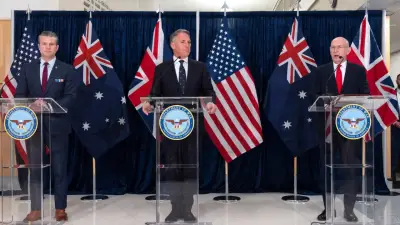
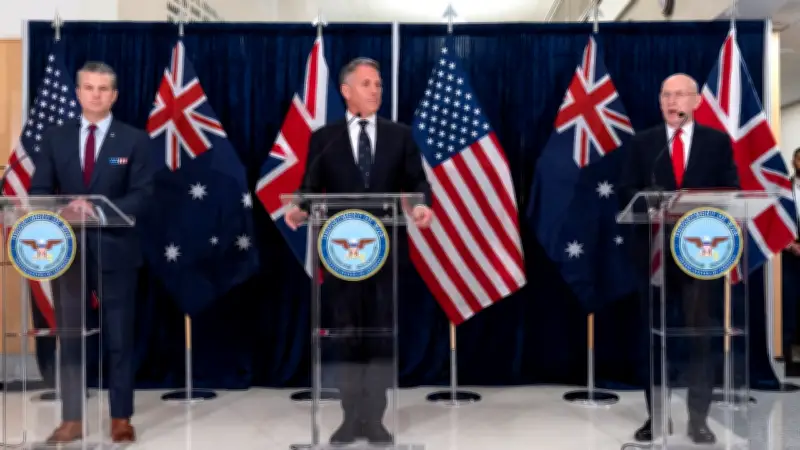
The announcement came after a meeting between Defence Minister Richard Marles, US Secretary of War Pete Hegseth, and British Defence Secretary John Healey. The ministers insisted that AUKUS Pillar I – Australia’s acquisition of a conventionally armed, nuclear-powered submarine capability – remained on track.
Unmanned Undersea Vehicles
The meeting also unveiled plans to develop unmanned undersea vehicles, with delivery set for 2027. This programme falls under AUKUS’s so-called “Pillar Two”, which aims to develop advanced defence technology including quantum computing, undersea capabilities, hypersonic systems, artificial intelligence, and cyber technology.
Formed by the three countries in 2021, AUKUS is part of efforts to push back against China’s growing power in the Indo-Pacific region. China has called the AUKUS pact dangerous and warned it could spur a regional arms race.