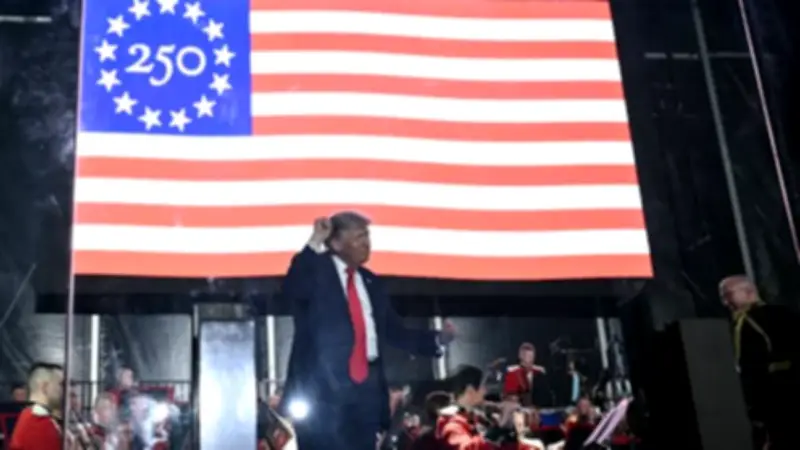
As the United States prepares to mark the 250th anniversary of its independence on July 4, 2026, President Donald Trump has transformed the celebration into a deeply personal spectacle. He has placed his own image on commemorative $250 bills and passports, and a giant structure erected on the White House's South Lawn for a pay-per-view UFC bout on his 80th birthday has been dubbed the “Arc de Trump.” The structure's construction came as a court ordered Trump's name removed from another federal building, highlighting the tension between his desire for personal branding and legal constraints.
Patriotism as Personal Loyalty
Trump's actions represent a fusion of patriotism with personal loyalty, suggesting that love of country is synonymous with love for him. This approach, while not unprecedented in American history, is uniquely intense in its vanity. Previous presidents have used patriotism to narrate the nation's character or emphasize necessary changes, but Trump's efforts signal an attempt to direct Americans' sense of national purpose toward himself.
Historical Contrasts: Washington and Ford
For George Washington, patriotism meant stepping down from the presidency, demonstrating that the new republic would be governed by popular sovereignty rather than inherited monarchy. His restraint showed that the balance of government branches required good-faith actors. Roughly 200 years later, President Gerald Ford faced a nation reeling from the Watergate scandal and economic turmoil. On July 4, 1976, Ford chose a low-key expression of patriotism, presiding over a naturalization ceremony at Thomas Jefferson's Monticello rather than appearing at a monument built in his honor.

Patriotism as Global Mission
Many presidents have framed patriotism in terms of America's global role, following Thomas Paine's assertion that “the cause of America is in a great measure the cause of mankind.” Franklin Roosevelt's 1941 Four Freedoms speech argued that the US must defend freedom of expression and religion, as well as freedom from want and fear, worldwide. This internationally-focused patriotism persisted through the Cold War. After the 9/11 attacks, President George W. Bush emphasized loyalty, telling other nations, “Either you are with us, or you are with the terrorists,” and enacting laws like the Patriot Act that intensified domestic surveillance and stifled dissent.
The Contradiction of American Freedom
American patriotism has always been shadowed by exclusion. Washington enslaved hundreds of people and pursued those who escaped. President Woodrow Wilson segregated the federal workforce and promoted racist myths. Franklin Roosevelt's New Deal and GI Bill excluded African Americans and other people of color. Trump's inward-looking patriotism is more explicit about exclusion than most recent presidents, but what is new is his fusion of patriotism with personal loyalty and the idea that he embodies the nation itself. This is the patriotism of the corporate raider: acquire the institution, put your name on it, reward loyalists, and extract all value.
The Question for the 250th Anniversary
The 250th anniversary does not require asking if Trump is politicizing patriotism—patriotism is always political. The question is whether patriotism can serve the greater good or whether it is just another asset for Trump to own.