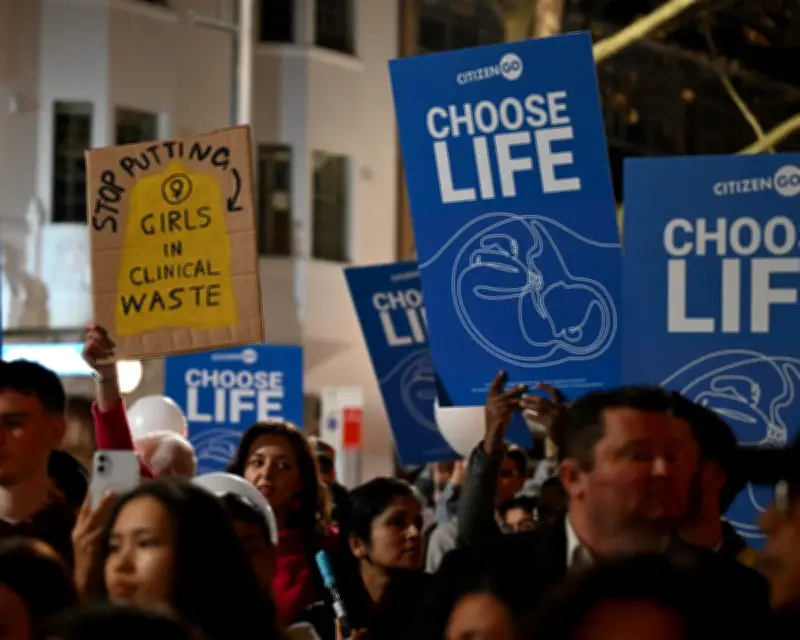
Anti-abortion protesters gathered in Sydney last week, carrying both hand-drawn signs and professional placards. Among them, blue-and-white posters reading "The greatest liberty is the right to life" bore the logo of CitizenGo, a group little known in Australia but influential in Europe's anti-abortion and anti-LGBTQ+ movements.
What is CitizenGo?
CitizenGo is an offshoot of the ultra-conservative Spanish group HazteOír (Make Yourself Heard), founded in Spain in 2013. It claims 20 million members across 50 countries. Its funding sources are disputed; a 2021 European parliamentary inquiry described it as "an organisation founded by US and Russian ultra-conservatives that has sought to coordinate the activities of far-right parties in Europe," though CitizenGo denies receiving money from Russian oligarchs. A 2024 UN research institute report called it an "ultra-conservative Catholic organisation" and a global leader of anti-gender ideology.
Outside Europe, CitizenGo has been active in Africa, contributing to a temporary ban on Marie Stopes abortion services in Kenya in 2018. Its methods include mass online petitions, such as attempts to pull a Cadbury's Creme Egg ad and successfully getting a DC Comics series on Jesus cancelled.

CitizenGo in Australia
In Australia, CitizenGo is on the foreign influence register and says it advocates "on issues of family, faith and liberty from a biblical perspective." Its campaigners include former Nationals MP and failed One Nation Senate candidate George Christensen, and Christopher Yates, a former adviser to independent Fowler MP Dai Le. Brian Marlow, former executive director of the Australian Taxpayers' Alliance and now running Revive Australia, joined in 2024, though his current involvement is unclear.
So far, CitizenGo's impact in Australia has been modest. A petition supporting anti-abortion activist Joanna Howe garnered nearly 14,000 signatures; Christensen's petition to ban sex-selective abortion has about 7,400 signatures; and a petition calling for dissolution of federal parliament over "mass migration" and inflation has around 22,300 signatures.
Role in the anti-rights ecosystem
Researchers say CitizenGo is part of a growing ecosystem of anti-rights groups energised by One Nation's rise and global populist movements. Lucy Hamilton, a doctoral researcher at UTS and far-right expert, uses the term "co-belligerence" to describe CitizenGo's role: different Christian groups cooperating for shared projects without formal alliances. These groups embrace multiple issues like abortion, immigration, and climate change to broaden their appeal. "Basically they're all extending their messaging to include as many factions as possible," Hamilton says.
Kurt Sengul, a research fellow at Macquarie University, notes that coalitions have emerged in the far-right space that "never would have seen eye to eye on anything before." CitizenGo has "definitely flown under the radar" in Australia, but recent prominence of abortion—with three bills before state parliaments to reduce access—has given it an opportunity. Yates, who attended last week's rally organised by Howe, said in a Facebook post he could have printed three times as many posters and that "ideally" abortion should be entirely banned.
Dr Adam Simpson from Adelaide University says cost-of-living pressures have driven people to unite on grievances, making them susceptible to far-right populist views on issues like abortion. Guardian Australia has contacted CitizenGo, Christensen, Yates, Le, and Howe for comment.