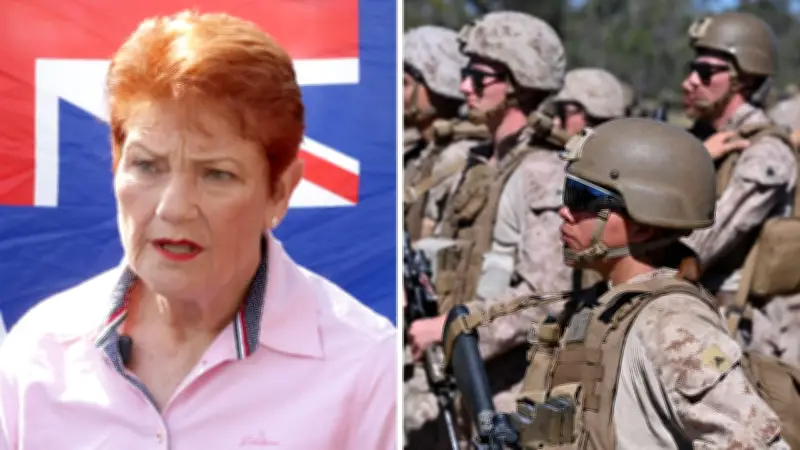
Pauline Hanson is defending her plan to massively boost defence spending, after an expert warned it could require a compulsory measure not seen since the Vietnam War.
Harrison Christian
2 min read

June 10, 2026 - 12:34PM
Pauline Hanson is defending her plan to massively boost defence spending, after an expert said it could slug taxpayers to the tune of $100 billion a year and require mandatory enlistment. In comments to The Age, Marcus Hellyer from Strategic Analysis Australia referred to a speech Senator Hanson gave at Donald Trump’s Mar-a-Lago resort in late 2025.
The senator had urged Australia to lift defence spending to at least 5 per cent of GDP. It was a suggestion also made by mining magnate Gina Rinehart during the federal election campaign earlier in the year, and a significant increase from the Trump administration’s own request for Australia to raise its defence budget to 3.5 per cent of GDP.
In a November speech, Senator Hanson said Australia should lift defence spending to at least 5 per cent of GDP. Picture: Steve Pohlner
Mr Hellyer said the increase to 5 per cent would cost taxpayers about $400 billion over four years, with the funds having to come from tax increases or other portfolios, and might result in the reintroduction of conscription. “To spend that amount of money, you’d need to get a lot more people into the defence force to operate all the equipment you are buying,” he said.
“You immediately start to think of some form of national service because you won’t get there voluntarily in peacetime.”
The 5 per cent figure was associated with wartime economies such as Ukraine and Israel, and not even South Korea spent that amount on defence, despite “sitting next to nuclear-armed North Korea”, Mr Hellyer said.
But a spokesperson for Senator Hanson’s office said spending 5 per cent of GDP on defence would bring Australia “in line with what the United States has asked allies to do to pull their weight”.
Australia last had conscription in 1972 during the Vietnam War (pictured the Australian Army’s 3rd Brigade). Picture: Evan Morgan
“This is in line with what NATO has now agreed to under The Hague Summit declaration.”
The NATO 5 per cent measure was made up of two buckets: 3.5 per cent on core defence spending, and 1.5 per cent on infrastructure networks, civil preparedness and resilience, and the defence industrial base, the spokesperson said.
Under the “traditional” measure (direct military spending), Australia’s defence budget was currently 2.13 per cent of GDP and forecast to fall to 2.04 per cent in 2027-28, Senator Hanson’s office said. “The government is promising big increases in funding, sometime in the second half of the next decade. Today and over the forward estimates, defence funding is going nowhere.”
The spokesperson did not address a question from news.com.au asking if the 5 per cent figure would require conscription.
Australia last had conscription in 1972, when the National Service Scheme required 20-year-old men, selected through a birthday ballot, to serve in the Vietnam War. Defence Minister Richard Marles has said the country is spending 2.8 per cent of GDP on defence, with plans to increase that figure to 3 per cent by 2033 when using NATO’s methodology.
The new strategy “affirms that Australia faces its most complex and threatening strategic circumstances since the end of World War II”, Mr Marles said when he unveiled the plan in April.