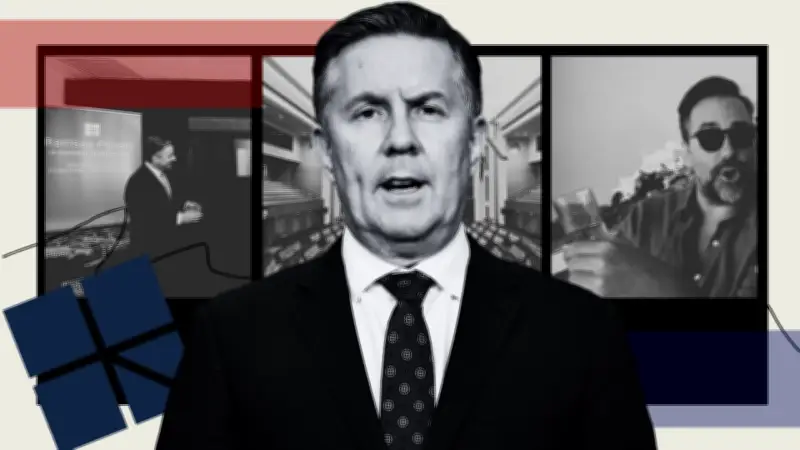
Secret documents have exposed a major loophole in federal transparency laws, revealing Health Minister Mark Butler’s former chief of staff walked straight into a corporate lobbying role where he gained access to his former boss within months.
Nick Martin served as Health Minister Mark Butler’s chief of staff for more than three years before landing a job as Head of Government Relations at Ramsay Health Care, in a move which has been labelled a “case study” in the country’s broken lobbying laws.
A SkyNews.com.au investigation has uncovered the access Mr Martin has gained to the Health Minister while working for a private company, just months after running the ministerial office.

Ministerial staff are strictly prohibited from becoming registered lobbyists, but the case of Mr Martin has exposed a loophole where staffers can work internally for a large corporation without falling under the lobbying code of conduct, and without breaching the law or regulations.
Mr Martin, who does not need to wait 12 months before engaging in lobbying activities as stipulated by the code, has been able to gain repeat access to his former boss while serving as a private government relations expert.
Meetings exposed by secret documents
Freedom of information documents obtained by SkyNews.com.au reveal that Mr Martin held a meeting with Mr Butler and Ramsay CEO Natalie Davis in August 2025, while he was still the Health Minister’s chief of staff, according to his LinkedIn profile.
Just months after leaving the minister’s office, Mr Martin greeted Mr Butler to a Ramsay-hosted function at Joondalup Health Campus on February 18, 2026, where the minister celebrated the government's $158 million investment in the facility.
The records also reveal the pair attended a Microsoft Teams meeting on April 9, 2026 alongside the Ramsay Health Care CEO.
SkyNews.com.au also understands Mr Martin attended the exclusive Labor Business Forum budget night dinner on May 12, where he was seated on a table with Mr Butler. Tickets to the event, sponsored by Visa, cost $5,500 per head and were attended largely by lobbyists, government relations executives and corporate representatives.
The meetings raise questions about the effectiveness of lobbying rules, which allow former political insiders to continue to leverage their relationships and access after moving into private sector influence roles.
The revelations are particularly significant because major reforms of the private hospital sector were underway while Mr Martin worked inside the minister's office. During that period, Mr Butler established a Private Hospital CEO Forum that included executives from major operators including Ramsay Health Care. His office was also heavily involved in reforms the government described as the biggest shake-up of the sector in decades.
Lobbying rules branded ‘a disgrace’
Independent Senator David Pocock told SkyNews.com.au the case exposed serious flaws in parliament’s lobbying framework.
“This is a case study in how broken our lobbying rules are – our rules are a disgrace and there is huge public support to reform them,” he said.
“Had this person been working as a contracted lobbyist for Ramsay Health Care, he would clearly be in breach of the Lobbying Code of Conduct. But because he's employed in-house as Ramsay's government relations manager, the code simply doesn't apply to him but it should.
“As the Health Minister's chief of staff he would have had access to all kinds of cabinet-in-confidence information and wielded significant influence. It raises serious questions that a chief of staff to a cabinet minister can go from working on something like private hospital reform to then working for a major private hospital with no cooling-off period.
“I'm deeply concerned about the revolving door between ministerial offices and industry, and the way it propels vested interests straight back into the rooms where decisions are being made.”
The revelations come after Labor blocked legislation introduced by Mr Pocock that sought to broaden the definition of lobbying and close loopholes in the system.

Political insider-turned government relations expert
While media reporting suggested Mr Martin departed the minister’s office in July 2025, his LinkedIn said he did not officially leave until November 2025, when he started working in government relations.
Mr Martin spent most of his career working for powerful Labor figures, with his foray into politics beginning 25 years ago as Katy Gallagher’s principal advisor in 2001. He spent three years working for Ms Gallagher before rising through the ranks of the Australian Labor Party, being appointed Director of Research in 2005. By 2008, Mr Martin held the influential position of Assistant National Secretary and Deputy Campaign Director.
After an eight-year gap working for the Fred Hollows Foundation he returned to politics to work for Mr Butler, before jumping ship to work in government relations.
Mr Martin's new role has given him opportunities to represent a company that has been a political donor to the Labor Party, to which he previously served as deputy national secretary. Australian Electoral Commission records show Ramsay Health Care has donated $66,000 to Labor since the party came to power in 2022.
Ramsay has also recruited another former staffer to Mr Butler, Billy Moore, who served as the minister's private health adviser and now works as a senior adviser in government relations.
After SkyNews.com.au contacted Mr Butler seeking answers about his interactions with Mr Martin, the minister declined to provide an on-the-record response to detailed questions. Mr Martin did not respond to SkyNews.com.au's requests for comment.
Ramsay Health Care defended its conduct and said the company complied with all applicable rules. “Ramsay Health Care and its employees are fully compliant with all government regulation in this area,” a company spokesperson said.
Harm to democracy
Transparency International Australia CEO Clancy Moore warned that movements like Mr Martin's risked giving vested interests disproportionate influence over public policy.
“The Commonwealth lobbying code only covers people that work for lobbying firms”, he said. “For example, a government relations manager for gambling company, SportsBet, or their industry association, Responsible Wagering Australia, advocating against changes to gambling advertising is not covered by the code. Whereas a specific lobbying firm hired by SportsBet to lobby the government is covered by the regulations.”
“This is a Sydney Harbour Bridge size gap in the laws which means only a fraction of people who lobby Commonwealth Ministers and MPs are covered by the laws. The lobbying code must include in-house lobbyists, and Ministers' diaries should be disclosed, to really increase transparency and accountability of decision making in Canberra.”
Mr Moore said that the gap in the lobbying code of conduct meant that former government officials could “shift the balance of access and influence” in favour of vested interests. “These lobbyists bring their personal contact books, relationships and their inside knowledge of how the system works,” he said. “When they become in-house lobbyists as opposed to guns for hire, they're not even listed on the Register of Lobbyists. This unfettered access risks corrupting the policy-making process and harming our democracy.”
Mr Moore said Australia lagged behind comparable democracies and called for a minimum three-year cooling-off period for ministers and senior public servants.
After years of inaction from both major parties, Mr Pocock has set up a voluntary register to publish information about lobbyists with privileged access-all-areas passes to Parliament House. According to the register, Mr Butler has sponsored two separate passes – one for Headspace National Youth Mental Health Foundation, and another undisclosed pass. Mr Pocock has urged voters to contact their federal MP to ask them to disclose which lobbyist passes they sponsor.