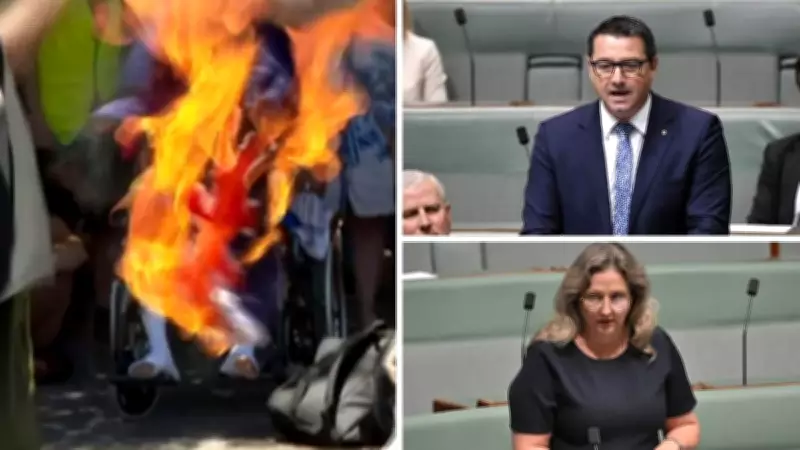
Flag Burning Could Lead to Jail Time Under Proposed New Laws
People who set fire to Australia's national flag could face significant jail time under new legislative proposals aimed at stamping out acts of desecration. The move comes in response to scenes witnessed during Invasion Day protests on January 26, where flags were burned as part of political demonstrations.
Two Separate Bills Target Flag Desecration
Nationals backbencher Pat Conaghan has proposed an amendment to the Flags Act that would specifically prohibit the burning or desecration of both the Australian national flag and the Australian Red Ensign maritime flag. Speaking in the House of Representatives, Conaghan argued his bill responds to calls from "millions of Australians" and would carry "serious consequences" for offenders.
"The Australian flag and the Australian Red Ensign are not abstract ideas," Conaghan stated. "They are not props for political theatre. They are national symbols earned through sacrifice, service and a shared history."

Conaghan's proposed penalties include:
- A fine of up to $16,500 or 12 months imprisonment for a first offence
- A minimum of 12 months imprisonment for subsequent offences
- Potential visa cancellation and deportation for non-citizens on character grounds
Sharkie's Broader Flag Protection Bill
Separately, Centre Alliance MP Rebekha Sharkie introduced a Criminal Code amendment that would extend protection to three flags:
- The Australian national flag
- The Australian Aboriginal flag
- The Torres Strait Islander flag
Sharkie's proposal would make it a criminal offence to "deliberately or recklessly act to desecrate or burn" any of these flags. She emphasised the need to draw "a clear line between peaceful protest and acts designed to provoke division and disrespect" within the communities these flags represent.
"This bill actually seeks to bring us all together to look at all three national flags and say the same rule should apply," Sharkie explained. "And it also draws a line in the sand. It says this behaviour is unacceptable."
International Comparisons and Public Support
Sharkie highlighted that many nations already criminalise flag burning, including:
- France, Germany, Italy, and Spain in Europe
- India, the Philippines, Singapore, and South Korea in Asia
- Argentina, Brazil, Cuba, and Mexico in the Americas
- New Zealand, with penalties up to $5,000
Her proposed penalties include up to two years imprisonment for a first offence and a minimum of one year for subsequent crimes.
Public opinion appears to support such measures, with an August poll of more than 1,000 Australians finding that 77 per cent either strongly agree or agree that burning the national flag should be against the law.
Government Response and Political Support
Education Minister Jason Clare has previously described a man who burned the Australian flag at a Brisbane Invasion Day protest as "an idiot," but stopped short of endorsing new federal legislation. He noted that existing state laws already provide police with powers to respond to certain circumstances, including illegal fires.
Sharkie expressed surprise that the government didn't support an opposition amendment to recently-passed hate laws that would have made flag burning a criminal offence. "The government didn't accept that. The government rejected that amendment," she said.
Fowler MP Dai Le voiced support for the legislation, stating: "This is not about silencing debate, it is about protecting the shared national symbol that represents unity, sanctuary and neutral respect."
Parliamentary Process Ahead
Both bills are expected to be debated during parliamentary sittings in early March, setting the stage for what promises to be a significant discussion about protest rights, national symbols, and legal boundaries in Australian society.